
Copywriting & Script Generation
AI's biggest problem with copywriting isn't that it can't write. It's that everything sounds like "a template that can talk." Copy and scripts that are actually publishable must solve 3 things simultaneously: hooks need to be fast, structure needs to be solid, and voice needs to sound like your brand. Just telling the model to "write some copy" produces AI-flavored output almost every time.
So this page skips the vague theory and goes straight into how content teams can turn AI into a stable copywriting workflow.
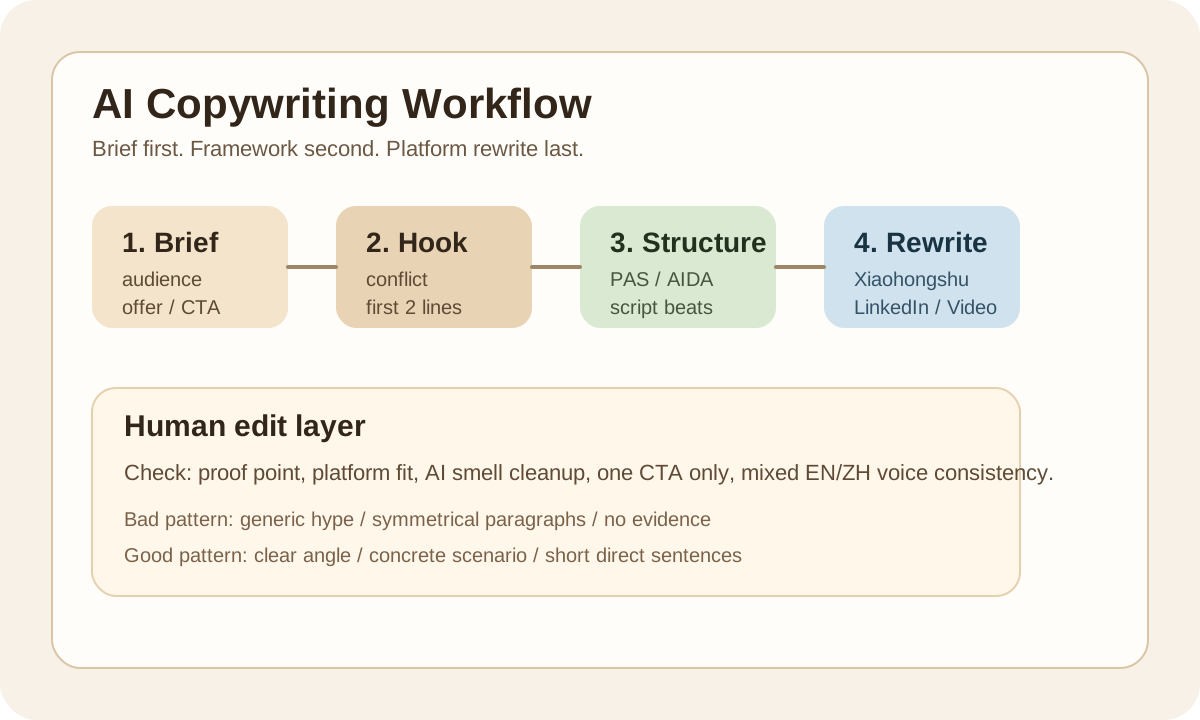
Bottom Line: Don't Let AI Freestyle from the First Sentence
A more stable approach: give it a brief first, specify a framework, then constrain the output format.
A landing-ready writing chain usually looks like:
Brief
  -> Hook options
  -> Structure
  -> Draft
  -> Platform rewrite
  -> Human edit
Skip the first two steps and AI easily outputs:
- Headlines that are loud but carry no information
- Sentences that flow but have no memorable moments
- CTAs that feel too pushy
What Copy Has the Most AI Smell
These traits won't necessarily get "punished" by Google, but users will leave first:
| AI smell | Why it's a problem | Better fix |
|---|---|---|
| Opening with big words | Looks like generic marketing copy | Lead with an opinion or conflict |
| Every paragraph same length | Rhythm too even, feels machine-generated | Mix short, long, and question sentences |
| Framework only, no details | Missing real usage scenarios | Add platform, audience, offer specifics |
| CTAs everywhere | Users feel pushed | Keep only one primary action |
| Same tone across platforms | LinkedIn reads like TikTok | Rewrite separately for each platform |
A Sufficient Copy Brief
For education content like JR Academy, the most practical thing isn't a "universal prompt." It's writing the brief clearly first.
Recommend locking in these 6 fields:
| Field | What to write |
|---|---|
| Audience | Who's reading -- juniors or career-switchers |
| Offer | Are you selling courses, capturing leads, or building brand awareness |
| Platform | Xiaohongshu, LinkedIn, newsletter, landing page |
| Angle | Pain point, result, counterintuitive, or case study entry |
| Proof | Real cases, numbers, timelines, testimonials |
| CTA | Comment, click, book call, or save |
Without these 6 fields, AI can only fill blanks with the safest, emptiest language.
Common Frameworks: Don't Misapply Them
Frameworks aren't "the more the better." Most content teams really only use these 4 regularly.
| Framework | Best for | Core logic |
|---|---|---|
| PAS | Lead gen, selling services/courses | Hit the pain, amplify it, then offer solution |
| AIDA | Landing pages, product pages, email | Push attention all the way to action |
| BAB | Before/after case studies | Great for transformation content |
| Hook-Value-CTA | Short posts, short video scripts | Good for fast-paced platforms |
A common error: using AIDA for a short video opening, then spending the first 10 seconds on setup. Short-form content can't afford that pace.
Platform Rewrite Matters More Than the First Draft
Same idea, different channel, noticeably different writing style.
| Platform | What users expect | Writing advice |
|---|---|---|
| Xiaohongshu | Authenticity, relatability, discovery feel | First person, short sentences, less corporate tone |
| TikTok / Reels | Rhythm, contrast, hook | Enter conflict in the first 1-2 lines |
| Insight, experience, professional judgment | Use opinions and cases, less hype | |
| Landing page | Clarity, benefit, proof | Headline + benefit + proof + CTA |
| Relevance, readability | Subject line passes first, body cuts the fluff |
Don't just tweak the original by 10%. Usually 30-50% needs rewriting to be truly platform-fit.
Scripts Are Not Just Longer Copy
Many people treat short video scripts as long copy split into lines. This directly tanks completion rates.
A more practical script template breaks into:
| Beat | Purpose | Example |
|---|---|---|
| Hook | Grab the first 2-3 seconds | Most people don't struggle with using AI. They struggle with giving AI good tasks. |
| Tension | Establish the problem | So you tweak your prompts daily, but results are still random. |
| Value | Give the solution | Write the brief first, then the prompt. Results get way more stable. |
| Proof | Provide evidence | That's exactly how we run our internal content workflow. |
| CTA | One action only | Want the template? Comment "brief" |
If a 30-second script squeezes in 3 viewpoints, 2 CTAs, and 4 transitions, it'll fall apart.
Copy-Paste Prompt Template
You are a senior content strategist for a bilingual AU-based education brand.

Task:
Write one [platform] draft for [audience].

Offer:
[course / service / lead magnet]

Angle:
[pain point / result / misconception / case study]

Must include:
- one clear hook in the first 2 lines
- one concrete proof point
- one primary CTA only

Voice:
- mixed EN/ZH for overseas Chinese readers
- keep all technical and workplace terms in English
- no generic motivational language
- avoid phrases like "全面提升", "赋能", "总的来说"

Output format:
1. Hook
2. Body
3. CTA
4. 3 alternate headline options
This prompt's value isn't being "advanced." It's being reusable. Next time just swap platform, offer, and angle for stable output.
Real Example: Same Topic, 3 Platform Rewrites
Topic: AI learning shouldn't start with tool reviews
Xiaohongshu version
Focus: "sounds like a real person talking," not a brand broadcasting.
I'm increasingly advising beginners against starting by binging AI tool recommendation lists.

The problem isn't that you don't know which tool is good. It's that you don't have a workflow yet. Without workflow, switching tools just means trying randomly in a different place.

If you're still in the "try this today, try that tomorrow" phase, write down your use case first, then decide whether to switch tools.
LinkedIn version
Focus: judgment and business context.
Most teams do not have an AI tool problem. They have a workflow problem.

When content teams evaluate tools before defining approval flow, brand voice, and QA checkpoints, they usually create more variance instead of more leverage.

Start with process design. Tool selection should come after that.
Short video script version
Focus: rhythm.
Hook:
Stop asking "what's the best AI tool to learn in 2026."

Body:
Most people can't produce content not because the tools aren't powerful enough, but because there's no workflow. If you haven't defined brief, review, and publish steps, switching to 10 different models won't help.

CTA:
Want my AI content workflow template? Comment "workflow."
Human Edit Checklist
After AI generates, do at least this one round of human review:
| Check item | Standard |
|---|---|
| Is hook specific enough | Can see topic and conflict within 2 lines |
| Is there real proof | At least 1 number, case, or experience-based judgment |
| Is there filler | Delete adjectives that don't add information |
| Is voice consistent | Sounds like the same brand talking |
| Is CTA singular | Don't simultaneously ask for comment / click / DM |
Common Crash Points
| Problem | Root cause | Fix |
|---|---|---|
| Copy too slick | AI defaulted to marketing tone | Add direct, low-hype, evidence-led |
| Script too slow | Background before the point | Hook first, context after |
| Platform feel is off | One draft for all channels | Rewrite separately per platform |
| Chinese sounds awkward | Force-translated all English terms | Mixed EN/ZH, keep common English terms |
Practice
Take a piece of content you're about to publish. Don't just ask AI to "write copy." Fill in these 4 lines first:
- Who's the audience
- Which platform
- What's the angle
- What's the single CTA action
Then generate the first draft. You'll notice output is noticeably more stable.