
Prompt Framework for Content Creation
Prompts in content production aren't "inspiration triggers." They're more like brief language. What you give AI isn't a single command -- it's a structured production spec. If the spec is unclear, no matter how strong the model, output will drift.
We recommend treating content prompts as team assets, not throwaway chat inputs. That way they have SEO value, reuse value, and training value.
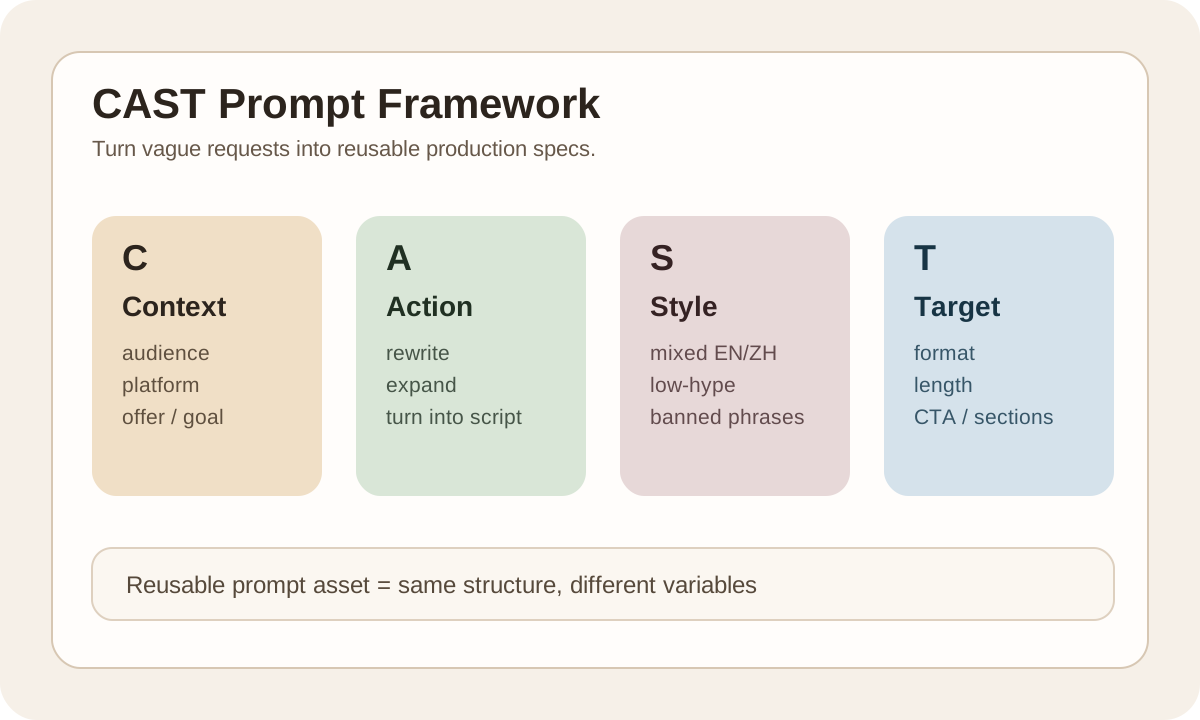
Bottom Line: Good Prompts Aren't Longer -- Their Variables Are Clearer
Many people think longer prompts are more professional. The issue isn't length -- it's whether variables are spelled out.
For content tasks, the most critical variables are usually:
- Context
- Action
- Style
- Target
That's the CAST framework we recommend.
Why CAST Works for Content Teams
Content tasks naturally cross platforms, formats, and styles. Without a shared language, copywriter, designer, editor, and operator constantly explain verbally.
| Dimension | What to specify | Common omission |
|---|---|---|
| Context | Audience, channel, offer, business goal | Only states topic, not target audience |
| Action | Write, rewrite, summarize, expand, script | Verb too vague, just says "generate" |
| Style | Tone, voice, references, dos / don'ts | Only says vague words like "premium feel" |
| Target | Format, length, structure, CTA | No output spec |
CAST's value is turning vague requests into executable requests.
Context Isn't Background Info -- It's the Success/Failure Dividing Line
Most AI output that looks "correct but unusable" traces back to thin Context.
You need to tell the model at minimum:
- Who's reading this
- Where it's being published
- What business goal this content needs to achieve
- What stage the user is at when they see it
For example, the same topic "AI learning roadmap" written for:
- Overseas Chinese career-switchers
- Marketing content operators already on the job
- Leads considering buying a course but still on the fence
These 3 audiences require completely different writing approaches.
Action Needs Strong Verbs
Don't write:
Help me generate some content
Write:
rewrite the draft into a LinkedIn post
turn the outline into a 45-second short video script
expand this case study into a landing-page section
The clearer the verb, the less the model wanders off.
Style Fears Abstract Words Most
"Premium feel," "youthful," "more professional" -- these are too broad for AI.
More useful phrasing:
| Bad phrasing | Better phrasing |
|---|---|
| Make it more premium | direct, premium, low-hype, evidence-led |
| More youthful | short sentences, casual, first-person, platform-native |
| More professional | precise claims, fewer adjectives, more structure |
If you want mixed EN/ZH style, specify it directly rather than fixing afterward:
Use mixed EN/ZH for overseas Chinese readers.
Keep common workplace and technical terms in English.
Do not translate words like workflow, prompt, brand voice, landing page, CTA.
Target Determines Whether Output Is Immediately Usable
Target should ideally be clear enough for "copy and use."
| Task | How detailed Target should be |
|---|---|
| Social post | Hook + body + CTA + 3 title options |
| Short video script | Beat-by-beat script + on-screen text + B-roll ideas |
| Landing page | Headline + subheadline + proof block + CTA |
| Newsletter | Subject line + intro + sections + CTA |
If you only write "output an article," what you get is usually a generic draft.
A Sufficient Master Prompt Template
You are a senior bilingual content strategist for an education brand.

Context:
- audience: [who]
- platform: [where it will be published]
- offer: [course / lead magnet / service]
- business goal: [lead gen / nurture / awareness / conversion]

Action:
- [write / rewrite / expand / turn into script]

Style:
- mixed EN/ZH for overseas Chinese readers
- keep all common technical and workplace terms in English
- direct, specific, low-hype
- sound like a practitioner, not a generic marketer
- avoid banned phrases: 全面提升, 赋能, 总的来说, 值得注意的是

Target:
- output in [format]
- include [hook / proof / CTA / headings]
- length: [word count / section count]
This master prompt's key isn't being "universal." It's that all team members can modify on the same skeleton.
Prompt Chains Beat Single Prompts for Complex Content
Long content, video scripts, campaign assets -- don't try to write everything in one shot.
More stable approach:
Step 1: generate angle options
Step 2: pick one angle and create an outline
Step 3: expand the outline into a first draft
Step 4: rewrite for the target platform
Step 5: run human QA and tone cleanup
Benefit: each step gets reviewed, so you don't end up with a massive output that looks complete but is actually unsalvageable.
Practical Example: Same Topic, Different Formats
Topic: AI content workflow
Task 1: LinkedIn post
Focus on insight, not tutorials.
Action:
Rewrite this idea into a LinkedIn post for marketing leads.

Target:
- 180-250 words
- clear point of view in the first 2 lines
- one business example
- one CTA at the end
Task 2: Xiaohongshu post
Focus on authenticity and relatability.
Action:
Write a Xiaohongshu-style post for overseas Chinese beginners learning AI content creation.

Style:
- first-person
- mixed EN/ZH
- practical, not overexcited

Target:
- title + short body + save-worthy checklist
Task 3: Short video script
Focus on rhythm and visual cues.
Action:
Turn this topic into a 30-second short video script.

Target:
- hook
- talking points
- on-screen text
- CTA
Common Crash Points
| Problem | Root cause | Fix |
|---|---|---|
| Content feels templated | Context too empty | Add audience and goal |
| Tone is unstable | Style description vague | Give tone rules and banned phrases |
| Format isn't directly usable | Target too broad | Specify sections and length |
| Same topic on multiple platforms all sounds the same | No platform rewrite | Set separate targets per platform |
Self-Check
- Did I write audience, not just topic
- Is Action a strong verb
- Does Style have specific rules, not empty words
- Can the output format be directly handed to the next teammate
- Can this prompt go into the template library
Practice
Take your most-used prompt. Rewrite it following CAST. If after rewriting, another colleague can use it directly without you verbally supplementing -- that version is qualified.