
Quality Control & Copyright Compliance
The most dangerous thing about AI content right now isn't that it can't generate. It's that it generates so fast that many teams skip QA and compliance entirely. Result: visual details unchecked, facts unverified, copyright boundaries unexamined, platform labels unhandled. Then it's either rework or takedown.
So this page isn't "legal stuff is important." It's telling you which checks can't be skipped in real production.
Why QA and Compliance Directly Impact Commercialization
For AI content to go from "viewable" to "ready for ad spend, launch, and sales," the critical barrier usually isn't creativity. It's:
- Detail quality
- Factual accuracy
- Copyright risk
- Platform disclosure requirements
If any one of these isn't handled, even the fastest workflow breaks down on the last mile.
Layer 1: Visual QA
The most obvious problems usually come from the image itself:
- Wrong number of fingers
- Weird teeth or eye details
- Incorrect object overlap logic
- Conflicting light/shadow direction
- Text spelling errors
These are common in both AI images and AI video. And the more commercial the content, the more users notice these "AI-feel" details.
Minimum Visual Checklist
- Face and hands
- Text and logos
- Light and perspective
- Background anomaly areas
- Product shape distortion
Layer 2: Text and Fact QA
Many teams only check visuals during QA. Text is just as likely to cause problems:
- Wrong year
- Feature descriptions that over-promise
- Data without sources
- Language that sounds like bad machine translation
A more stable approach is requiring AI output to categorize content as:
Confirmed facts
Assumptions
To verify
This makes it much easier to spot what needs human verification.
Layer 3: Copyright and Commercial Use Boundaries
This is the most consistently underestimated layer. Common risks include:
- Using obviously protected IP styles or characters
- Using a living artist's name directly for commercial style imitation
- Using real person likenesses without authorization
- Output containing unauthorized logos or brand elements
One sentence: AI can generate it. That doesn't mean you can commercialize it.
Layer 4: Platform Rules and Disclosure
Many platforms already have explicit requirements for AI-generated content. At minimum consider:
- Whether you need an
AI-generatedlabel - Whether metadata needs to be preserved
- Whether it involves realistic people, news, or social issues
- Whether the platform might flag it as misleading content
If this layer is ignored, the most direct consequence is distribution problems.
A More Practical QA Gate
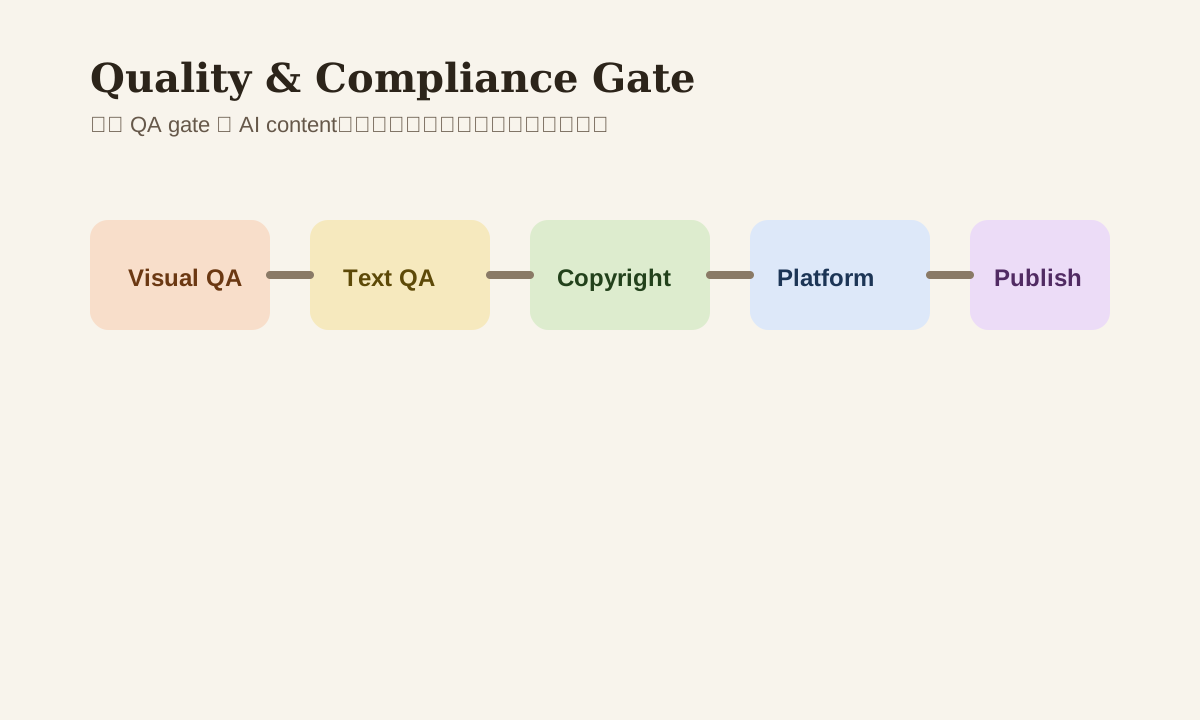
Visual check
  -> Fact check
  -> Copyright / brand check
  -> Platform disclosure check
  -> Final publish approval
Only after passing the first 4 gates should you proceed to publish.
4 Most Common Red Lines
| Red line | Risk |
|---|---|
| Deepfakes / unauthorized likenesses | Legal and platform risk |
| Trademark / brand misuse | Commercial disputes |
| False information / fake news | Platform penalties, trust damage |
| Claiming pure AI output as "fully original copyright" | Legal overstatement |
Common Missteps
| Misstep | Problem | Better approach |
|---|---|---|
| Only check visuals, not facts | Text risks get missed | Add text QA |
| Ship fast, publish direct | Last mile most prone to failure | Set up QA gate |
| "AI can generate it" = "commercially safe" | Copyright boundaries unclear | Do separate commercial use judgment |
| Platform will auto-detect | You may still need disclosure | Proactively check platform rules |
Practice
Take a recent piece of AI-generated content. Run through this sequence:
- Visual QA
- Facts / assumptions / to verify
- Copyright and brand element check
- Platform disclosure judgment
If you skipped any of these 4 steps, that content hasn't yet reached stable publish standards.