





Get code, APIs, and Git working first
If you cannot yet build a small full-stack application, agents will keep turning into environment, authentication, and deployment problems. Build the foundation first.
See the full-stack prerequisite

Company
About UsMetaverse ClassroomNews & BlogJR CareersBecome a MentorOur MentorsContact UsJR Store J3.ClubResources
Events1-on-1 TutoringIndustry WhitepapersOnline LearningInterview CenterShare Interview ExperienceInternshipMembershipAI Learning Paths
All Learning PathsAI EngineerContext EngineeringVibe CodingPrompt MasterAI BuilderAI Product ManagerPython BasicsAI in Practice
AI ProductivityAI Data AnalysisAI FinanceAI Content CreationAI Image CreationFrontend DevelopmentHermes AgentOpenClaw Local AgentUniversity Resources
University of MelbourneUniversity of QueenslandUNSW SydneyUniversity of SydneyMonash UniversityUniversity of AdelaideRMITQUTUTSKids AI Education
Airbotix — AI Coding for KidsAU Family Resource HubNAPLAN Report GuideMy School Data GuideSydney Private School Fees 2026Kids Coding ProgramsImmigration Services
Australia ImmigrationSkilled Visa 189/190/491Employer Sponsored 482/186/494Business Visa 188/888UK ImmigrationUS ImmigrationCanada ImmigrationEnterprise
P3 Career IncubatorEnterprise (EN)Corporate TrainingInternship PartnershipRecruitment PartnershipApply for PartnershipTop Categories
Web Full-Stack BootcampDevOps BootcampData Engineering BootcampData Analysis BootcampCoding for BeginnersBusiness Analyst InternshipAlgorithm BootcampCareer Services
BA & PM InternshipData Science InternshipData Analysis InternshipMarketing InternshipResume ReviewInterview CoachingVIP Mentor GuidanceAddresses
Level 10b, 144 Edward Street, Brisbane CBD(Headquarter)Level 2, 171 La Trobe St, Melbourne VIC 300045A13, Block B, Oriental Hope Tianxiang Plaza, 500 Tianfu Avenue Middle Section, Wuhou District, Chengdu, Sichuan, ChinaBusiness Hub, 155 Waymouth St, Adelaide SA 5000Disclaimer


JR Academy acknowledges Traditional Owners of Country throughout Australia and recognises the continuing connection to lands, waters and communities. We pay our respect to Aboriginal and Torres Strait Islander cultures; and to Elders past and present. Aboriginal and Torres Strait Islander peoples should be aware that this website may contain images or names of people who have since passed away.
All content on the JR Academy website, including course materials, logos, and information provided, is protected under Australian intellectual property laws. Unauthorized use, sale, distribution, reproduction, or modification is strictly prohibited. Violations may result in legal action. By accessing our website, you agree to respect our intellectual property. JR Academy Pty Ltd reserves all rights, including patents, trademarks, and copyrights. Any infringement will be subject to legal prosecution. View Terms of Service
© 2017-2026 JR Academy Pty Ltd. All rights reserved.
ABN 26621887572
If you can use ChatGPT or Claude but cannot see the path to RAG, agents, evaluation, and production, start here. Build the engineering foundation, ship one working project, then use a course or certification to strengthen your evidence.
A 70-skill checklist creates anxiety before it creates clarity. Pick the situation closest to yours and take one useful first step.
If you cannot yet build a small full-stack application, agents will keep turning into environment, authentication, and deployment problems. Build the foundation first.
See the full-stack prerequisiteYou do not need to relearn programming. Use one working AI application to add streaming, retrieval, tool use, evaluation, and observability.
Start with the LLM APIEmployers need to see that you can explain architecture decisions, diagnose failures, and ship. Courses, P3 projects, and certifications should support that evidence.
See the structured programmeEach phase should leave you with something that runs, can be explained, and can be reviewed. Finish one phase before adding the next.
Learn LLM APIs, structured output, streaming, error handling, and prompt fundamentals.
Learn chunking, embeddings, retrieval, reranking, and citations so answers return to verifiable sources.
Add tool calls, agent workflows, evaluation sets, regression tests, and failure fallbacks.
Handle authentication, logs, cost, latency, security, and release so the demo becomes maintainable.
Select a layer to see the problem it solves, the outcome it produces, and where courses and certifications fit. This turns a wall of technology names into a system you can complete one layer at a time.
A core programme, a prerequisite, and a focused workshop should not look like three equal ads. Choose based on whether you need a full transition, engineering foundations, or a Claude Code specialisation.
Connect LLMs, RAG, agents, evaluation, and deployment through continuous projects, with feedback and career support.
Build code, API, database, Git, and deployment foundations so AI projects stop failing on basic engineering problems.
Focus on project context, CLAUDE.md, tool use, and agent collaboration. This is a specialist skill, not a replacement for the full path.
An AI Engineer project is not a screenshot or a repository that only calls an API. It should make the problem and the trade-offs across data, quality, and cost easy to understand.
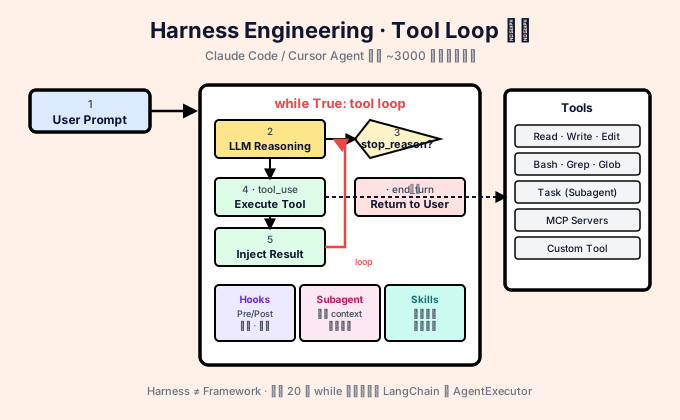
A certification can validate platform knowledge, but it cannot replace a project. Ship at least one working application, then choose the credential closest to your target role.
Covers agentic architecture, tools and MCP, Claude Code, prompting, context management, and reliability—the closest overlap with this engineering path.
View the Claude certification pathA closer platform match when the target team uses Azure AI, Azure OpenAI, AI Search, or enterprise cloud governance.
View AI-102Use this after an engineering project when the target role leans toward machine-learning workloads, deployment, and operations on AWS.
View MLA-C01Tool lists will keep changing. The learning path should not expand every time a new tool appears. Keep course, architecture, practice, and career evidence separate.
Continue through LLM, RAG, agent, evaluation, and deployment lessons.
Understand how retrieval, memory, tools, and context budgets form one system.
Use small tasks to verify that you can run and debug the work yourself.
Turn project decisions, architecture trade-offs, and incidents into explainable cases.
LLM application engineering does not require you to train a foundation model first. Start with APIs, data flow, RAG, evaluation, and deployment. Add maths and ML foundations when the project moves into model training, ranking, or deeper ML work.
Vibe Coding is useful for quickly building interfaces, flows, and prototypes. AI Engineering continues into data, retrieval, agents, quality evaluation, security, and production operation. When a prototype hits reliability or scale problems, you have entered AI Engineering.
A certification can show platform knowledge, but employers will still ask about projects, architecture choices, and failure handling. Put the certification after a working project and it becomes useful supporting evidence.
Finish the LLM API fundamentals and attempt one small project first. Continue independently if you can make progress. The Bootcamp becomes useful when you repeatedly get stuck on sequence, project feedback, or explaining your work to employers.
One working result will tell you more about this path than bookmarking twenty tools and three certifications.
Short explainers on agents, LLMs, evaluation, reliability and safety.