
The Skills Paradigm: From Agents to Skill Libraries
Background: Agents Are Smart but Unreliable
Over the past year "Agent" became the hot buzzword, but most Agents are more like "interns with good IQs but zero experience." They can finish tasks, but they lack stable professional processes and accumulated know-how:
- They don't remember what worked last time
- They can't build up experience over time
- They can't share best practices across a team
That makes it really hard to put Agents into serious production environments.
Anthropic's Answer: Skills
Anthropic introduced a key concept: package capabilities into reusable, composable skills.
The core idea: stop stacking more Agents — build a skill library instead.
And the way Skills are implemented is surprisingly simple: a Skill is just a folder.
The "Folder" Wins
Folders are the most universal organizational unit. Everyone understands them, they're easy to share, and they plug right into existing workflows:
- Version with Git
- Share via cloud storage
- Package as a zip for distribution
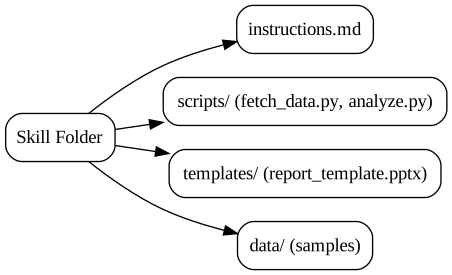
A Skill folder can contain:
- instructions.md: steps and gotchas
- fetch_data.py: pull internal data
- analyze.py: metrics analysis logic
- report_template.pptx: output template
When an Agent needs to complete a task, it reads the folder, runs the scripts, and generates the output — like receiving a "toolkit + operations manual."
Progressive Disclosure: The Key to Scalability
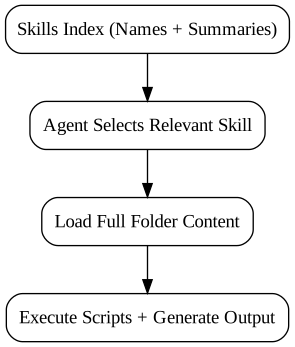
Agents don't load all Skills at once. Instead:
- They first see skill metadata (name + summary)
- They only read full contents when needed
This lets Agents equip a massive number of skills without being limited by the context window.
From "Calling Tools" to "Driving Code"
Traditional Agents depend on APIs/Tools. When a tool has a bug, the Agent just... waits.
The Skills paradigm changes that relationship: code is the universal interface.
- Code is the most precise documentation
- Code can be modified and optimized
- Code can be saved as new skills
This evolves Agents from "tool callers" to "code drivers," and the capability library grows with them.
From Individual Intelligence to Collective Wisdom
Skills aren't just valuable for a single Agent — they matter at the organizational level:
- Base skills: Anthropic's built-in capabilities
- Third-party skills: Deep integrations with products like Notion, Stagehand, etc.
- Internal enterprise skills: Company processes and standards packaged as skills
The result: team best practices get continuously accumulated, and new team members can directly reuse the "veteran's" experience.
The OS & Apps of the AI Era
You can think of a complete agent architecture this way:
- LLM = CPU
- Agent Runtime = Operating System (OS)
- Skills = Applications (Apps)
Real productivity comes from the "app ecosystem," not from reinventing the OS.

Continuous Learning and Self-Evolution
The ultimate goal is for Agents to create Skills on their own:
When a workflow keeps recurring, the Agent can save it as a new skill folder, turning memory into controllable, shareable "procedural memory."
Practical Guide: Turning Experience into Skills
Here's a concrete skill-packaging workflow that teams can use to quickly accumulate best practices.
1) Define a "Reusable Task"
Pick a task your team does repeatedly but keeps getting wrong:
- Generating weekly/operations reports
- Financial statement analysis and reporting
- Customer service scripts and knowledge base responses
- Code deployment and rollback procedures
2) Design the Skill Folder Structure
Recommended structure:
skill-name/
  instructions.md
  scripts/
    fetch_data.py
    analyze.py
  templates/
    report_template.pptx
  data/
    sample.json
3) Write Clear instructions.md
Give the Agent a "stable execution SOP." It should include:
- Goals and inputs/outputs
- Core steps (numbered)
- Common errors and how to handle them
- Acceptance criteria for success
4) Script the Critical Steps
Prioritize scripting the steps that are error-prone or repetitive:
- Data fetching
- Metric calculation
- Result formatting
- Report export
5) Define Metadata (for Discoverability)
Tag each Skill with a short description of its purpose and prerequisites:
- "For quarterly financial analysis, requires API credentials to be configured"
- "For community weekly summary, input is CSV"
6) Add Samples and Tests
Include a minimal runnable sample so the Agent can quickly verify:
data/sample.jsonscripts/test_run.py
Template: Financial Report Analysis Skill
You can use this template directly:
- instructions.md: document the financial analysis steps
- fetch_data.py: fetch the financial report
- analyze.py: calculate key metrics
- report_template.pptx: output template
This way, the Agent follows the same process every time, reducing uncertainty.
Common Pitfalls to Avoid
-
Pitfall 1: Stuffing everything into the Prompt Move stable workflows into Skills instead. The Prompt should only handle "invocation."
-
Pitfall 2: Skills that are too complex If a single Skill gets too big, split it into smaller skills and compose them.
-
Pitfall 3: No verifiable output Define "acceptance criteria" for each Skill's output to prevent results from drifting.
Takeaway
Anthropic's Skills paradigm is about moving expertise from "inside the Prompt" to "inside a skill library."
Shifting from building individual Agents to building a reusable skill ecosystem — that's probably the real path for AI-era applications.
📚 Related resources
❓ Common questions
Open a question to review the practical answer.
How is a Skill different from an Agent and why switch paradigms?
Agents behave like clever-but-green interns — they finish the task but cannot remember what worked last time, so experience never accumulates. A Skill packages a reusable task into a single folder (instructions.md + scripts/ + templates/) that you version in Git and share across the team, so the model runs the same SOP every time. Anthropic's line: stop stacking more agents, build a skill library.
Why is a Skill represented as something as plain as a folder?
Folders are the most universal unit — everyone understands them, you version them with Git, share via cloud drives, distribute as zip, no new tooling required. A typical Skill folder is instructions.md (SOP) + fetch_data.py (data fetch) + analyze.py (logic) + report_template.pptx (output) — the agent essentially receives a toolbox plus a runbook.
How does progressive disclosure work in the Skills paradigm?
Agents do not load every Skill into context at once — they see only the metadata (name + brief) and read the full content on demand. The context window only carries the one or two Skills currently needed, so the library scales effectively without limit; 200 Skills cost no extra tokens up front, the same idea as RAG retrieval over documents.
My Skill keeps growing — when should I split it?
Split when instructions.md runs past two screens, you have more than five scripts, or one SOP visibly contains distinct sub-stages. The chapter's second pitfall calls this out directly: a Skill that grows too complex should decompose into smaller composable Skills. Example — "Quarterly Financials" splits into "Fetch Data / Compute Metrics / Render Deck", each independently verifiable and recombinable.
What is the deepest difference between a Skill and a traditional API tool call?
Classical agents depend on API tools — when the tool has a bug, the agent just waits. Skills flip the relation into "code as universal interface": the code is the most precise documentation, the agent can modify and optimize it, and successful workflows crystallize into new Skills. The model graduates from tool-caller to code-driver, and the capability library grows without being gated by an external tool vendor.