
Synthetic Data & Augmentation
Synthetic Data Augmentation
Synthetic data is easily misunderstood as "don't have enough data, so let the model make up more." That's dangerous. Effective synthetic data isn't about making the dataset bigger -- it's about making coverage reasonable, making evals sharper, and exposing model blind spots earlier.
So this page isn't about batch-generating text. It's about how AI engineers should use synthetic data in a more reliable augmentation workflow.
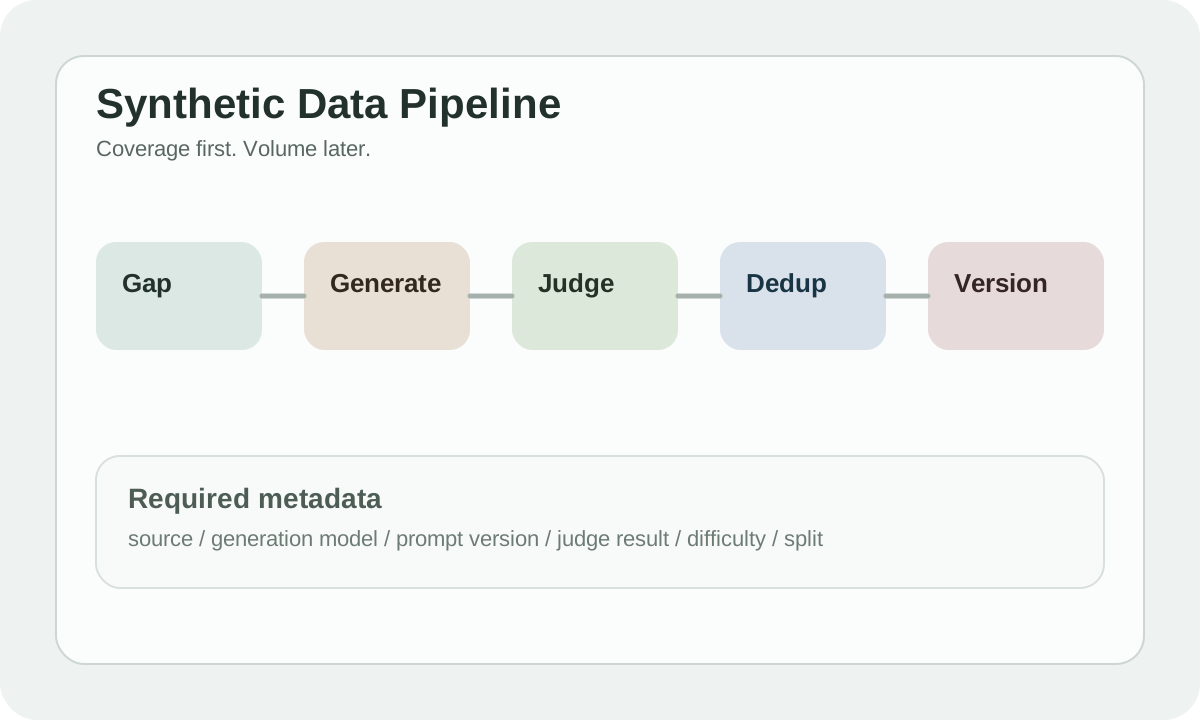
Bottom line: fix coverage first, don't chase scale
When teams are short on data, the instinct is to 10x or 100x the dataset immediately.
A more stable sequence:
- Identify real data gaps
- Decide which case types need filling
- Generate, then verify and deduplicate
- Only then consider scaling production
If coverage isn't thought through, synthetic data just amplifies bias.
Where synthetic data works best
| Scenario | Why it fits |
|---|---|
| eval set expansion | Fill edge cases and rare cases |
| safety / refusal testing | Generate jailbreak and policy-boundary samples |
| structured extraction | Batch-generate structurally similar but diverse inputs |
| locale / style variation | Cover different languages and expression styles |
| low-resource task bootstrap | Quickly build a trainable/evaluable starting point |
Its biggest value usually isn't training data -- it's evaluation and coverage gap-filling.
The most common misuses
| Misuse | Consequence |
|---|---|
| Same model generates and evaluates | Easy to fool yourself, misjudge quality |
| Only paraphrasing | Looks diverse, actually low information |
| No provenance tracking | Can't tell later which batch contaminated results |
| train / test source mixing | Leakage makes evaluation unreliable |
Synthetic data isn't "more is stronger." Once it's out of control, it actually makes judging real capability harder.
A more stable generation pipeline
gap analysis
  -> generation prompt
  -> judge / filter
  -> dedup
  -> difficulty tagging
  -> split and version
The middle steps are the ones that get skipped most often.
But it's precisely the judge, dedup, and tagging steps that determine whether a batch is usable.
Common generation methods
| Method | Good for |
|---|---|
| paraphrase | Adding expression diversity |
| template expansion | Adding entity, industry, locale variables |
| adversarial generation | Adding attack samples, boundary samples |
| source-grounded generation | Generating Q&A / citation cases from real docs |
The most reliable one is usually the last.
Because it's closest to real tasks and easiest to check for correctness.
Verification can't rely on "looks fine"
Each synthetic item should at minimum go through:
| Check | Why it's needed |
|---|---|
| format validation | Ensures structure fits the pipeline |
| faithfulness check | Makes sure it didn't drift from source |
| safety filter | Prevents unwanted content from sneaking in |
| manual spot check | Automated judges miss things too |
| duplicate control | Prevents fake diversity |
Without these, the improvements you see might just be dataset contamination.
Provenance and versioning are critical
Each synthetic sample should record at minimum:
- source
- generation model
- generation prompt version
- judge result
- tags
- difficulty
- split
Without provenance, the moment you get bad samples, weird improvements, or regressions, you'll have almost no way to trace them.
Difficulty layering matters more than averaging
The most valuable thing AI engineers can do with synthetic data is difficulty tagging.
| Difficulty | Examples |
|---|---|
| easy | Standard format, standard expression |
| medium | Paraphrase, light ambiguity |
| hard | Multi-constraint, long context, edge case |
| adversarial | Injection, manipulation, format breaking |
This way you actually know whether the model improved broadly or just looks better on easy cases.
When to stop expanding synthetic data
| Situation | Why |
|---|---|
| Real data pipeline isn't organized yet | You'll just keep spinning on synthetic |
| Judge mechanism is unstable | More data means more noise |
| Bad cases haven't been reviewed | Generating more won't hit the right spots |
| Team has no version governance | Data becomes increasingly unmaintainable |
Synthetic data is an amplifier, not a shortcut that replaces real data governance.
Practice
Take your current eval set. Don't 10x it yet.
Answer these 4 questions first:
- Which case types are missing?
- Which ones are worth filling with synthetic data?
- How will you judge the generated data?
- How will you record provenance?
Get these 4 clear, then start batch generation.
📚 Related resources
❓ Common questions
Open a question to review the practical answer.
Is synthetic data just "not enough data, let the model make more"?
No, and that approach is dangerous. The real value of synthetic data is not 10x-ing the dataset — it is making coverage reasonable, making eval more aggressive, and surfacing model blind spots earlier. Run gap analysis first to find what real data is missing, then generate targeted samples. Bulk expansion before you understand coverage just amplifies bias.
Where does synthetic data actually pay off?
Five high-value use cases: expanding the eval set for edge and rare cases; safety and refusal testing with jailbreak-adjacent samples; structured extraction with format-similar but content-diverse inputs; locale and style variation for different languages; bootstrapping low-resource tasks. The biggest payoff is usually evaluation and coverage patching — not the primary training set.
How do I tell if generated synthetic samples are actually usable?
At minimum five gates: format validation to keep the pipeline alive, faithfulness check against source, safety filter for dangerous content, manual spot check (auto-judges miss things), and duplicate control to avoid fake diversity. Using the same model to generate and judge is the most common anti-pattern — it grades its own homework and inflates quality.
Why must every synthetic sample carry provenance metadata?
Without provenance, when you see weird improvements, regressions, or bad samples later, you cannot trace what poisoned them. Each sample needs at least seven fields: source, generation model, prompt version, judge result, tags, difficulty, and split — so you can rewind to find which batch caused the contamination.
When should I stop expanding synthetic data?
Four red lines: the real data pipeline is still messy (you will loop on synthetic forever), the judge is unstable (more data, more noise), bad cases are not yet reviewed (more generation will not hit the right points), and the team has no version governance (data becomes unmaintainable). Synthetic data is an amplifier, not a shortcut around real data governance.