
Deployment & Cost Optimization
Deployment & Cost Optimization
The most common trap after shipping an LLM feature isn't poor model quality -- it's "it works, but we can't afford to run it." Many AI teams only care about quality during the demo phase. Once it hits production, latency spikes, fallback chaos, and token burn rates blow up. The result is either bad user experience or margins going negative.
So this page isn't about tweaking individual parameters. It's about how AI engineers should design deployment, reliability, and cost together from day one.
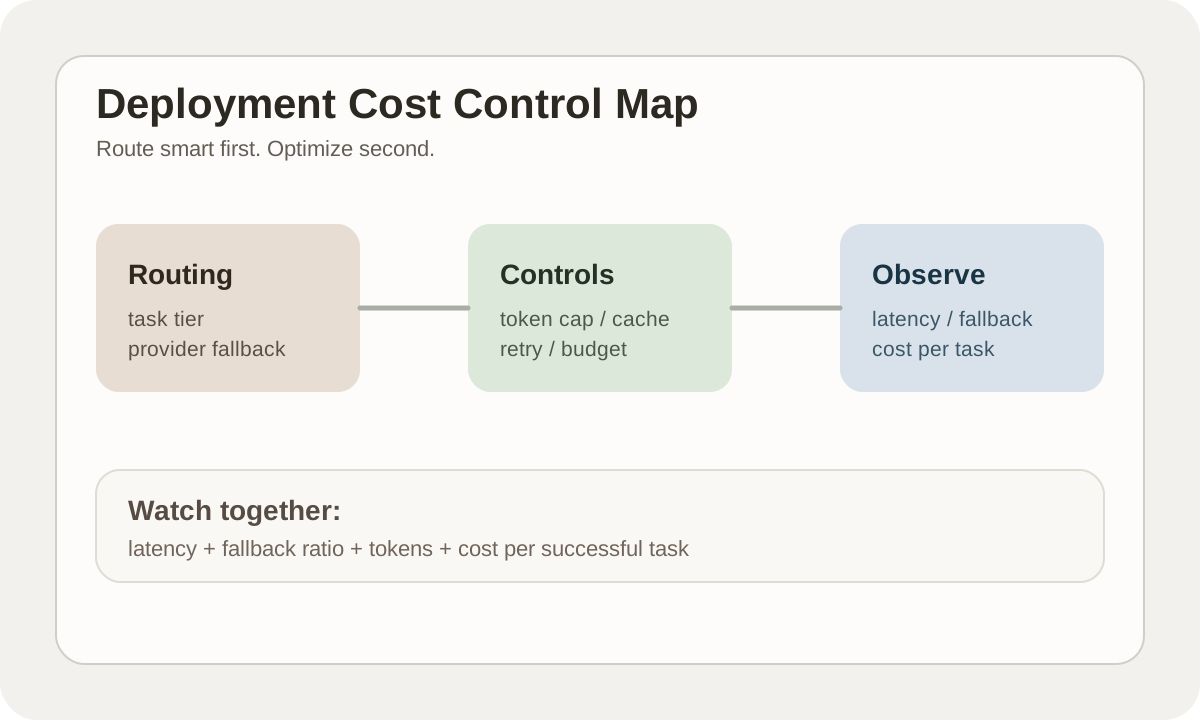
Bottom line: build routing first, optimize second
Just switching to a cheaper model usually isn't enough.
A more effective sequence:
- Define task tiers
- Route different tasks to different models
- Then optimize tokens, cache, retry, and fallback
If every request hits the strongest model from day one, you'll be playing defense the whole time.
The 4 most common deployment problems
| Problem | Real consequence |
|---|---|
| All requests hit the large model | Costs explode fast |
| Fallback isn't designed properly | One provider hiccup takes down the whole site |
| Prompts keep getting longer | Latency and token costs climb together |
| Rollout has no canary | One bad config change hits all users |
The scariest thing in AI deployment isn't a single failure -- it's preventable problems getting amplified systemically.
A more production-like deployment stack
A stable LLM deployment needs at least these layers:
| Layer | What you manage |
|---|---|
| request layer | User requests, tenant, quota, feature flags |
| routing layer | Model selection, fallback, regional routing |
| control layer | Token cap, cache, retry, timeout, budget |
| observability layer | Latency, errors, fallback ratio, cost delta |
Don't separate these layers and debugging later will be miserable.
Model routing is the first step of cost control
Instead of one model for everything, route by task tier.
| Task tier | Examples | Better route |
|---|---|---|
| low-complexity | rewrite, classification, light summary | small / cheap model |
| medium-complexity | structured extraction, RAG answer | balanced model |
| high-complexity | long-context reasoning, complex generation | stronger model |
| failure recovery | primary is down or timed out | fallback provider / smaller safe mode |
The value here isn't "saving a few bucks" -- it's making the system economically viable from day one.
Token cost isn't just an output problem
Many teams only watch output tokens, but input quietly spirals out of control too.
The most common cost sources:
- System prompt keeps growing
- Too much history is included
- Too many retrieval chunks stuffed in
- Same task gets regenerated repeatedly
So cost optimization is often a context management problem, not a model problem.
A more reliable cost control checklist
| Control point | Why it matters |
|---|---|
| input / output token cap | Prevents runaway requests from blowing costs |
| history trimming / summarization | Stops long conversations from ballooning |
| deterministic cache | No need to burn tokens on repeated tasks |
| request budget per tenant | Prevents a single customer from draining you |
| daily alerting | Catch spikes early instead of at month-end |
Without these, cost reviews typically lag by at least a week.
Reliability and cost are tied together
Many people think of reliability as just a stability thing.
But it's directly related to cost.
Examples:
- Overly aggressive retries amplify failure costs
- Heavy fallbacks can double costs during outages
- Timeouts that are too long waste experience and worker resources
So deployment strategy can't just pursue "never fail" -- it also needs to pursue "don't get expensive when it does fail."
Always canary. Never go full blast.
The most stable rollout sequence for LLM features is usually:
internal
  -> canary
  -> 5% traffic
  -> 20% traffic
  -> full rollout
At each stage, watch 4 signals:
- latency
- error / 429 / timeout
- fallback usage
- cost per successful task
Only watching success rate without watching cost delta is a classic AI infra blind spot.
Multi-provider isn't for show -- it's for survivability
A more mature AI system typically has:
- provider aliases
- fallback policies
- capability matrix
- region / compliance routing
This way when a provider wobbles, changes pricing, or has feature incompatibilities, you don't get completely stuck.
The metrics worth watching
| Metric | Why it matters |
|---|---|
| P95 latency | What users actually feel |
| fallback ratio | Is the primary route healthy? |
| avg tokens per request | Catches prompt/context bloat |
| cost per successful task | The real business metric |
| error by provider/model | Quickly pinpoints the source |
If your dashboard is missing the last two, deployment management isn't complete yet.
Practice
Take one of your live AI features and fill in these 4 items:
- Which request types shouldn't be hitting the strongest model?
- What are the current fallback trigger conditions?
- Do you have
cost per successful tasktracked? - During rollout, are you watching fallback and cost delta?
Get these 4 covered and your deployment management will be significantly more mature.
📚 Related resources
❓ Common questions
Open a question to review the practical answer.
What are the four most common LLM deployment pitfalls?
Everything routes to the strongest model (cost burns fast), fallback is not designed (one provider hiccup brings the site down), prompts keep accreting (latency and tokens both climb), and rollout has no canary (one bad config blasts to 100% of users). The real risk in AI deployment is not a single failure — it is preventable issues getting systemically amplified.
Why is model routing — not switching to a cheaper model — the first cost-control step?
Routing by task tier beats wholesale model swaps. Low-complexity (rewrite, classification, light summary) goes to cheap models; medium (structured extraction, RAG answers) goes to balanced; only high-complexity (long-context reasoning) hits the strongest model; failure recovery goes to a fallback. Sending everything to the strongest model from day one leaves you with no levers later.
What usually causes runaway token cost?
It is rarely the output tokens — input creep does the damage: ever-growing system prompts, bloated history, too many retrieval chunks, and repeated regenerations on the same task. So cost optimization is usually a context-governance problem, not a model problem — fixing the prompt beats swapping the model.
Why are reliability and cost tied together?
Three examples: aggressive retries multiply failure cost, heavy fallbacks double cost during incidents, and long timeouts strangle UX and worker capacity. Deployment must aim not only at "do not fail" but also "fail cheaply." Cost per successful task is the real business metric — success rate alone hides the damage.
What is the standard canary cadence for shipping an LLM feature?
internal → canary → 5% traffic → 20% traffic → full rollout, watching four signals at each step: latency, error/429/timeout, fallback usage, and cost per successful task. Watching success rate without cost delta is a classic AI-infra blind spot — a misconfig can keep success rate normal while tripling per-call cost.