
Workflow & Automation
Workflow Automation
Many AI apps look great in a single-request demo. But the moment they become long tasks, batch jobs, or multi-step pipelines, problems surface: tasks get lost, retries go haywire, state is unclear, and there's no way to insert human review. The real value of an AI engineer often isn't tuning a single prompt to 90 -- it's making the entire workflow recoverable, observable, and scalable.
So this page is about production workflow automation, not just "chaining a few APIs together."
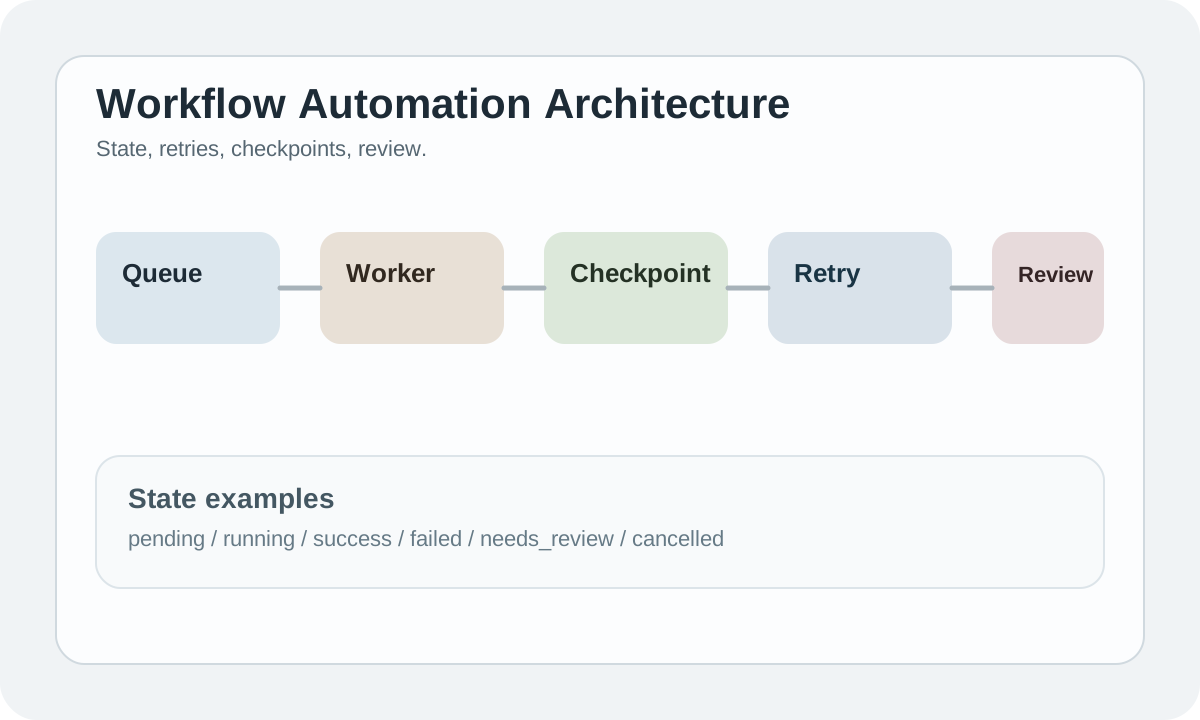
Bottom line: build explicit state first, then automate
The worst thing for AI workflows is implicit state.
Which step a task is on, how many times it's failed, whether it should go to a human -- if all of that can only be guessed from logs, the automation will spiral out of control fast.
A more stable principle:
- Every step has a clear state
- Every step can be retried or recovered
- Every step can be observed
When you actually need a workflow system
| Scenario | Why a single request isn't enough |
|---|---|
| multi-step research | Needs search, parse, summarize, merge |
| batch summarization | One request can't handle a whole document batch |
| embedding / indexing pipeline | Has ingest, split, embed, store -- multiple steps |
| HITL review flow | Model finishes, but humans still need to review |
| tool orchestration | Calls multiple external systems |
If the task spans time, tools, and states, a workflow isn't optional.
A more reliable workflow skeleton
ingest
  -> queue
  -> worker step
  -> checkpoint
  -> next step or retry
  -> human review if needed
  -> completion
The critical parts here aren't the queue itself -- they're checkpoints and retry policy.
Why a state machine beats "scripts chained together"
A more production-like task state should at least include:
| State | Meaning |
|---|---|
| pending | Created, not yet processed |
| running | Currently executing |
| success | Completed |
| failed | Failed this round, needs evaluation |
| needs_review | Waiting for human intervention |
| cancelled | Aborted or rolled back |
With this state layer, SLAs, reruns, monitoring, and auditing all become much easier.
Retry isn't just "failed, try again"
A solid retry policy needs to define at minimum:
| Item | Why it needs to be explicit |
|---|---|
| max attempts | Prevents infinite retries |
| backoff strategy | Avoids instantly hammering dependencies |
| idempotency key | Prevents duplicate side effects |
| escalation threshold | When to go to human or DLQ |
Many workflow incidents aren't caused by the first failure -- they're caused by failing the same way many times after.
LLM steps in workflows should be treated as unstable dependencies
This is key.
An LLM step isn't a deterministic function, so you should assume it will:
- timeout
- schema fail
- output drift
- quality fluctuate
That means every LLM step should ideally have:
- timeout
- schema validation
- fallback / retry
- low-confidence review path
Treating the LLM as a stable black box is why many workflows become unmaintainable later.
Design HITL paths early
Human-in-the-loop isn't a patch for when the system fails -- it's a formal workflow branch.
It typically fits:
| Scenario | Why humans need to step in |
|---|---|
| Low confidence output | Model itself isn't reliable |
| High-risk business content | One mistake is expensive |
| Repeatedly failed tasks | Automation is no longer worth it |
| Key customer tasks | SLA and trust demands are higher |
If the review path is cobbled together after the fact, it's usually terrible to use.
Observability: don't just watch overall success rate
Look at these instead:
| Metric | Purpose |
|---|---|
| queue lag | Is the system backed up? |
| step-level P95 | Which step is slowing everything down? |
| retry count | Which step is most unstable? |
| DLQ size | How many tasks has automation given up on? |
| review rate | What percentage needs human intervention? |
If you only watch overall success, you'll discover local bad trends way too late.
Common failure points
| Problem | Root cause |
|---|---|
| Rerun writes duplicate results | No idempotency |
| Crash mid-way means full redo | No checkpoints |
| Hard to insert human review | No explicit review state |
| Debugging is pure guesswork | No per-task trace |
The most valuable part of AI workflow engineering is turning these "used to rely on luck" aspects into system capabilities.
Practice
Take one of your multi-step tasks and map out these 5 things:
- task states
- retry policy
- checkpoint locations
- review triggers
- failure metrics
Once these 5 are defined, your workflow automation is already a level above script chaining.
📚 Related resources
❓ Common questions
Open a question to review the practical answer.
When is a single request not enough — when do I need a workflow system?
Five clear signals: multi-step research (search + parse + summarize + merge), batch summarization (one request cannot finish a whole batch), embedding/indexing pipelines (ingest + split + embed + store), HITL review flow (humans after the model), and tool orchestration across multiple external systems. Once a task spans time, tools, or states, a workflow stops being optional.
Why is a state machine more reliable than chaining scripts?
Production tasks need at least six explicit states: pending / running / success / failed / needs_review / cancelled. Chained scripts hide every state in memory or logs, killing SLA, replay, monitoring, and audit. Explicit states let you know exactly which step a task is on, how many times it has failed, and whether to escalate to a human.
What does a solid retry policy actually contain?
At minimum four fields: max attempts to bound retries, a backoff strategy so you do not hammer downstreams, an idempotency key so side effects do not double-fire, and an escalation threshold deciding when to hand off to a human or DLQ. Incidents are rarely caused by the first failure — they are caused by the system redoing the same wrong thing many times.
What assumptions should I bake into an LLM step inside a workflow?
Treat it as an unreliable dependency: it will time out, fail schema, drift outputs, and oscillate in quality. Each LLM step needs at minimum a timeout, schema validation, a fallback / retry path, and a low-confidence review path. Treating an LLM as a deterministic function is the root cause of unmaintainable workflows down the line.
Beyond overall success rate, what observability metrics matter for workflows?
Five metrics: queue lag (is the system clogged), step-level P95 (which step is slow), retry count (which step is flaky), DLQ size (how many tasks have given up automatically), and review rate (how often humans step in). Watching only overall success means local degradations get caught very late.