
AI PM Mindset Upgrade: Technical Boundaries & Business Logic
Understand how LLMs work, model selection strategies, cost control, and business value to build a core cognitive framework for AI product managers
Understand how LLMs work, model selection strategies, cost control, and business value to build a core cognitive framework for AI product managers
A reviewable product artefact: an assumption, prototype, evaluation result or launch decision.
State the decision, the supporting evidence and the gate for moving to the next stage.
The most common mistake AI PMs make isn't "not understanding models." It's treating AI as a feature you plug in and it automatically creates value. In reality, most AI products fail not because the demo doesn't work, but because after launch, accuracy, latency, cost, and user expectations all spiral out of control simultaneously.
So this page isn't about memorizing model names. It's about building a business-first decision framework. An AI PM's real job is making trade-offs between capability and business model.
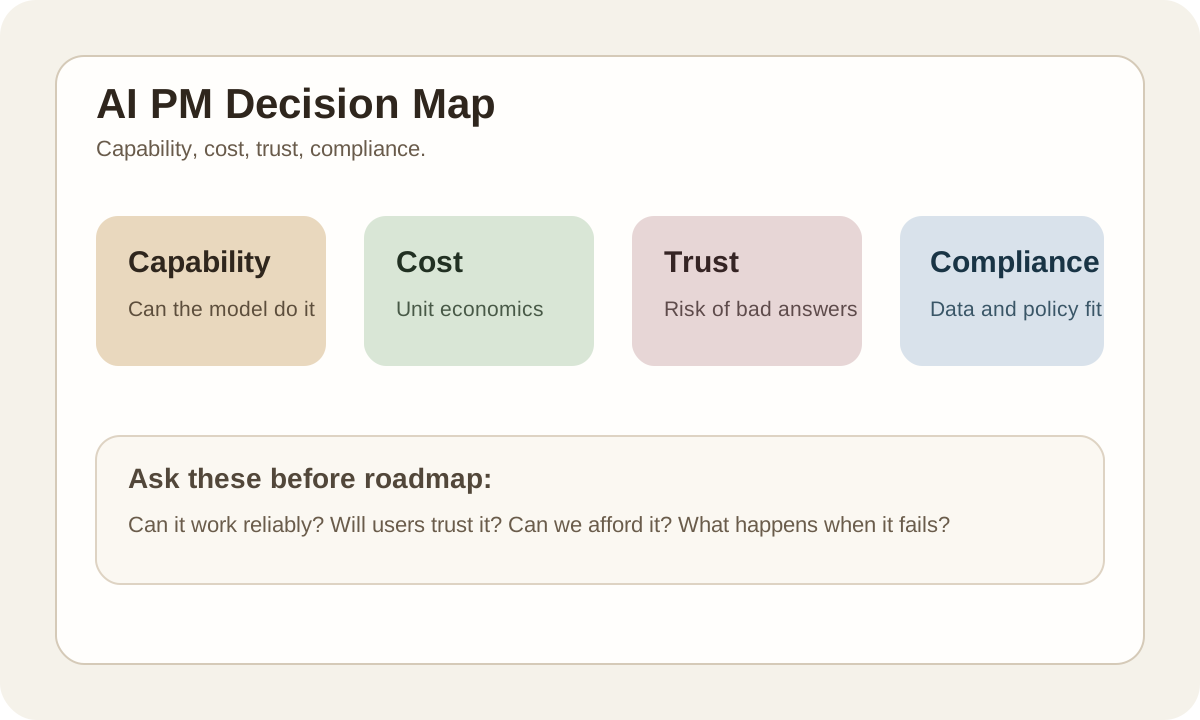
Bottom Line First: AI PMs Should Ask 4 Questions Before Talking Features
Before greenlighting any AI feature, pass these 4 gates:
- Can the model actually complete this task reliably
- Do users actually want to delegate this task to AI
- Can the unit economics work
- If things go wrong, does the product have guardrails
If two of these can't be answered clearly, the feature probably shouldn't be on the roadmap yet.
AI PMs Don't Need to Train Models, but Must Understand Boundaries
You don't need to derive Transformer math or build fine-tuning pipelines. But not understanding these concepts will lead to bad decisions.
| Concept | What PMs need to understand | Why it matters |
|---|---|---|
| Token | It affects cost and context | Directly impacts margin and response speed |
| Context window | How much info the model can process at once | Affects long document/conversation scenarios |
| Temperature | It affects stability vs creativity | Affects UX and evaluation results |
| Hallucination | It's not a bug, it's a probabilistic feature | Affects product boundaries and trust |
| Model tier | Differences between large, small, and open-source models | Determines cost/quality tradeoff |
AI PM fundamentals aren't "showing off tech knowledge." They're about avoiding impossible roadmaps.
3 Most Common AI Product Misjudgments
Misjudgment 1: Demo works, so it's ready for commercial use
Nope. A demo only proves the model can occasionally produce the right output. It doesn't mean it can work reliably under real traffic, real inputs, and real user error tolerance.
Misjudgment 2: Smarter answers = more product value
Also nope. In many business scenarios, users don't want "smart" -- they want "stable, fast, and verifiable."
Misjudgment 3: Start with the strongest model, optimize costs later
This one can drive a startup straight into a dead end. If a feature can only survive on the most expensive model from day one, it's nearly impossible to fix unit economics later.
An AI PM's Core Job Is Actually Constraint Management
Traditional PMs mostly make trade-offs between features and priorities. AI PMs also need to manage 4 additional constraint types:
| Constraint | Typical question |
|---|---|
| capability | Can the model do this reliably |
| cost | How much per API call |
| trust | Do users dare trust the results |
| compliance | Can data, copyright, and review requirements be met |
These 4 constraints shouldn't be patched in later. They should be considered on the day the requirement is designed.
Model Selection: Don't Pick by Popularity
A more practical approach is picking by scenario.
| Scenario | Better model strategy | Key consideration |
|---|---|---|
| customer support draft | Small model first, large model as fallback | Cost and latency |
| internal knowledge Q&A | RAG + stable model | Source grounding |
| long-document analysis | Large context model | Document length and reasoning stability |
| creative ideation | Creative/divergent model | Diversity matters more than precision |
| regulated workflow | Human review + clear guardrails | Trust and compliance first |
Don't ask "which model is best." Ask "which model is most worth it for this use case."
Hallucination Isn't an Exception, It's the Default Risk
AI PMs need to accept a reality: any generative system will hallucinate.
So the real question isn't "how to completely eliminate it," but rather:
- Which scenarios can tolerate it
- Which scenarios absolutely cannot
- When it happens, who catches it, who handles it
A practical classification:
| Risk level | Example | Product strategy |
|---|---|---|
| Low risk | Brainstorming, title suggestions | Can show directly to users |
| Medium risk | Summaries, drafts, category suggestions | Show sources and edit step |
| High risk | Medical, legal, financial advice | Must include human review |
If you skip this classification, product design will be either too slow or too unsafe.
Unit Economics Is the AI PM's Real Fundamental Skill
Many AI features look great early on, then get killed after 3 months. Usually not because users don't like it, but because costs don't pencil out.
At minimum, track these numbers:
| Metric | What you need to know |
|---|---|
| input tokens / request | Is the prompt getting longer over time |
| output tokens / request | Is the model being too verbose |
| avg latency | Are users willing to wait |
| cost per successful task | How much does each completed real task cost |
| gross margin after AI cost | Is this feature worth long-term investment |
If you can only report DAU but not cost per successful task, you're not actually managing the AI feature.
AI PMs Should Design Guardrails, Not Just Happy Paths
A shippable AI workflow needs at least these guardrails:
| Guardrail | Purpose |
|---|---|
| source grounding | Keep answers based on verifiable info |
| fallback answer | When model is uncertain, don't force an answer |
| human review | Human backstop for high-risk steps |
| prompt / model versioning | Ability to roll back when issues arise |
| feedback capture | Let bad answers get flagged and learned from |
Many teams put 90% of effort into prompt wording and only 10% into guardrails. That's backwards.
A More AI PM-Like Project Kickoff Template
Before writing the PRD, fill out this table:
| Question | Your answer |
|---|---|
| What's the user task | e.g., "generate customer service reply drafts" |
| Why use AI | Because rules can't cover everything, manual is too slow |
| What happens when model fails | Wrong answers, goes off-topic, leaks things it shouldn't |
| What's the error handling | Source + review + fallback |
| Do the economics work | Is cost per successful task acceptable |
If answers to these 5 questions are vague, the feature probably isn't mature enough yet.
Practice
Take your most-wanted AI feature. Don't start with a feature list. Just answer these 4 lines:
- What specific task is AI completing for the user
- What happens when this task goes wrong
- How do you measure success for this task
- Roughly how much does one successful task cost
If you can articulate these 4 lines clearly, you've truly entered the AI PM perspective.
Opportunity Constraint Card Before Project Approval
| Field | Decision to make explicit |
|---|---|
| User task | How is it done now, and where is the painful step? |
| Why AI | Why are rules, search, or ordinary automation insufficient? |
| Acceptable error | Which errors are editable, and which must never occur? |
| Success signal | What user behaviour proves value? |
| Cost boundary | Maximum model and review cost per successful task |
| Stop condition | Which failed assumption ends investment? |
Completion Criteria
- “Improve efficiency” has been replaced by a specific user task
- AI is justified by task needs, not popularity
- Worst error and human takeover point are explicit
- At least one user claim remains to be validated rather than presented as fact
Chapter Deliverable
Save an Opportunity Constraint Card, then continue to AI User Research and test its riskiest claim with real evidence.
📚 Related resources
❓ Common questions
Open a question to review the practical answer.
What are the 4 questions an AI PM must answer before greenlighting a feature?
(1) Can the model reliably complete this task (2) do users actually want to delegate it to AI (3) do the unit economics work (4) is there a guardrail when it fails. If two of the four are unclear, the feature probably should not be on the roadmap yet.
If an AI PM does not train models, how much technical depth is actually needed?
Understand 5 concepts deep enough to affect decisions: Token (drives cost and context), context window (input capacity per call), temperature (stability vs creativity), hallucination (a probabilistic trait, not a bug), and model tier (cost-quality tradeoff between large/small/open-source). You do not need to derive Transformer math or build a fine-tuning pipeline.
Why does a working demo not mean the product is ready for commercial launch?
A demo only proves the model can occasionally produce the right output—it does not prove the system holds up under real traffic, dirty inputs, and user error tolerance. Most AI products fail post-launch because accuracy, latency, cost, and user expectations spiral out of control at the same time.
How should hallucination risk be tiered for product decisions?
Three tiers: low risk (brainstorming, headline suggestions) can ship directly to users; medium risk (summaries, drafts, classifications) must show sources plus an edit step; high risk (medical, legal, financial advice) requires human review. Generative systems will always hallucinate—the question is not eliminating it but containing it to scenarios that can absorb the error.
Which unit-economics numbers should every AI feature track?
Five minimums: input tokens per request (is the prompt creeping longer?), output tokens per request (is the model over-talking?), average latency, cost per successful task (what does one real completion cost?), and gross margin after AI cost. If you can report DAU but not cost per successful task, the feature is not actually being managed yet.