
AI User Research: Data-Driven Insights
Leverage AI for synthetic persona creation, large-scale sentiment analysis, and automated competitor monitoring to sharpen demand insights
Leverage AI for synthetic persona creation, large-scale sentiment analysis, and automated competitor monitoring to sharpen demand insights
A reviewable product artefact: an assumption, prototype, evaluation result or launch decision.
State the decision, the supporting evidence and the gate for moving to the next stage.
AI can make user research faster, but it won't automatically make research more truthful. Right now many teams don't lack data -- they dump a pile of reviews, tickets, and forum posts into a model, then treat the output as conclusions. This kind of research is fast, but it easily turns noise into beautifully-summarized noise.
So this page isn't about "letting AI do your research." It's about how to use AI to amplify your research workflow while protecting judgment quality.
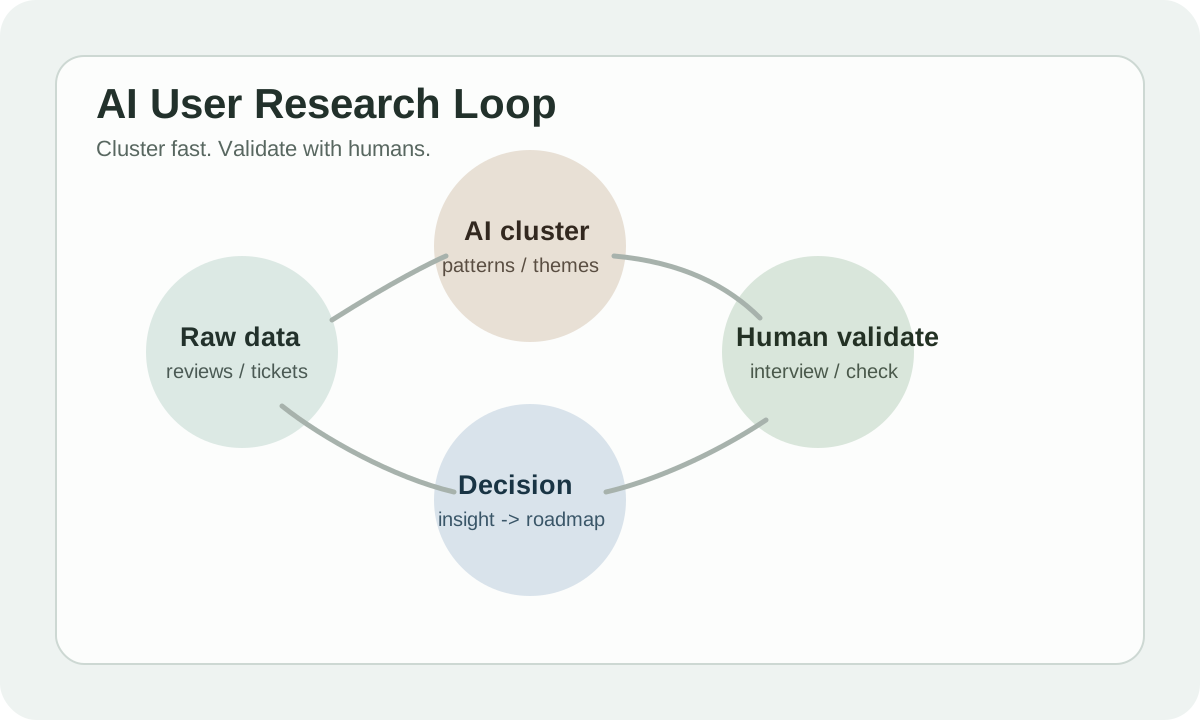
Bottom Line: AI Is Best at Accelerating Analysis, Not Replacing Real User Contact
Where AI adds the most value in research:
- Batch organizing large volumes of feedback
- Finding patterns and clusters
- Generating interview drafts and follow-up questions
- First-pass competitor scan organization
But it shouldn't replace:
- Talking to real users
- Judging which insights to trust
- Final prioritization decisions
How AI User Research Should Actually Be Used
A more practical workflow:
Raw feedback
  -> AI clustering
  -> human interpretation
  -> live interview / validation
  -> insight synthesis
  -> product decision
If you go straight from raw feedback -> AI summary -> roadmap, the missing step in the middle is often why the product goes off-track later.
Best Materials to Feed AI
| Material type | What AI can help with |
|---|---|
| App reviews | Cluster pain points, extract high-frequency complaints |
| Support tickets | Find repeated issues and severity |
| Sales call notes | Extract objections and buying triggers |
| Open-ended surveys | Thematic grouping and user language extraction |
| Interview transcripts | Pull key quotes and behavior patterns |
These materials share a common trait: high volume, fragmented, time-consuming for humans to organize. That's exactly AI's sweet spot.
Synthetic Personas: Usable, But Don't Over-Trust
Synthetic personas' biggest value isn't "replacing users." It's helping you quickly form several hypothesis viewpoints.
You can use them for:
- Pre-interview hypothesis prep
- Use case coverage checks
- Messaging draft testing
But don't use them directly for:
- Key product direction decisions
- Pricing decisions
- Final sign-off on high-value features
Synthetic personas are always derived artifacts, not ground truth.
What a More Reliable Persona Prompt Looks Like
Don't let AI fabricate users from nothing. A better approach: feed it real material summaries first, then ask it to label "what's data-supported vs. what's inferred."
Based on the following real user feedback clusters, create 3 provisional personas.

For each persona:
- separate evidence-backed traits from inferred traits
- list top pains
- list likely trigger to try the product
- list likely reason to churn

Do not invent fake certainty. Mark assumptions as assumptions.
That line Mark assumptions as assumptions is crucial. It noticeably reduces the probability of "AI confidently making things up."
Batch Feedback Analysis: What to Actually Look For
Don't just ask the model for "Top 5 pain points." Ask it to simultaneously answer:
| Dimension | Why it matters |
|---|---|
| Frequency | How often does this issue appear |
| Severity | How much does it hurt when it happens once |
| Segment | Which user type is complaining |
| Trigger moment | Does it happen during onboarding, usage, or pre-payment |
| Current workaround | How users currently struggle through it |
Frequency alone without severity sends roadmaps chasing small issues. Severity alone without segment distorts priorities too.
Interview Guide Generation Is a Great AI Assist Point
AI is well-suited for generating:
- Screener questions
- Interview guides
- Follow-up questions
- Interview summary drafts
Especially when you already know the research objective, it noticeably improves prep efficiency.
But the real value still comes from live follow-up questions. Good researchers, when a user makes a vague complaint, keep asking:
- When did this last happen
- How did you handle it
- Why didn't you use another method
This kind of probing can't be fully replaced by templates yet.
Competitor Research Also Benefits from AI's First Pass
A big time-saver:
Step 1: use AI to scan public positioning, pricing, reviews, and feature language
Step 2: manually verify claims and screenshots
Step 3: summarize strategic differences
The key here is step two. AI can spread out the information landscape, but final judgment can't be built on unverified summaries.
4 Most Error-Prone Research Methods
| Mistake | Why it's dangerous |
|---|---|
| Only let AI summarize, don't read raw material | Easily biased by summary bias |
| Treat synthetic personas as real people | You'll over-invest confidence in nonexistent users |
| Only look at frequency, not severity | Roadmap optimizes the wrong things |
| Competitor analysis without source-checking | Stale info directly pollutes judgment |
The core of AI research isn't skipping thinking. It's putting thinking where it's most worth spending time.
A Sufficient Research Output
After one round of AI-assisted research, produce at least these 4 deliverables:
- High-frequency problem clusters
- High-value user segments
- Key hypotheses that need human validation
- Specific impact on roadmap
If the end result is just a "nicely-summarized" document without clear decision direction, the research round wasn't actually high-value.
Practice
Take a batch of real user feedback you have on hand. Don't just ask AI to "summarize." Instead ask it these 4 things:
- What are the high-frequency complaints
- Which complaints hurt the most
- Which user type is most affected
- Which conclusions still need live interview validation
This will be much more useful than a generic summary.
Worked Example: Does “Sign-up Is Hard” Mean Rebuilding Onboarding?
Suppose 36 support records mention difficult sign-up. AI can cluster them, but it cannot jump straight to “remove registration steps.”
| Initial AI cluster | Evidence count | Question still unanswered |
|---|---|---|
| Verification code never arrives | 14 | Delay, spam filtering, or number format? |
| Users do not understand why they must register | 11 | Is the account gate shown before value? |
| Too many fields | 7 | Which fields trigger abandonment? |
| Other | 4 | Are these even the same problem? |
The next step is not an AI-generated persona. Interview 5–8 recent abandoners and replay the last attempt: what they wanted to do, where they stopped, and what workaround they chose.
Separate the Research Result into Three Layers
Confirmed evidence: 14 of 36 records explicitly mention verification-code failure
Interpretation: code reliability may affect completion more than form length
Decision implication: fix and measure code delivery before rebuilding onboarding
This prevents “users complain about sign-up” from automatically becoming a large project.
Research Decision Brief for the Next Stage
| Field | Required content |
|---|---|
| User and moment | Which user encounters the problem, and when |
| Raw evidence | Interviews, tickets, behavioural data, and links |
| Confirmed | Facts supported by more than one evidence source |
| Unconfirmed | Explanations that remain assumptions |
| Riskiest assumption | The belief that would invalidate the prototype if wrong |
| Next experiment | Smallest test and success signal |
Completion Criteria
- At least one behavioural signal and one direct user statement
- Every conclusion traces back to source material
- Counterexamples and minority views survive AI clustering
- The riskiest assumption is written as a falsifiable statement
- The next step is an experiment, not a feature wish list
Chapter Deliverable
Complete a Research Decision Brief with evidence, unknowns, and the riskiest assumption. Take it to No-Code MVP Building, where the prototype tests only that assumption.
📚 Related resources
❓ Common questions
Open a question to review the practical answer.
What is AI good at and bad at in user research?
Good at: bulk-sorting feedback, finding patterns and clusters, drafting interview guides and follow-ups, running first-pass competitor scans. Bad at: talking to real users, deciding which insight is trustworthy, and making final prioritization calls. Going straight from raw feedback to AI summary to roadmap is usually exactly where the product later veers off course.
Why is 'Top 5 pain points' not enough when clustering feedback?
Look at five dimensions together: frequency (how often), severity (how painful when it happens), segment (which user type is complaining), trigger moment (onboarding, in-product, pre-purchase), and current workaround (how users cope today). Frequency without severity sends the roadmap chasing small issues; severity without segment skews prioritization.
What can synthetic personas be used for, and what should they never replace?
Use them for: pre-interview hypothesis prep, use-case coverage checks, and draft messaging tests. Do not use them for: major product direction calls, pricing decisions, or high-value feature commits. A synthetic persona is a derived artifact, never ground truth—treat it as real and you build overconfidence in users who do not exist.
How do you write a persona prompt that stops AI from inventing certainty?
Feed it summaries from real user-feedback clusters first, then require each persona to separate evidence-backed traits from inferred traits, list top pains/triggers/churn reasons, and add the line 'Mark assumptions as assumptions, do not invent fake certainty.' That single instruction noticeably cuts down on confidently fabricated detail.
What must one round of AI-assisted research produce at minimum?
Four deliverables: a high-frequency problem cluster, the high-value user segment, the key assumptions still needing live-user validation, and the concrete roadmap implications. If the round only ships 'a nicely summarized doc' with no clear decision pointing somewhere, it did not earn its keep.