
AI Product Metrics: Measurement & Optimization
Build a North Star metric framework for AI products and master the unique DAU/retention/LTV calculations and optimization strategies for AI products
Build a North Star metric framework for AI products and master the unique DAU/retention/LTV calculations and optimization strategies for AI products
A reviewable product artefact: an assumption, prototype, evaluation result or launch decision.
State the decision, the supporting evidence and the gate for moving to the next stage.
The most dangerous state for an AI product is when the team is busy every day but nobody can accurately answer "is this feature actually getting better." Usage alone isn't enough. Thumbs-up alone isn't enough. Model benchmarks definitely aren't enough. AI PMs need to manage a complete metrics chain from value to quality to cost.
So this page isn't just about dashboards. It's about building a metrics system that actually drives decisions.
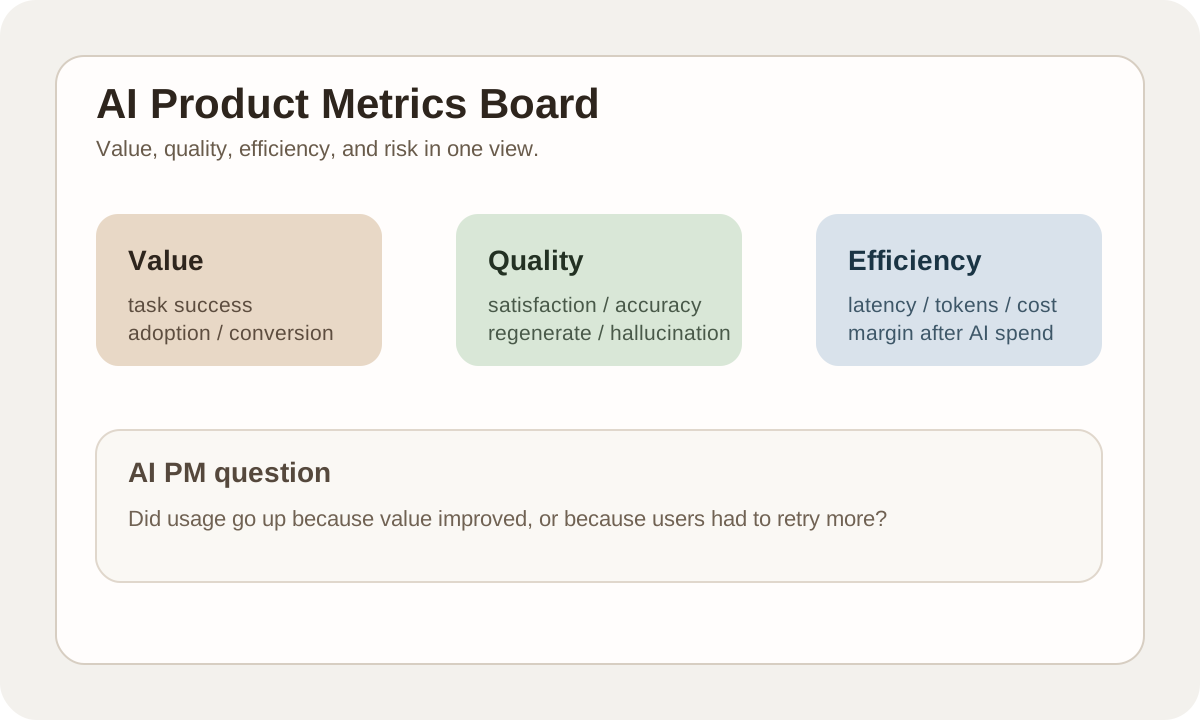
Bottom Line: AI Metrics Can't Just Track Growth -- Track the Price Too
Traditional products make a common mistake: if engagement is up, the product must be better. AI products need follow-up questions:
- Did users actually complete the task
- What was the completion quality
- How much did this result cost
Miss any one of these and your metrics will mislead you.
AI Metrics Look More Like a Three-Layer Structure
| Layer | What to track |
|---|---|
| Business | Revenue, conversion, retention, ROI |
| Product / Quality | Task success, satisfaction, accuracy, regenerate rate |
| Efficiency / Cost | Latency, token usage, cost per task, margin |
If your dashboard only has the first and third layers without quality in the middle, you won't know why users are churning. If you only have quality without cost, you won't know why the business math doesn't work.
North Star Metric: Don't Make It Too Vague
Many AI products use "AI usage count" as their North Star. That metric is usually too shallow.
A more reasonable approach:
North Star = successful task completion x quality factor
Examples:
| Product type | More credible North Star |
|---|---|
| AI writing tool | Weekly adopted output |
| AI support copilot | Resolved tickets assisted by AI |
| AI search | Successful answer sessions |
| AI coding assistant | Accepted AI-generated code changes |
The key is "the user actually used the result," not "AI just said something."
First Define What Success Means
AI PMs very easily skip this step and jump straight to event tracking.
But you must first define:
| Scenario | What counts as success |
|---|---|
| AI summary | User doesn't need to heavily rewrite to keep using it |
| AI drafting | Output is adopted, not just generated |
| AI support | Problem gets solved, not just more chat turns |
| AI search | User gets a trustworthy answer and stops searching |
Without a success definition, all downstream metrics are half-empty.
A Sufficient Core Metrics Set
1. Value metrics
| Metric | What it tells you |
|---|---|
| Task success rate | Did the task get done |
| Adoption rate | Do users keep using it |
| Assisted conversion | Did AI actually drive business results |
2. Quality metrics
| Metric | What it tells you |
|---|---|
| Satisfaction / thumbs up | User's subjective feeling |
| Regenerate rate | Indirect signal of first-answer dissatisfaction |
| Hallucination rate | Is high-risk content making things up |
| Edit distance / acceptance rate | How much generated content actually got changed |
3. Efficiency metrics
| Metric | What it tells you |
|---|---|
| Avg latency | Whether users are willing to wait |
| Tokens per request | Whether prompts are growing out of control |
| Cost per successful task | This is the real business metric |
| Model routing ratio | Whether small/large model split is reasonable |
Most Commonly Misread Metrics
| Metric | Why it misleads |
|---|---|
| Session length | Longer isn't necessarily better -- model might not be solving the problem |
| Total prompts | More doesn't mean value -- users might be retrying |
| Thumbs up rate | People who don't give feedback aren't necessarily satisfied |
| Avg cost per request | Without combining with success rate, insufficient information |
AI PMs need to build a habit: any single metric needs a counter-metric alongside it.
How to Build a More Practical Dashboard
A more credible metrics board has at least 4 sections:
| Section | Core question |
|---|---|
| Acquisition / activation | Are users actually entering the AI scenario |
| Task quality | First-answer, re-answer, adoption quality |
| Cost / performance | Response speed, cost level |
| Risk / trust | Bad answers, safety issues, complaints |
This is way more useful than staring at a single "DAU curve."
Quality Metrics Must Mix Automated and Manual
Many AI products don't have good automated evaluation early on, so human review can't be skipped.
A more stable approach:
online metrics
  + sampled human review
  + labeled bad cases
  + weekly trend review
Automated metrics tell you "where problems might exist." Human review tells you "what the problem actually is."
Cost Metrics Must Connect to Business
Just reporting monthly API bills has little management value. You should be looking at:
| Metric | More useful question |
|---|---|
| Cost per request | How much does each call cost |
| Cost per successful task | How much to get one thing done |
| AI gross margin | Is there room left after AI costs |
| Wasted generation ratio | How much generated content never gets used |
If you see usage growing but cost per successful task growing with it, that's not necessarily good news.
A Simple But Sufficient Weekly Review
Each week, the AI PM should answer at least these 5 questions:
- Which use case had a success rate change
- Which type of bad answers increased
- Why are users regenerating
- Which model route is burning the most money
- Which metric change is worth putting on next week's roadmap
Lock in these 5 questions and team data discussions get much clearer.
Practice
Take an AI feature you're working on. Look at your current dashboard, then fill in 3 questions:
- Is there a clear success definition right now
- Is there a
cost per successful task - Is there a stable human review sampling mechanism
If all 3 are missing, this metrics system is basically still in the "spectator" stage.
Every Metric Needs a Metric Contract
Continue the “preview first, register second” release. A label such as “registration rate” allows product, data, and engineering to calculate three different numbers.
| Field | Example |
|---|---|
| Metric | Preview-to-registration completion |
| Denominator | Eligible unique users who saw a result preview |
| Numerator | Users who verify and create an account within the window |
| Exclusions | Staff, test accounts, bots, and existing accounts |
| Window | 24 hours after the first preview |
| Segments | Channel, device, region, and verification result |
| Sources | Event, account, and experiment-assignment tables |
| Owner | Product defines, data implements, engineering validates instrumentation |
| Decision | Continue, hold, or roll back using baseline and guardrails |
If the definition changes during an experiment, create a new version. Never silently overwrite the old calculation.
When the Metric Improves, Check Four Traps
- Denominator changed: Did failed users disappear from measurement?
- Traffic changed: Is a new channel naturally easier to convert?
- Value moved forward: Did sign-up rise while later retention fell?
- Averages hide harm: Did one region or device regress sharply?
A Decision-Ready Review Statement
Known: registration completion improved; verification success remained stable.
Limit: mobile sample is still small and seven-day retention is immature.
Bad cases: some users thought preview content had already been saved permanently.
Decision: hold at 5%, fix messaging, and wait for mobile and retention evidence.
Completion Criteria
- Primary metric has numerator, denominator, exclusions, and time window
- Quality, cost, and risk guardrails travel with the primary metric
- Dashboard can reach key segments and failure samples
- Data delay, missingness, and definition version are visible
- Weekly review ends in continue, hold, correct, or stop
Chapter Deliverable
Leave a Metric Decision Pack containing metric contract, baseline, guardrails, segments, bad cases, and this week's decision. Continue to AI Ethics & Compliance and check whether metric improvement costs users safety, privacy, or fairness.
📚 Related resources
❓ Common questions
Open a question to review the practical answer.
What are the three layers of an AI product metrics system?
Business (revenue, conversion, retention, ROI), Product/Quality (task success, satisfaction, accuracy, regenerate rate), and Efficiency/Cost (latency, token usage, cost per task, margin). With only layers 1 and 3, you cannot explain why users churn; with quality but no cost, the business math never closes.
Why is 'AI usage count' a weak North Star metric?
Too shallow—it measures 'the AI talked', not 'the user used the result'. Better: successful task completion × quality factor, per product: AI writing tracks weekly adopted output, support copilot tracks AI-assisted resolved tickets, AI search tracks successful answer sessions, coding assistant tracks accepted AI-generated code changes.
Which AI metrics look healthy but are actively misleading?
Four common traps: session length (long can mean unresolved, not engaged), total prompts (high count can be retry frustration), thumbs-up rate (silent users are not necessarily satisfied), and avg cost per request (meaningless without success rate). For every metric, pair it with a counter-metric before drawing conclusions.
How do you define success for an AI feature?
Write it per scenario: AI summary—user does not need to heavily rewrite; AI drafting—the output is adopted, not just generated; AI support—the issue is resolved, not the chat lengthened; AI search—the user gets a trustworthy answer and stops searching. Without a success definition, every downstream metric is half-empty.
How should AI cost metrics be reported so they actually serve the business?
A monthly API bill alone is useless for management. Track four: cost per request, cost per successful task, AI gross margin (margin after AI cost), and wasted generation ratio (share of outputs never used). If usage is climbing while cost per successful task is also climbing, that is not necessarily good news.