
AI Product Iteration: From MVP to Scale
Master AI product iteration cadence, version management, A/B testing, and canary release strategies for a smooth transition from prototype to production
Master AI product iteration cadence, version management, A/B testing, and canary release strategies for a smooth transition from prototype to production
A reviewable product artefact: an assumption, prototype, evaluation result or launch decision.
State the decision, the supporting evidence and the gate for moving to the next stage.
The biggest difference between AI product iteration and traditional SaaS isn't faster pace -- it's more variables. Change the UI and that's one variable. Swap models, change the system prompt, add few-shot examples, adjust temperature, and you've already got four more. Many AI teams find their system harder to control the more they iterate, precisely because they don't manage these variables in layers.
So this page isn't about "how to ship more versions." It's about how to iterate amid uncertainty while still knowing which layer of change actually drove the result.
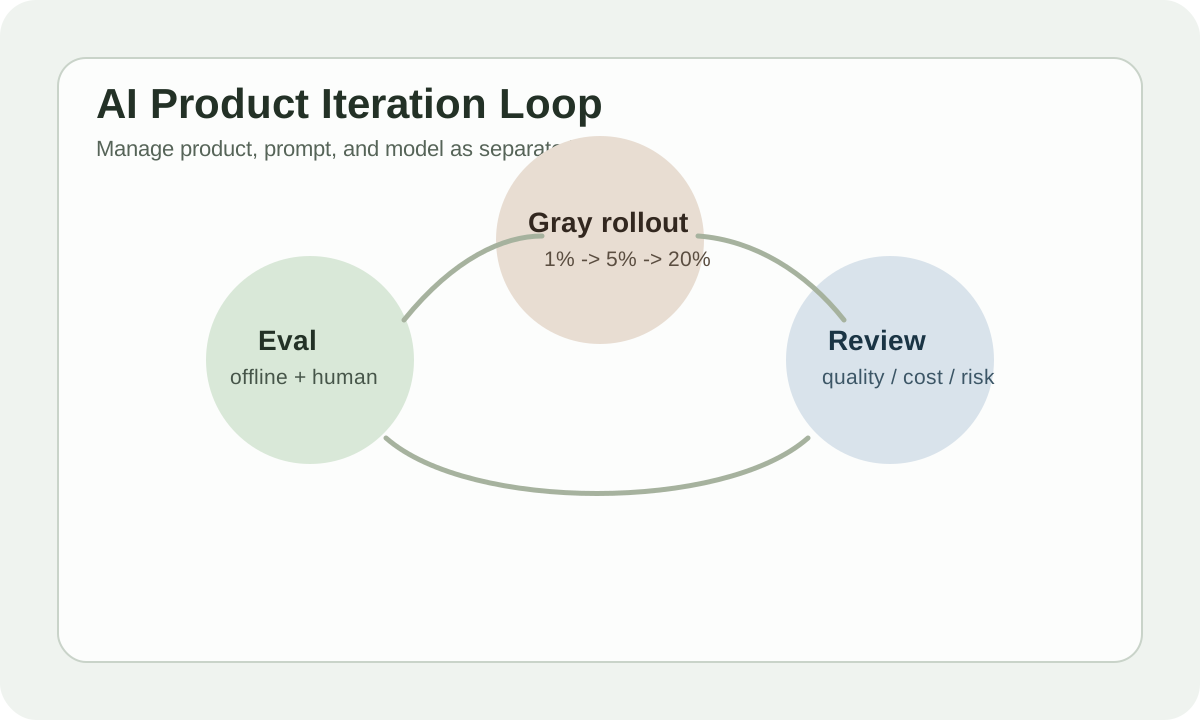
Bottom Line: AI Products Can't Do Feature Version Management Alone
Traditional product version management looks like:
feature release -> bug fix -> next sprint
AI products need to manage at least 3 version layers simultaneously:
- Product version
- Prompt version
- Model version
If all three ship together, problems become nearly impossible to diagnose.
Why AI Iteration Loses Control More Easily
| Traditional products | AI products |
|---|---|
| Logic is mostly predictable | Output is inherently random |
| Regression test coverage is clearer | Many issues only found via eval + human review |
| Rollback is usually code-level | Must also consider model, prompt, data versions |
| User expectations are more stable | Users directly perceive changes in answer style |
This is why AI PMs shouldn't only track sprint burndown. They also need to watch quality drift.
A More Stable Iteration Layer System
| Layer | What it includes | Better release method |
|---|---|---|
| Product layer | UI, flow, permissions, feature flags | Regular sprint releases |
| Prompt layer | System prompt, few-shot, output spec | Small-traffic canary |
| Model layer | Model swap, routing, parameter changes | Must have eval + rollback |
Rule of thumb: the closer to the model layer, the less you should change at once.
Most Common MVP-Stage Mistakes
Mistake 1: Rush features first, add evaluation later
This means you can only say "seems better" by gut feeling every time.
Mistake 2: Treat prompts like marketing copy, skip versioning
Result: everyone on the team secretly tweaks prompts, nobody knows which version is running in production.
Mistake 3: Only check demos before launch, skip edge cases
Real user input is always dirtier, messier, and more unpredictable than demos.
AI Iteration Must Have Eval Before Optimization Talk
Without eval, all "optimization" is just subjective preference.
A sufficient eval combo usually includes:
| Eval type | What it discovers |
|---|---|
| Offline test set | Whether baseline capability improved |
| Human review | Whether answers are actually usable |
| Online metrics | Whether users are buying it |
| Safety check | Whether new risks appeared |
Don't wait for an incident to add eval. By then you're already testing on real users.
How to Set a More Reasonable Iteration Cadence
A more stable AI iteration cadence:
| Iteration type | Cycle | Example |
|---|---|---|
| Hotfix | Same day | Prompt bug, safety issue, obvious derailment |
| Minor tuning | 1-2 weeks | Prompt optimization, small UI tweaks, threshold adjustments |
| Capability release | 2-4 weeks | New workflow, new tool calls, new model routing |
| Architecture shift | 1-3 months | RAG overhaul, agent-ification, infra rebuild |
If you stuff all changes into biweekly sprints, you'll usually lose risk management.
Gradual Rollout Matters Way More Than Full Release
AI features fear "works offline, fails online" the most. So a more practical rollout should be:
internal testing
  -> 1% traffic
  -> 5% traffic
  -> 20% traffic
  -> full rollout
At each stage, watch 3 signal types:
- Is quality dropping
- Is latency spiking
- Are user complaints rising
Watching only usage but not complaints is a very typical AI PM blind spot.
A/B Testing Needs Extra Care in AI Products
The biggest A/B test problem in AI is unstable output, so experiment design needs to be more constrained.
| Issue | More stable approach |
|---|---|
| Same input, different output | Extend sample period, don't trust single-run results |
| Metrics too subjective | Mix automated metrics with human annotation |
| Treatment changes too much | Validate only one core hypothesis at a time |
| Only looking at averages | Also check bad samples and high-risk cases |
A version with high averages but severe tail-end failures isn't necessarily worth shipping.
Rollback Strategy Must Be Written in Advance
A common dangerous mindset on AI teams: "Let's ship it and see. If it doesn't work, we'll figure it out."
More stable approach: define these before launch:
| Question | What needs pre-definition |
|---|---|
| Rollback trigger | Satisfaction drops, complaints rise, specific error rates exceed threshold |
| Rollback target | Product, prompt, or model -- which layer |
| Rollback speed | Who executes, how fast can we switch back |
| Data retention | Which experiment logs and bad cases to keep |
Without a rollback playbook, you're not iterating. You're gambling.
A Sufficient Iteration Review Template
After each version release, review at least these 6 things:
- Which layer did we change
- What metric were we expecting to improve
- Which samples are clearly better
- Which edge cases got worse
- Any cost/latency side effects
- Is this change worth expanding traffic
The more stable this review template is, the less the team falls into "re-explaining everything every time."
Practice
Take an AI feature you're currently working on. Break down the most recent launch:
- Was the change to product, prompt, or model
- Was there a corresponding eval
- Was there a canary stage
- Was there a clear rollback threshold
If two of these 4 questions can't be answered, the iteration process is basically still immature.
Write a Release Contract Before Rollout
Continue the sign-up prototype. If the team plans to expose “preview first, register second” to 5% of traffic, the release note cannot merely say “improve onboarding.”
| Field | Example |
|---|---|
| Hypothesis | Seeing value first will improve registration completion |
| One primary variable | Move registration from before the task to after result preview |
| Held constant | Traffic source, form fields, and verification service |
| Primary metric | Registration completion after task entry |
| Guardrails | Verification success, complaint rate, and support volume |
| Exposure | 5% of new users; exclude existing accounts |
| Observation | Required sample plus one complete business cycle |
| Rollback | Any safety gate or critical-flow regression |
| Owners | Named product, engineering, data, and support owners |
The required sample must be calculated from baseline and expected effect. There is no honest universal number for this course to invent.
Release-Day Stop / Continue Gate
STOP: new safety, privacy, permission, or payment failure
HOLD: quality signal is unclear; collect more evidence or human review
CONTINUE: primary metric improves, guardrails are stable, failures are understood
ROLL BACK: a pre-defined rollback threshold is crossed
Attach version identifiers to every conclusion: product, prompt, model, retrieval data, and feature flag. Without them, the team cannot reconstruct the degraded production combination.
Completion Criteria
- One release tests one primary change
- Baseline, primary metric, and guardrails are locked before exposure
- Prompt, model, data, and product versions are traceable
- Stop / Hold / Continue / Roll Back owners are named
- A rollback rehearsal proves recovery within the promised time
Chapter Deliverable
Complete an AI Release Contract with hypothesis, version matrix, exposure plan, guardrails, and rollback record. Continue to AI Product Metrics and turn each release decision into an explainable metric contract.
📚 Related resources
❓ Common questions
Open a question to review the practical answer.
Why must AI product iteration be tracked across three version layers?
Track product version, prompt version, and model version separately. A UI change is one variable; swapping model, editing system prompt, adding few-shot, and tweaking temperature is four more—if they ship together, you cannot locate the regression. Product layer ships in normal sprints, prompt layer ships behind small-traffic canaries, and model layer requires evals plus a rollback plan.
Does tweaking prompts without evals count as optimization?
No—without evals, every 'optimization' is just subjective preference. Set up four eval layers: offline test set (did core capability move?), human review (is the answer truly usable?), online metrics (do users buy in?), and safety check (any new risks?). If you wait until a production incident to add evals, you are already running tests on real users.
How should you stage the rollout of an AI feature?
Internal testing → 1% → 5% → 20% → full rollout, and at each step watch three signals: quality regression, latency spike, and complaint volume. Watching usage without watching complaints is a classic AI PM mistake—AI features fail most often in the gap between 'looked fine offline' and 'broke under live traffic'.
What is different about A/B testing AI features versus traditional products?
AI outputs are stochastic, so the same input can produce different outputs—run longer sample windows and do not trust single-shot results. Mix automatic metrics with human labels, validate one core hypothesis at a time, and inspect tail-risk and bad-case samples on top of the mean. A version with great averages but ugly long-tail failures is not necessarily worth shipping.
What must your rollback plan define before launch?
Define four things upfront: trigger conditions (satisfaction drop, complaint spike, error rate over threshold), rollback target (which layer—product, prompt, or model), execution speed (who runs it, how fast can it switch), and data retention (which experiment logs and bad cases to preserve). Without a rollback playbook, you are not iterating—you are gambling.