
No-Code MVP: From Idea to Launch
Use v0.dev, Bolt.new, Cursor, Coze, Dify, and other tools to rapidly build working AI product prototypes without coding
Use v0.dev, Bolt.new, Cursor, Coze, Dify, and other tools to rapidly build working AI product prototypes without coding
A reviewable product artefact: an assumption, prototype, evaluation result or launch decision.
State the decision, the supporting evidence and the gate for moving to the next stage.
AI PMs learn No-Code MVP not to replace engineers, but to turn "ideas" into testable things as fast as possible. Many requirements look smooth in documents, but once they become prototypes, problems surface immediately: entry point too heavy, interaction too convoluted, AI output has no value, users have no idea what to do next.
So this page isn't a tool list. It's about how PMs can use No-Code / Low-Code to pull an AI idea to the "worth investing engineering resources" stage within one day.
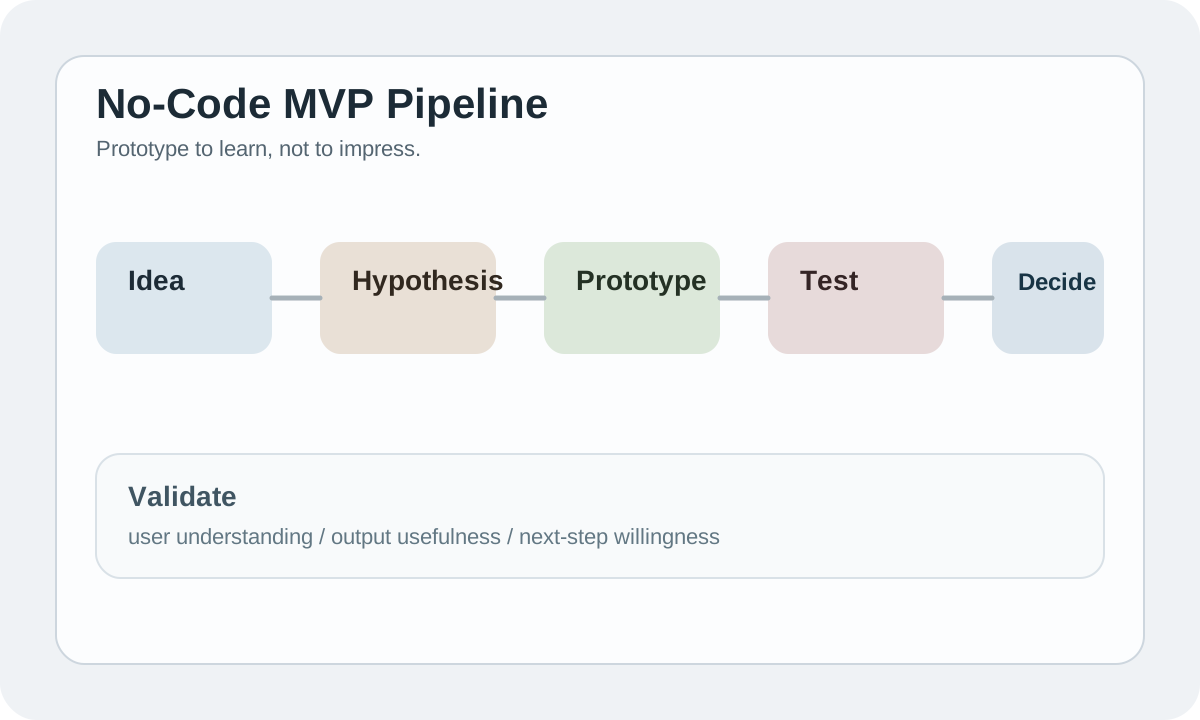
Bottom Line: MVP Isn't About Building the Smallest Thing -- It's About Validating the Most Critical Hypothesis
Many PMs doing MVPs mistakenly think "building fewer features" equals MVP. More accurately:
MVP = Minimum Validatable Product
You need to first clarify what this prototype is actually validating:
- Will users understand this AI interaction
- Will users be willing to provide enough context
- Does AI output actually help
- Can this flow work end-to-end
A demo without a validation goal is just a pretty demo.
When No-Code / Low-Code Fits
| Scenario | Why it fits |
|---|---|
| Landing page / value test | Quickly validates messaging and interest |
| AI copilot interaction draft | Can validate flow and output format first |
| Internal ops tool prototype | Validate task fit first, no rush to engineer |
| Bot / workflow demo | Convenient for first-round stakeholder alignment |
Usually not a great fit:
- Complex permission systems
- High-concurrency production products
- Workflows heavily dependent on custom infra
How to Pick Tools -- Don't Try to Learn Everything at Once
A more practical categorization:
| Goal | Better tool direction |
|---|---|
| Quick pages and UI | UI generation tool |
| Quick complete web app | All-in-one app builder |
| Quick AI bot / workflow | Bot builder / LLM app platform |
| Quick third-party system integration | Automation tool |
The PM's goal isn't becoming an expert in any single tool. It's getting a user-testable artifact as fast as possible.
A More Stable MVP Pipeline
Idea
  -> hypothesis
  -> prototype
  -> internal test
  -> 5-user feedback
  -> decision: kill / iterate / build
Note the last step. Many teams finish the prototype without a clear decision gate, so the demo forever stays at "looks pretty good" with no follow-up judgment.
What Should Be Built First in a Prototype -- Not Everything
More worth prioritizing:
| Priority item | Reason |
|---|---|
| Primary user flow | Validate the main path first |
| Input form / prompt area | See if users will provide enough info |
| Output presentation | See if AI results are actually useful |
| One correction loop | See if users can continue refining |
Many AI prototypes try to integrate too many features from the start, and the main path becomes unclear as a result.
How to Judge "Is It Worth Continuing" for an AI MVP
Don't just rely on stakeholders saying "that's cool." More useful judgment criteria:
| Question | What you're observing |
|---|---|
| Will users try it | Is the entry point frictionless |
| Can users understand it | Is the interaction natural |
| Is output being adopted | Does AI deliver real value |
| Will users take the next step | Does the flow have momentum |
AI MVPs should validate user behavior, not team excitement.
Most Common PM Mistakes When Building No-Code MVPs
| Mistake | Consequence |
|---|---|
| Overpolishing the interface | Lots of time spent, little validation value |
| Connecting real complex data too early | Prototype becomes a half-baked engineering project |
| Not writing hypotheses | After the demo, you don't know what you learned |
| Not doing user testing | Only getting internal subjective feedback |
MVP's goal is rapid learning, not rapid self-congratulation.
Making Prototypes More Discussion-Worthy
On each prototype page, consider labeling:
- What this step is validating
- Which parts are fake data / mocked results
- Which capabilities need real engineering later
This way stakeholders discussing the demo stay focused and don't mistakenly think "this is ready to ship."
A Sufficient MVP Review Template
After the first internal demo, answer at least these 5 questions:
- Is the user task faster to complete than before
- Which step was most confusing
- Which part of AI output was most valuable
- Which parts actually don't need AI
- Next step: kill, keep testing, or hand to engineering
Without this kind of review, prototypes easily become a one-time show-and-tell.
Practice
Take your most-wanted AI product idea. Don't start by drawing 10 pages. Just build these 4 things first:
- One entry point
- One main flow
- One AI output
- One user correction action
Once these 4 work end-to-end, decide whether to keep expanding.
Write an Experiment Contract Before Building
Continue the sign-up problem from the research chapter. Do not rebuild every screen. Test one assumption:
We believe: showing one useful result before registration will increase willingness to sign up.
Participants: first-time users from the target segment.
Prototype: same core task; A requires registration first, B previews a result first.
Observe: whether users understand the value, continue, and where they exit.
Pass: at least 6 of 8 participants complete without help and explain why registration is needed.
Fail: users still refuse after the preview, or cannot explain the core value.
Those numbers are the decision rule for this experiment, not an industry benchmark. Write them before seeing results to prevent convenient reinterpretation.
What a Useful Prototype Test Records
| Record | Do not stop at | Capture instead |
|---|---|---|
| Task result | “User liked it” | Independent completion, time, and exit point |
| AI result | “Quite accurate” | Which part was adopted, deleted, or rewritten |
| Confusion | “UX needs work” | Exact pause point and user statement |
| Risk | “Do later” | Which mock or human-operated step cannot ship |
Do not teach participants where to click. Once you explain, the test measures whether they understand you, not the product.
Every Prototype Ends at a Decision Gate
| Decision | Choose it when | Next step |
|---|---|---|
| Kill | The problem is weak or behaviour will not change | Preserve evidence and stop investment |
| Iterate | The problem is real but interaction or result is weak | Change one critical variable and retest |
| Build | Task value, intent, and major risks have evidence | Define engineering scope and evaluation |
Completion Criteria
- The prototype maps to one falsifiable assumption
- Participants come from the target context, not only colleagues
- Notes contain behaviour, not only opinions
- Mocks, human-operated steps, and real capabilities are labelled
- A Kill / Iterate / Build decision is recorded with evidence
Chapter Deliverable
Leave with an MVP Evidence Pack: Experiment Contract, prototype link, test observations, failure samples, and Decision Gate result. After Build or Iterate, continue to AI Product Iteration Management and turn prototype evidence into a controlled release plan.
📚 Related resources
❓ Common questions
Open a question to review the practical answer.
Is an MVP about doing the minimum or validating the most critical assumption?
The latter—MVP stands for minimum viable validation, not minimum feature set. Every prototype must commit to one of these: (1) will users understand the AI interaction (2) are they willing to type in enough context (3) is the AI output actually useful (4) does the end-to-end flow hold together. A demo with no validation target is just a pretty demo.
When is No-Code the right choice and when should you avoid it?
Use it for: landing-page/value tests, AI copilot interaction drafts, internal ops tool prototypes, bot or workflow demos—anything where the goal is to validate messaging, flow, or task fit. Avoid it for: complex permission systems, high-concurrency production apps, and workflows that depend on custom infrastructure—those turn a No-Code prototype into a half-built engineering project.
Which parts of an AI prototype should you build first?
Four priorities: the primary user flow (does the main path hold?), the input form or prompt area (will users type in enough context?), the output presentation (is the AI output actually useful?), and one correction loop (can the user iterate on the result?). Do not pile on features upfront—the main path gets blurred.
How do I decide whether an AI MVP is worth continuing?
Do not lean on 'this is cool' from stakeholders. Watch four behavioral signals: are users willing to try (entry-point friction), do they understand it (interaction clarity), do they adopt the output (is the AI actually useful), and do they take the next step (does the flow have momentum). An AI MVP validates user behavior, not team excitement.
Which questions must be answered after the first internal MVP demo?
Five mandatory questions: (1) does the user finish the task faster than before (2) which step confuses people most (3) which part of the AI output is most valuable (4) where is AI actually unnecessary (5) is the next move kill, iterate, or hand to engineering. Skip this review and the prototype becomes a one-off show-and-tell.