
AI Team Collaboration: Effective PM-Engineer Partnership
Establish a collaboration framework between AI PMs and AI Engineers, covering tech reviews, requirements alignment, and iteration communication best practices
Establish a collaboration framework between AI PMs and AI Engineers, covering tech reviews, requirements alignment, and iteration communication best practices
A reviewable product artefact: an assumption, prototype, evaluation result or launch decision.
State the decision, the supporting evidence and the gate for moving to the next stage.
The most common failure mode for AI projects isn't that the model isn't strong enough. It's that PM and Engineer start speaking two different languages from week one. PMs talk user value, deadlines, experience. Engineers talk latency, hallucination, tokens, fallback. Neither side is wrong, but without a shared decision interface, the project stays stuck on "everyone thinks they explained clearly."
So this page isn't about who should do what. It's about turning AI project collaboration from abstract discussions into executable division of labor and review mechanisms.
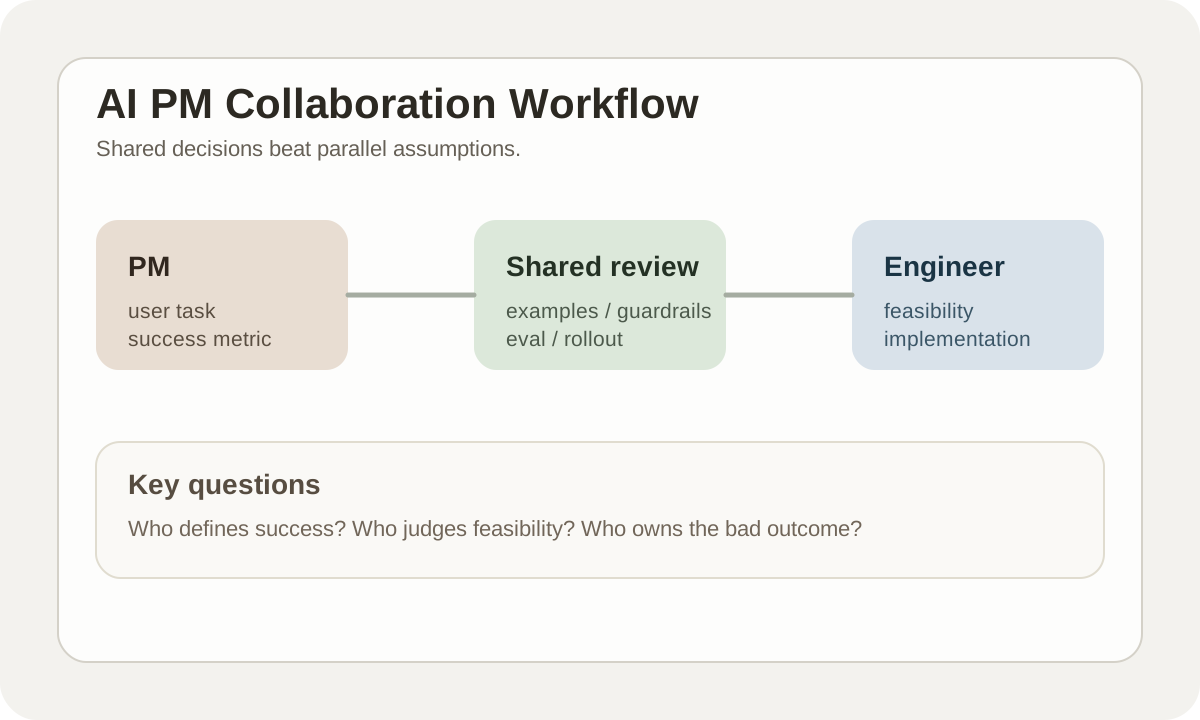
Bottom Line: The Scariest Thing Isn't Disagreement -- It's Unclear Boundaries
A healthy AI team doesn't need PMs who understand every technical detail or Engineers who set business priorities. What really matters is three things:
- Who defines success
- Who judges feasibility
- Who's responsible for bad outcomes
If these three aren't clear, every review meeting will rehash the same arguments.
How Should PM and Engineer Actually Split Work
A more practical framing isn't "who understands AI better," but who owns which type of decision.
| Decision type | PM leads | Joint decision | Engineer leads |
|---|---|---|---|
| User problem definition | User tasks, business goals | Boundary conditions | Doesn't lead |
| Capability assessment | Doesn't lead | How well it can be done, to what degree | Model & architecture feasibility |
| Delivery standards | Success metrics, launch criteria | Eval / guardrails | Implementation & testing |
| Cost trade-offs | ROI, priorities | Model routing, quality thresholds | Technical optimization details |
| Risk control | Compliance & business risk | Fallback, review flow | Safety mechanisms & isolation |
PMs shouldn't promise capability boundaries on Engineers' behalf. Engineers shouldn't decide whether something is worth doing on PMs' behalf.
4 Most Common Collaboration Missteps in AI Projects
| Misstep | Actual consequence |
|---|---|
| PM only writes "build an AI assistant" | Engineer can't determine scope or quality bar |
| Engineer only says "technically possible" | Team assumes it's commercially viable |
| Neither side writes edge cases | Users discover problems for you post-launch |
| Discussion centers on models, not tasks | Roadmap drifts toward tech showboating |
If your weekly meetings keep discussing "should we switch models" but rarely discuss "is the user task actually being completed," collaboration direction is already skewing.
An AI Requirement Needs at Least This Level of Detail
AI feature requirement docs need examples and boundaries more than regular features.
Recommend writing at least these 6 sections:
| Section | What you should write |
|---|---|
| User task | What the user needs to accomplish, not just a feature name |
| Input / output | What goes in, what comes out |
| Success definition | How to tell if it actually helped |
| Unacceptable failure | What errors are absolutely not OK |
| Latency / cost expectation | How long users can wait, how much the business can spend |
| Review path | How to roll back and backstop when issues arise |
Without these, Engineers are left filling in your requirements based on guesswork.
Example: Turning a Vague Requirement Into a Collaboratable One
Bad version
Build an AI meeting summary feature
Better version
User task:
After a 30-minute meeting, user wants a forwardable summary within 1 minute.

Input:
- transcript
- meeting title
- participants

Output:
- summary
- action items
- owner
- deadline if mentioned

Success:
- User can forward to team without major edits
- Action item extraction accuracy meets threshold

Unacceptable failure:
- Fabricating owners
- Writing discussion items as confirmed decisions
- Missing key next steps
This kind of requirement writing actually gets Engineers into the right problem space.
Technical Review Isn't a One-Way Engineer Report
AI technical review is more like a joint decision meeting.
Each review should answer at least these 5 questions:
- How reliably can the model handle this use case (score it)
- What are the main failure modes
- How will we evaluate it
- What guardrails ship with this version
- Which layer do we roll back if issues arise
If a technical review only produces "looks doable," it wasn't really a review.
Shared Language Should Be Productized as Much as Possible
PMs don't need to chase every term, but some keywords must have shared definitions.
| Term | More practical collaboration definition |
|---|---|
| Hallucination | Model says something that sounds true but isn't reliable |
| Eval set | A set of test cases used to verify differences between versions |
| Latency | How long the user waits from submission to seeing results |
| Fallback | What the system does when the model is unreliable |
| Grounding | Whether the answer is based on a real source |
Collaboration efficiency largely depends on whether both sides mean the same thing by these words.
Where Conflicts Usually Happen
The most common conflicts in AI projects aren't interpersonal -- they're trade-off conflicts.
| Conflict point | PM cares about | Engineer cares about |
|---|---|---|
| Launch timing | Can we validate value ASAP | Will we launch with obvious risks |
| Model selection | Is user experience strong enough | Are cost and stability manageable |
| Quality bar | Can users accept this | Is this bar technically realistic |
| Scope | Can we cover a few more scenarios | Wider boundaries make things unstable |
The most effective way to handle these conflicts isn't arguing about who knows more. It's reframing the question:
If we only ship the smallest controllable scenario first, can we launch and validate?
A Sufficient Collaboration Cadence
A more stable AI project cadence usually looks like:
problem framing
  -> example collection
  -> technical review
  -> small eval
  -> limited rollout
  -> weekly quality review
In this pipeline, the PM's most important contribution isn't pushing for speed. It's bringing examples, bad examples, and business judgment into the process.
What to Look at in Weekly Reviews
Each week, review at least these together:
- 3 cases that clearly improved
- 3 cases that clearly failed
- The failure mode users complain about most
- This week's most expensive call chain
- Whether to expand or contract scope next week
This is way more useful than just looking at ticket completion rates.
Practice
Take an AI feature you're currently pushing forward. Align with your Engineer on 4 things:
- What does a success example look like
- What's the most unacceptable error
- Which scenarios does this version launch with
- Which layer do you roll back first if issues arise
Once these 4 questions are aligned, collaboration friction drops noticeably.
Launch Ownership Does Not Fit in a Jira Assignee Field
| Decision | Product | Engineering | Data / Eval | Risk / Ops |
|---|---|---|---|---|
| Define successful task | A | C | C | C |
| Lock versions and instrumentation | C | A | R | I |
| Expand or hold exposure | A | R | R | C |
| Trigger rollback | A | R | C | R |
| Incident communication and review | C | R | C | A |
A is accountable, R performs the work, C contributes to the decision, and I must be informed. Teams may change the roles, but each row needs one accountable owner.
Handoff Check
- PM supplies success, failure, and uncertain examples, not only feature prose
- Engineering supplies observability, permission, and rollback, not only a happy path
- Data confirms metric definition and experiment assignment are reproducible
- Risk or operations knows when to take over, notify, and stop
Chapter Deliverable
Save a Launch Ownership Map with owners, decision deadlines, and escalation paths. Take it to AI Product Iteration Management.
📚 Related resources
❓ Common questions
Open a question to review the practical answer.
How should PM and Engineer responsibilities be split on AI projects?
Three boundaries cover most disputes: (1) who defines success (PM owns user problem and business goal) (2) who judges feasibility (Engineer owns model and architecture viability) (3) who owns bad outcomes (joint—evals, guardrails, fallbacks). PMs should not commit to capability limits on the Engineer's behalf, and Engineers should not decide whether the work is business-worth-it for the PM.
How detailed must an AI feature spec actually be?
Six required blocks: user task (the user goal, not the feature name), input/output (concrete examples), success definition (what 'truly helped the user' looks like), unacceptable failure (errors that cannot ship), latency/cost expectations (user wait tolerance, cost ceiling), and review path (rollback when it breaks). Skip any block and Engineers fill the gap with guesswork.
What is wrong with a brief like 'build an AI meeting-summary feature'?
It lacks every executable detail. The better version splits into user task (1-min shareable summary after a 30-min meeting), input (transcript, title, participants), output (summary, action items, owner, deadline), and success (user can forward with minimal edits). Then add unacceptable failures: never invent an owner, never turn discussion into a decision, never drop a critical next step.
What 5 questions must every AI technical review answer?
(1) How reliably can the model handle this use case? (2) What is the primary failure mode? (3) How will we evaluate it? (4) What guardrails ship in this version? (5) Which layer do we roll back when it breaks? An AI technical review is a joint decision meeting, not a one-way status update—if all you walked away with is 'looks doable', it was not a review.
What are the typical PM/Engineer conflict points on AI projects?
Four tradeoff fights: launch timing (PM wants fast validation vs Engineer fears shipping risk), model choice (UX vs cost and stability), quality bar (user-acceptance vs technical realism), and scope (more scenarios vs harder-to-stabilize boundaries). The escape hatch is not arguing who is right—it is reframing as 'can we ship the minimum controllable scenario first to validate?'