
AI Ethics & Compliance: Safety & Governance
Build an AI product compliance checklist, design safety guardrails, and implement privacy protection and IP governance best practices
Build an AI product compliance checklist, design safety guardrails, and implement privacy protection and IP governance best practices
A reviewable product artefact: an assumption, prototype, evaluation result or launch decision.
State the decision, the supporting evidence and the gate for moving to the next stage.
The biggest compliance risk for AI products isn't "forgetting to write a disclaimer." It's the team defaulting to "we'll add safety later." In practice, many AI features that ship first and add safety afterward pay a very high price, because risk doesn't just appear in the output -- it spreads across the entire chain from data collection, prompt design, and tool access to user expectations.
So this page isn't about memorizing legal articles. It's about a more practical AI safety and compliance thinking from a PM perspective.
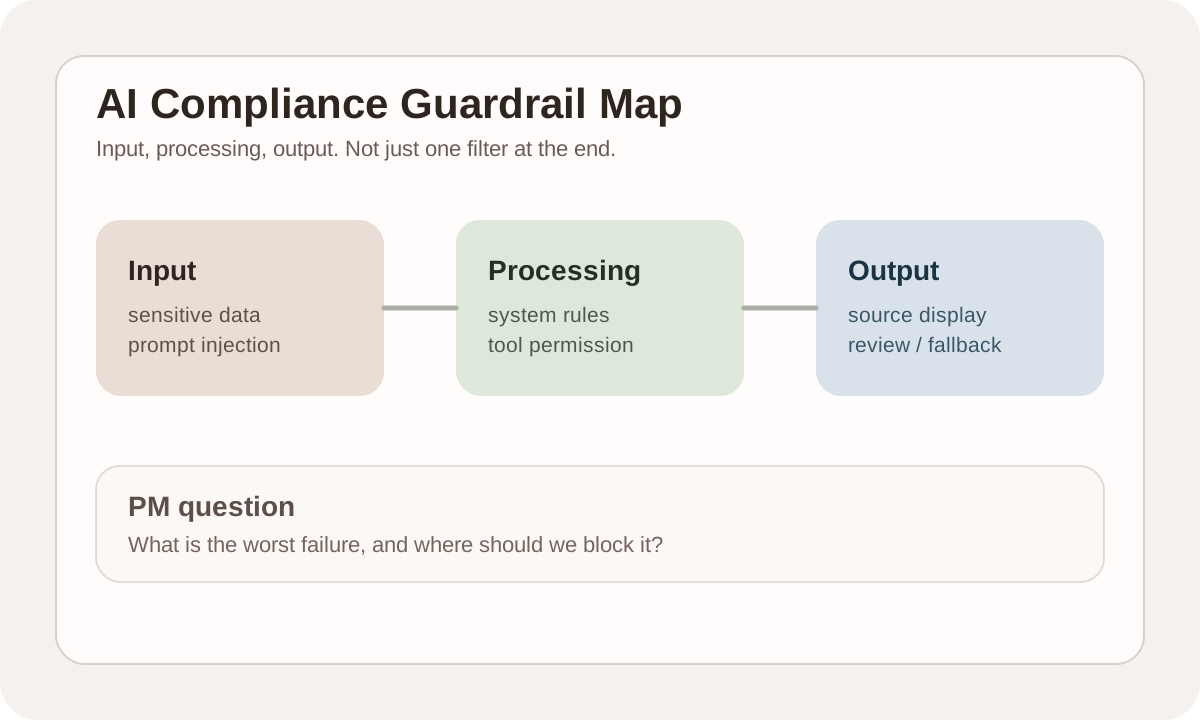
Bottom Line: AI Compliance Isn't a Review Step -- It's a Design Constraint
The more practical view:
- It's not a one-time audit before launch
- It's not one team's (legal's) problem
- It's not only for sensitive industries
Any generative AI product involving user input, knowledge output, automation, or content distribution already has compliance and safety risks.
4 Risk Types PMs Must Identify First
| Risk | Common manifestation |
|---|---|
| Accuracy risk | Confidently wrong, and the user believes it |
| Privacy risk | Data that shouldn't enter the model gets sent in |
| Misuse risk | Users use the product for things it shouldn't be used for |
| IP / copyright risk | Generated results or training materials have copyright issues |
Among these 4, the most dangerous isn't the one with highest probability -- it's the one where a single occurrence is extremely costly.
Risk Isn't Handled Uniformly -- Classify by Use Case
A practical classification:
| Use case | Risk level | Why |
|---|---|---|
| Brainstorming | Low | Errors have limited impact |
| Draft generation | Medium | Users might send it out directly |
| Support answers | Medium-high | Wrong answers affect trust and ops cost |
| Hiring / finance / legal / medical | High | One error can cause serious consequences |
If risk classification isn't done clearly, all downstream guardrails will be either too loose or too heavy.
Guardrails Should Cover Input, Processing, and Output
A complete guardrail system doesn't just filter output -- it has 3 layers:
| Layer | Core question | Typical approach |
|---|---|---|
| Input guardrail | Can user input go straight into the system | Length limits, sensitive content detection, prompt injection defense |
| Processing guardrail | How is the model constrained | System prompt, tool permissions, retrieval boundaries |
| Output guardrail | Can the final result go straight to users | Policy check, source display, human review, fallback |
Output moderation alone usually isn't enough.
Privacy Issues Are Often "Collecting Too Much by Default," Not "Leaking"
PMs designing AI features easily default to "give more context, model performs better." But this often directly breaks data boundaries.
The more stable principle remains data minimization:
| Scenario | Actually needed data | Often over-collected data |
|---|---|---|
| AI summary | The text content itself | User's full profile |
| AI support | Question context, necessary order fields | Entire CRM history |
| AI writing | Writing goal and style | Unrelated browsing history |
If a field isn't necessary for this task, don't send it in.
Prompt Injection and Tool Abuse Aren't Just Engineering Problems
PMs also need to know what can happen at the product level.
Typical issues include:
- Users tricking the model into ignoring its rules
- Accessing unauthorized data through tool calling
- Using your product to generate prohibited content
This means when designing tool-enabled AI features, you're not just designing "what it can do" -- you're also designing "what it absolutely must not do."
Source Grounding Is Key to Trust
In medium-to-high risk scenarios, having the model "answer like it's right" isn't nearly enough. The more stable direction:
- Cite sources whenever possible
- Explicitly say "not sure" when uncertain
- Refuse to answer or escalate to human when out of scope
These mechanisms sacrifice a bit of "smoothness" but typically earn more long-term trust.
What Compliance Review Should Ask
Before launch, PMs should at least be able to answer:
- How bad can this feature fail at worst
- What data entered the model
- Does the user know AI is involved
- Do we need source display, disclaimers, or human escalation paths
- How do we handle and track bad outputs when they occur
If all 5 questions are still fuzzy, compliance design isn't finished.
4 Most Dangerous Mindsets
| Mindset | Why it's dangerous |
|---|---|
| Ship first, add guardrails later | Risk reaches users first |
| The model provider will cover us | Responsibility doesn't automatically transfer out |
| It's just an internal tool, no need to be strict | Internal tools can also process sensitive data |
| Low-frequency risks can wait | AI risks are often low-frequency but high-impact |
The thing AI PMs should avoid most is treating safety issues as "we'll deal with it later" technical debt.
A Sufficient PM Checklist
- Is this use case low, medium, or high risk
- Is there unnecessary sensitive data in the input
- What real consequences come from wrong output
- Is there source / disclaimer / escalation path
- Is there bad case logging and rollback mechanism
This checklist isn't complex, but it's practical. Many incidents could've been caught by running through it once.
Practice
Take an AI feature you're building. Write these 4 lines:
- Worst case -- how could it harm users or the business
- What data actually shouldn't be sent to the model
- What questions should the model refuse to answer
- After a bad output -- who discovers it, who handles it
Once you can articulate these 4 lines clearly, compliance design has actually begun.
Turn Risk into an Executable Product Risk Register
Continue the registration experiment. “Be careful with privacy” is not a control. Put risk, prevention, monitoring, response, and stop authority in one table:
| Risk event | Affected user | Preventive control | Monitoring signal | Triggered response | Owner |
|---|---|---|---|---|---|
| Preview exposes another user's content | New registrants | Session isolation and cache-key checks | Cross-account content alert | Disable preview and investigate | Engineering |
| User thinks preview content is already saved | First-time users | Explicit save state and registration message | Complaints and missing-content reports | Correct messaging and provide recovery guidance | Product |
| Verification data is reused beyond purpose | All registrants | Data minimisation and purpose limitation | Unexpected field access | Stop processing and start privacy response | Privacy owner |
| Completion drops for one region | A specific user group | Regional test and accessibility review | Segmented conversion and failure reason | Pause rollout in that region | Product + Data |
Risk level is not probability alone. Include severity, detectability, and reversibility.
Final Go / Hold / No-Go Gate
GO: critical controls are verified, owners are ready, monitoring and rollback work
HOLD: risk is controllable but evidence is incomplete; limit exposure and verify
NO-GO: a high-impact, unacceptable risk remains unmitigated
“Legal reviewed it” is not a completion criterion. The product team must still know what data enters the system, what decisions it makes, when a person takes over, and who can press stop.
Pre-Launch Completion Criteria
- Every high-impact risk has prevention, monitoring, response, and an owner
- Users can tell AI is involved and whether a result will be saved or acted on
- High-risk decisions retain human review and an appeal path
- Logs support incident tracing without collecting unrelated sensitive data
- The team rehearsed stop, rollback, notification, and bad-sample preservation
- Go / Hold / No-Go is recorded with unresolved items
Chapter Deliverable
Complete an AI Product Launch Dossier containing the Research Decision Brief, MVP Evidence Pack, Release Contract, Metric Decision Pack, and Risk Register. Its purpose is not more documentation; it lets the team explain why the product exists, what evidence supports it, when to stop, and who is accountable.
📚 Related resources
❓ Common questions
Open a question to review the practical answer.
Why can AI compliance not be a single pre-launch review?
Compliance is not a review step—it is a design constraint. Risk is not just in the output; it spreads across data collection, prompt design, tool access, and user expectations. 'Ship first, add safety later' is expensive because the harm reaches users first, and the liability does not automatically transfer to the model vendor.
What are the 4 risk categories every AI PM must identify?
(1) Accuracy risk (the model is confidently wrong and users believe it), (2) privacy risk (data that should not enter the model does), (3) misuse risk (users do things with the product they should not), (4) IP/copyright risk (generated output or training data has rights issues). The dangerous one is not the most frequent—it is the one whose single occurrence is the most expensive.
How many layers should an AI guardrail cover?
Three layers: input guardrail (length limits, sensitive-content detection, prompt-injection defense), processing guardrail (system prompt, tool permissions, retrieval boundaries), and output guardrail (policy checks, source display, human review, fallback). Output moderation alone is rarely enough.
Why is AI privacy usually 'collecting too much by default' rather than 'leaking'?
PMs default to 'more context, better output', which silently breaks the data boundary. The rule is data minimization: AI summary needs the text itself, not the user's full profile; AI support needs the question context and necessary order fields, not the entire CRM history; AI writing needs the goal and style, not browsing history. If a field is not strictly required for this task, do not send it.
What are the 5 compliance questions a PM must answer before launch?
(1) What is the worst this feature can get wrong? (2) Which data categories enter the model? (3) Do users know AI is involved? (4) Is a source citation, disclaimer, or human-escalation path needed? (5) When bad output appears, how is it caught and tracked? If any of the five is fuzzy, compliance design is not done—do not file safety under 'we will deal with it later' technical debt.