
AI Research, Summaries & Knowledge Bases
Collect, compare, and summarize with AI — build SOPs and knowledge bases
Collect, compare, and summarize with AI — build SOPs and knowledge bases
A reusable work template with realistic input, a defined output format and a human review point.
Run one real task, verify the critical facts and record the before-and-after time.
AI is great for research and summarization — as long as you don't treat it as an "automatic conclusion machine." In real work, the most common problem isn't that summaries are slow. It's that AI mixes sources together, sounds very confident, and the facts don't hold up.
Use AI as a research assistant, not an analyst replacement. It accelerates collection, organization, comparison, and initial synthesis. You judge whether the conclusions stand.
Why This Page Deserves Careful Attention
This type of content has strong search intent:
how to do research with AIhow to avoid AI hallucination in summarieshow to make ChatGPT cite sourcesAI competitor analysis template
If the page just says "provide enough material and ask for citations," that's useless for both SEO and users. What's actually valuable is showing: how to feed input, how to do source tagging, how to do counter-verification, and how to do final review.
Ground Rules: Research Isn't Letting AI Guess
A good research workflow must meet at least these 4 conditions:
- Key conclusions should have sources wherever possible
- When sources are insufficient, clearly mark
to be verified - Multiple documents get summarized individually first, then merged
- At least one counter-verification pass before finalizing
Without these 4 rules, what you get is usually "prose that reads like a briefing."
Step 1: Structure the Input First
Many people just ask "research this topic for me," which gives AI too much freedom. More reliable — break down the input clearly:
| Input field | Why you need it |
|---|---|
| Topic | Prevents scope creep |
| Target audience | Determines summary granularity |
| Time range | Avoids mixing in outdated material |
| Source types | Official sites, news, reports, community, user reviews |
| Output format | Briefing, table, FAQ, decision memo |
Example prompt
You are a research assistant. Help me compile AI customer support software market info.

Requirements:
- Prioritize official websites, product docs, pricing pages, credible media reports
- Time range limited to 2025-2026
- Output structure:
  1. executive summary
  2. key vendors
  3. pricing / packaging signals
  4. open questions
- Tag every key conclusion with its source
- If source is insufficient, mark as `to be verified`
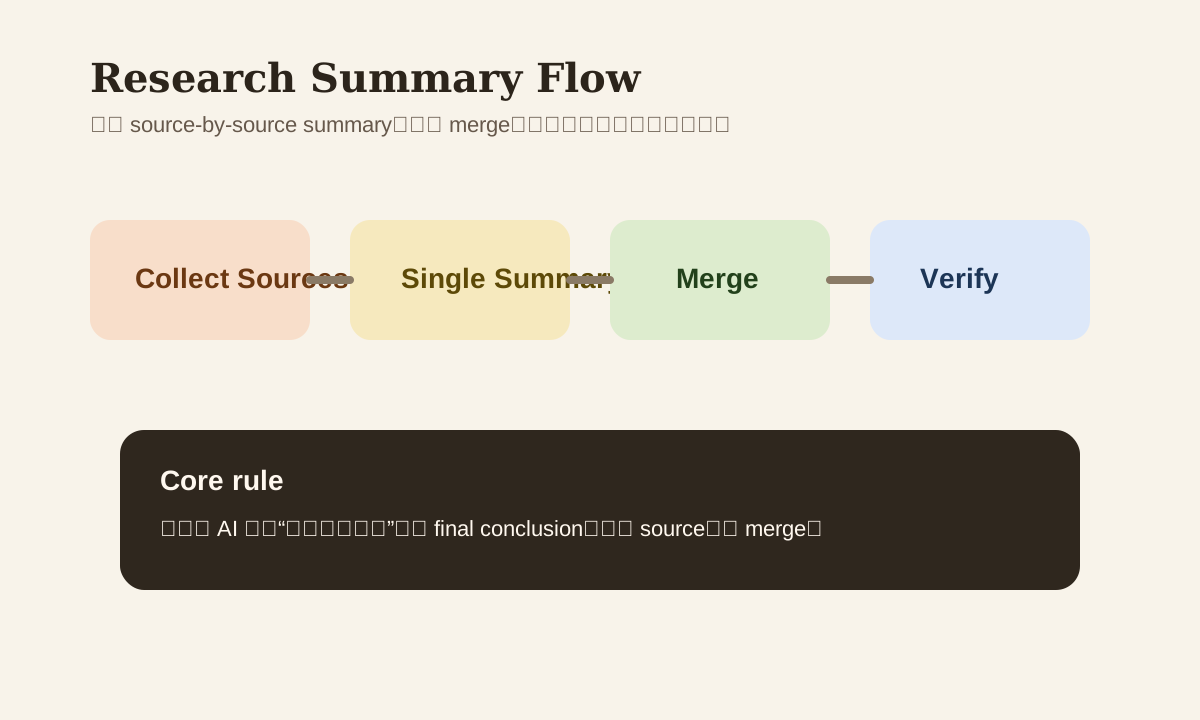
Step 2: Summarize Multiple Documents Separately, Then Merge
This step is critical. If you dump 5 documents and 3 links in at once, AI will likely:
- Mix up sources
- Miss conflicting information
- Apply one document's viewpoint to another
Better flow:
doc A -> single summary
doc B -> single summary
doc C -> single summary
then -> comparison / merge / briefing
Recommended output fields
| Field | Purpose |
|---|---|
| File / source name | Traceability |
| Publish date | Check if outdated |
| Core claim | Main argument |
| Supporting evidence | Evidence |
| Possible bias | Limitations |
Step 3: Require Source-Aware Output
Don't just ask AI to "summarize the key points." More reliable — require this structure:
Conclusion:

Evidence:
- [source 1]
- [source 2]

Unverified points:
- ...
Two benefits:
- You can quickly distinguish "confirmed" from "plausible guess"
- Results are easier to persist into a KB or briefing
Step 4: Counter-Verification Is Worth More Than the Summary
Many AI summaries look complete, but the real value isn't what it restated — it's whether it can point out what's shaky.
Add this after every research task:
List the 5 points in this summary that most need verification,
and specify where to check, what keywords to search, and who should confirm.
Way more useful than "please double-check."
Common Use Cases
| Use case | What AI best helps with |
|---|---|
| Competitor analysis | Aligning features, pricing, positioning |
| Policy review | Extracting key changes, affected parties, pending items |
| Industry brief | Generating 1-page summary with risk notes |
| Internal doc digest | Turning long docs into readable briefings |
| Client background | Compiling company profile, news, signals |
A Practical 1-Page Briefing Template
Topic:

Executive summary:

Key findings:
- ...

What changed recently:
- ...

Risks / unknowns:
- ...

Recommended next steps:
- ...

Sources:
- ...
This output is better for sharing, reviewing, and reusing than a long block of prose.
Common Mistakes
| Mistake | Problem | Better Approach |
|---|---|---|
| Dump all links at once | Sources get mixed up | Single-source summary first |
| Only "summarize," no counter-check | Leads to overconfidence | Force unverified points list |
| No time range restriction | Old info mixed in | Specify year / date range |
| No defined output format | AI writes vague prose | Use table, briefing, or FAQ |
Practice
Pick a topic you actually need to research, then run these steps:
- List 3 credible sources
- Summarize each separately
- Merge into a 1-page briefing
- Have AI list 5 points that need verification
After this, what you get will feel more like a deliverable research result — not just "text that looks researched."