
AI Team Adoption & Training
Pilot, train, and incentivize to land AI adoption at scale
Pilot, train, and incentivize to land AI adoption at scale
A reusable work template with realistic input, a defined output format and a human review point.
Run one real task, verify the critical facts and record the before-and-after time.
Getting AI to actually land in a team isn't about how many tools you buy — it's about adoption. Most companies start with a few power users going hard, but 2 months later realize: the people who already knew keep getting better, and the people who didn't still don't.
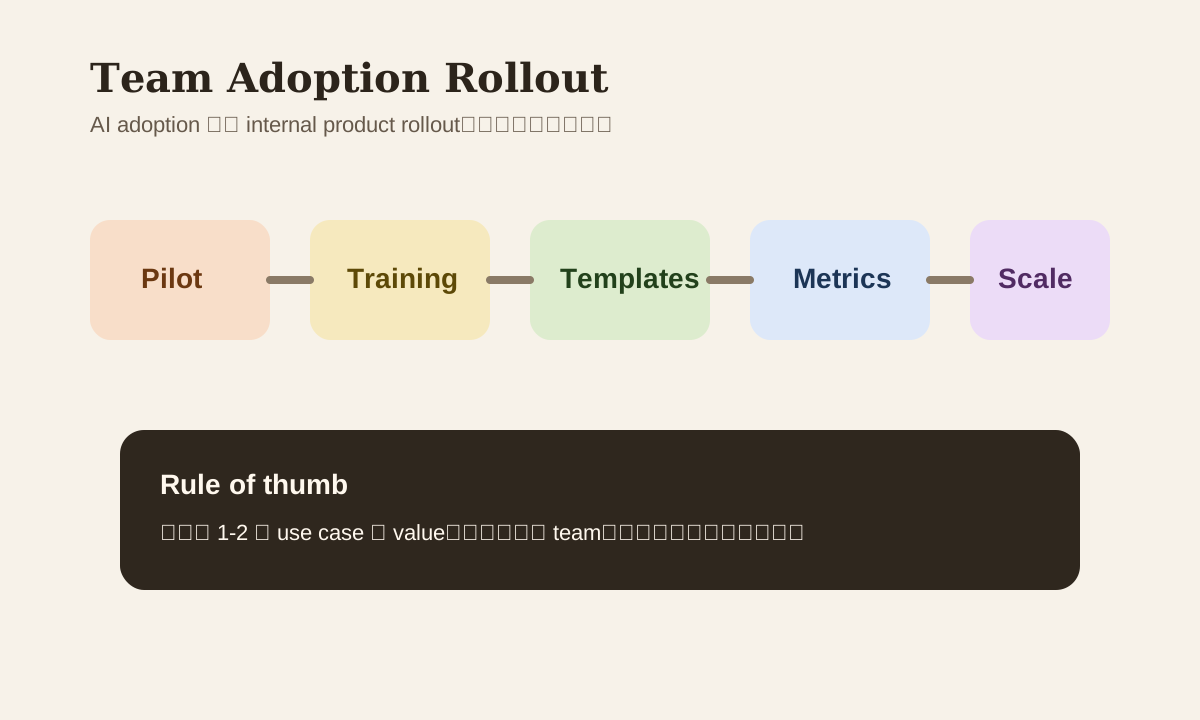
So AI adoption is more like an internal product rollout than a one-time training session. You need a pilot, training, templates, office hours, and clear boundaries. Miss any one of these and you'll drift back to "everyone doing their own thing."
Why Most Team Adoption Efforts Fail
The most common failure isn't employee resistance. It's a bad rollout approach:
- Full-team rollout from day one, no pilot
- No real use cases given, just concepts
- No template pack, so everyone starts from zero
- No clear rules on what's allowed and what's not
- No metrics, so nobody knows if adoption is improving
If your AI rollout is "send an announcement + do one presentation," it's unlikely to stick.
Step 1: Pilot First — Don't Roll Out to Everyone
Start with 1-2 low-risk, high-repetition scenarios:
- Meeting notes
- Weekly summaries
- Email drafting
- Spreadsheet formula help
- Internal FAQ summarization
Pilot Selection Criteria
| Criteria | Why it matters |
|---|---|
| High repetition | Easy to see time savings |
| Relatively low risk | Won't cause incidents early on |
| Clear before / after | Easy to prove value |
| Team willing to participate | Easy to collect feedback |
Step 2: Training Needs Real Cases, Not Just Prompt Theory
The biggest problem with most training: the demo looks amazing, but the team can't apply it. Better approach — walk through real scenarios live:
- What the raw input looks like
- How to write the prompt
- Where the output falls short
- How to refine it
This live walkthrough beats "sharing 20 generic prompt tips" for driving adoption.
Step 3: Ship a Template Pack, Not Just a Recording
Recordings get watched and forgotten. Templates stay. A useful enablement pack should include:
| Asset | Content |
|---|---|
| Prompt pack | High-frequency templates: email, meeting, summary, report |
| Quick guide | Input requirements, common errors, tone guide |
| Risk note | What content shouldn't go to public AI |
| Good / bad example | Show new users what usable output looks like |
Without a template pack, many teams finish training and still don't know what to do at work tomorrow.
Step 4: Champions Beat "Free Exploration for Everyone"
If each team has 1-2 AI champions, adoption tends to be much steadier. They don't have to be the most technical people, but they should be able to:
- Collect use cases within the team
- Persist useful templates
- Answer the most common questions
- Identify which workflows are worth expanding to automation
This is way more efficient than "everyone figures it out themselves."
Step 5: Metrics Should Be Simple but Must Exist
You don't need a complex dashboard from day one. But at minimum track:
- Active users
- Weekly usage
- Estimated time saved
- Top use cases
- Top failure reasons
Without this data, team adoption easily becomes "feels like everyone's using it" when actually only a few people are using it regularly.
Step 6: Boundaries Must Be Clear
AI adoption isn't just teaching people "how to use it." It's also teaching "when not to use it."
At minimum, clarify:
- Which data can't be sent directly to public AI
- Which outputs must go through human review
- Which scenarios require enterprise tools
- What to do when encountering hallucination or policy-violating output
If boundaries aren't clear, the more enthusiastic the team is, the higher the risk.
A Practical Rollout Cadence
pilot group
  -> collect feedback
  -> refine template pack
  -> run training
  -> appoint champions
  -> measure adoption
  -> expand to more teams
The key: prove value first, then expand scope.
Common Mistakes
| Mistake | Problem | Better Approach |
|---|---|---|
| Full rollout from day 1 | Hard to control, support can't keep up | Pilot first |
| Training covers only theory | People go back and still can't use it | Demo with real cases |
| No template pack | Adoption depends entirely on individual skill | Provide starter templates |
| No champions | Nobody to answer questions | Appoint 1-2 per team |
| No risk boundaries | More usage = more risk | Roll out policy alongside rollout |
Practice
Write a 2-week pilot plan for your team:
- Pick 1 use case
- Select 3-5 pilot users
- Prepare a template pack
- Define 3 adoption metrics
- Write clear boundaries and escalation path
Once you've done this, AI adoption looks more like a scalable internal rollout — not a one-off experiment.