
PAL
Program-Aided Language Models:用可执行程序做中间推理
Program-Aided Language Models:用可执行程序做中间推理
一份保留任务边界的可复用 Prompt、示例集、评测记录或安全规则。
至少跑一个代表性样本,检查结果,并记录仍需人工复核的部分。
Gao 等人(2022)提出了一种使用 LLMs 读取自然语言问题并生成程序作为中间推理步骤的方法。被称为程序辅助语言模型(PAL),它与思维链提示不同,因为它不是使用自由形式文本来获得解决方案,而是将解决步骤卸载到类似 Python 解释器的编程运行时中。
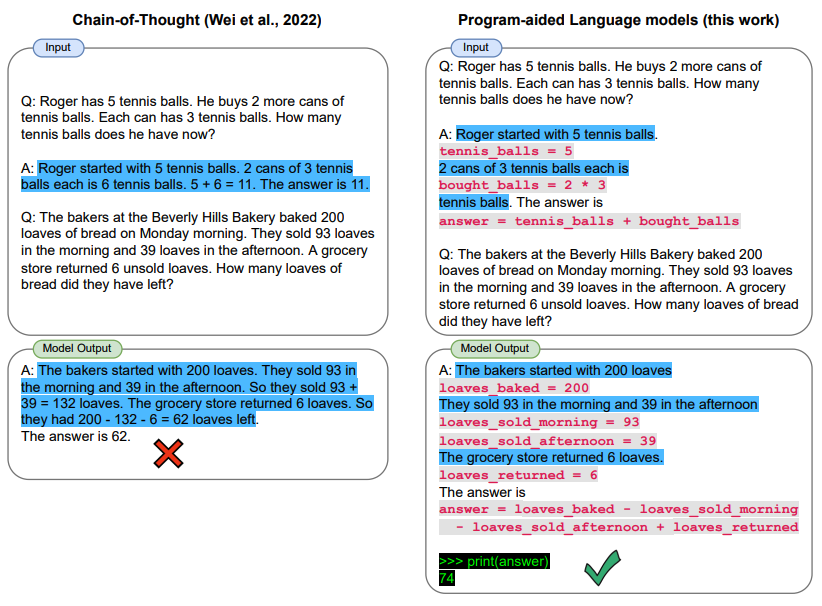
图片来源:Gao 等人(2022)
让我们以 LangChain 和 OpenAI GPT-3 为例。我们有兴趣开发一个简单的应用程序,它能够解释所提出的问题,并利用 Python 解释器提供答案。
具体来说,我们有兴趣创建一个功能,允许使用 LLM 回答需要日期理解的问题。我们将为 LLM 提供一个提示,其中包括一些示例,这些示例是从这里采用的。
这是我们需要导入的包:
from datetime import datetime
from dateutil.relativedelta import relativedelta
from langchain.llms import OpenAI
from dotenv import load_dotenv
让我们先配置一些环境:
load_dotenv()

# API configuration
openai.api_key = os.getenv("OPENAI_API_KEY")

# for LangChain
os.environ["OPENAI_API_KEY"] = os.getenv("OPENAI_API_KEY")
设置模型实例:
llm = OpenAI(model_name='text-davinci-003', temperature=0)
设置提示+问题:
question = "Today is 27 February 2023. I was born exactly 25 years ago. What is the date I was born in MM/DD/YYYY?"

DATE_UNDERSTANDING_PROMPT = """
# Q: 2015 is coming in 36 hours. What is the date one week from today in MM/DD/YYYY?
# If 2015 is coming in 36 hours, then today is 36 hours before.
today = datetime(2015, 1, 1) - relativedelta(hours=36)
# One week from today,
one_week_from_today = today + relativedelta(weeks=1)
# The answer formatted with %m/%d/%Y is
one_week_from_today.strftime('%m/%d/%Y')
# Q: The first day of 2019 is a Tuesday, and today is the first Monday of 2019. What is the date today in MM/DD/YYYY?
# If the first day of 2019 is a Tuesday, and today is the first Monday of 2019, then today is 6 days later.
today = datetime(2019, 1, 1) + relativedelta(days=6)
# The answer formatted with %m/%d/%Y is
today.strftime('%m/%d/%Y')
# Q: The concert was scheduled to be on 06/01/1943, but was delayed by one day to today. What is the date 10 days ago in MM/DD/YYYY?
# If the concert was scheduled to be on 06/01/1943, but was delayed by one day to today, then today is one day later.
today = datetime(1943, 6, 1) + relativedelta(days=1)
# 10 days ago,
ten_days_ago = today - relativedelta(days=10)
# The answer formatted with %m/%d/%Y is
ten_days_ago.strftime('%m/%d/%Y')
# Q: It is 4/19/1969 today. What is the date 24 hours later in MM/DD/YYYY?
# It is 4/19/1969 today.
today = datetime(1969, 4, 19)
# 24 hours later,
later = today + relativedelta(hours=24)
# The answer formatted with %m/%d/%Y is
today.strftime('%m/%d/%Y')
# Q: Jane thought today is 3/11/2002, but today is in fact Mar 12, which is 1 day later. What is the date 24 hours later in MM/DD/YYYY?
# If Jane thought today is 3/11/2002, but today is in fact Mar 12, then today is 3/12/2002.
today = datetime(2002, 3, 12)
# 24 hours later,
later = today + relativedelta(hours=24)
# The answer formatted with %m/%d/%Y is
later.strftime('%m/%d/%Y')
# Q: Jane was born on the last day of Feburary in 2001. Today is her 16-year-old birthday. What is the date yesterday in MM/DD/YYYY?
# If Jane was born on the last day of Feburary in 2001 and today is her 16-year-old birthday, then today is 16 years later.
today = datetime(2001, 2, 28) + relativedelta(years=16)
# Yesterday,
yesterday = today - relativedelta(days=1)
# The answer formatted with %m/%d/%Y is
yesterday.strftime('%m/%d/%Y')
# Q: {question}
""".strip() + '\n'
llm_out = llm(DATE_UNDERSTANDING_PROMPT.format(question=question))
print(llm_out)
这将输出以下内容:
# If today is 27 February 2023 and I was born exactly 25 years ago, then I was born 25 years before.
today = datetime(2023, 2, 27)
# I was born 25 years before,
born = today - relativedelta(years=25)
# The answer formatted with %m/%d/%Y is
born.strftime('%m/%d/%Y')
llm_out 是一段 python 代码,我们可以使用 exec 执行它:
exec(llm_out)
print(born)
这将输出以下内容:02/27/1998
📚 相关资源
❓ 常见问题
点击问题,查看本章对应的实践答案。
PAL 是什么?跟 CoT 区别是什么?
PAL(Program-Aided Language Models,Gao 等人 2022)让 LLM 把推理步骤写成代码而不是自由文本——LLM 输出 Python,交给解释器执行得到答案。CoT 走自然语言推理,遇到算术容易算错;PAL 把计算卸载给 Python 运行时,数学绝对正确。CoT 容易在数字加减乘除上出错,PAL 直接绕过这个问题。
PAL 是用代码代替整个推理过程吗?
不是替换全部——是替换「需要精确计算」的那部分。LLM 仍然负责自然语言理解(题目要算什么、用什么变量、如何拆步骤),把这些理解翻译成代码后由解释器执行。换句话说,LLM 做语义解析 + 规划,Python 做精确执行,两者分工。
PAL 适合什么任务?
数学题、日期计算、单位换算、统计聚合——所有「能用程序精确计算的问题」。论文 demo 是日期理解:「今天 2023 年 2 月 27 日,我恰好 25 年前出生,我的生日 MM/DD/YYYY 是?」LLM 生成 `today - relativedelta(years=25)` 的 Python 代码,exec 后输出 02/27/1998。也适合财务、化学计量、表格统计。
PAL 怎么实现?要专门的解释器吗?
标准做法:用 few-shot 把每个示例写成「注释 + Python」格式 → LLM 续写代码 → 用 `exec(llm_out)` 执行 → 取结果变量。论文 demo 用 LangChain + OpenAI + datetime / dateutil。生产环境必须用 sandbox(如受限子进程或 wasm 运行时)——直接 exec LLM 输出在生产是安全炸弹。
PAL 和 ReAct + 计算器工具是同一回事吗?
思路相近,但 PAL 更激进。ReAct + Calculator 让 LLM 调一次单步算术;PAL 直接让 LLM 写整个程序——多变量、循环、import 库都行,是「LLM = 代码作者,Python = 执行者」。OpenAI Code Interpreter / ChatGPT Advanced Data Analysis 本质就是 PAL 的产品化形态。