
Active-Prompt
Select demonstrations by uncertainty for CoT prompting
Select demonstrations by uncertainty for CoT prompting
A reusable prompt, example set, evaluation record or safety rule with its task boundary preserved.
Run at least one representative case, inspect the result and record what still requires human review.
Chain-of-thought (CoT) methods rely on a fixed set of human-annotated exemplars. The problem? Those exemplars might not be the most effective ones for different tasks. To address this, Diao et al. (2023) proposed Active-Prompt, a new approach that adapts LLMs to different task-specific example prompts (annotated with human-designed CoT reasoning).
Here's the method illustrated. Step one: query the LLM with or without a few CoT examples. Generate k possible answers for a set of training questions. Compute an uncertainty metric based on those k answers (using disagreement). Select the most uncertain questions for human annotation. Then use the new annotated exemplars for inference on each question.
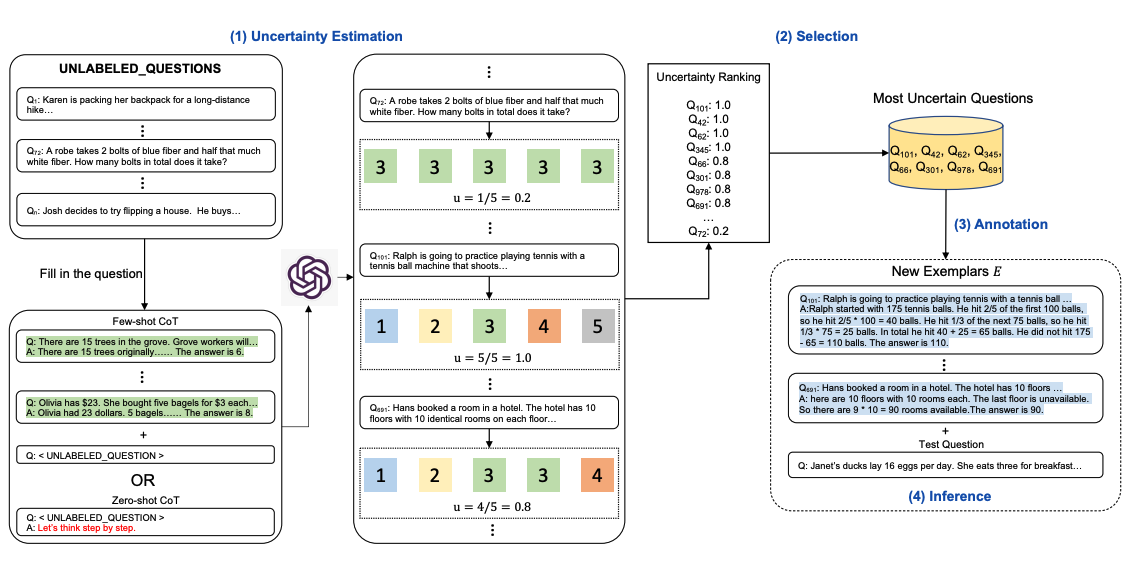
Image source: Diao et al. (2023)
Core Idea
The problem with traditional CoT: all tasks share the same set of hand-annotated examples, but different tasks have different hard parts. Fixed examples can't cover every scenario. Active-Prompt's key insight: let the model tell you which questions are hardest, then prioritize annotating those as examples.
This borrows from active learning -- instead of randomly picking training samples, you pick the ones the model is most "confused" about. Minimum annotation effort, maximum performance gain.
Four-Step Process
Step 1: Uncertainty Estimation
First, use the LLM to generate k answers for each training question (e.g., k=5). Multiple samples let you observe how consistent the model is on each question.
Question: If 3 times a number minus 7 equals 20, what is the number?

Sample 1: 3x - 7 = 20, 3x = 27, x = 9 → Answer: 9
Sample 2: 3x - 7 = 20, 3x = 27, x = 9 → Answer: 9
Sample 3: 20 + 7 = 27, 27 / 3 = 9 → Answer: 9
Sample 4: 3x = 20 + 7 = 27, x = 9 → Answer: 9
Sample 5: 3x - 7 = 20, x = 9 → Answer: 9
→ Disagreement: 0 (all answers agree, model is confident)
Question: A train takes 3 hours from station A to B. From B to C, the speed is 1.5x
         and the distance is 2x. How many hours total from A to C?

Sample 1: AB 3hrs, BC = 2d/(1.5v) = 4hrs, total 7hrs → Answer: 7
Sample 2: BC speed 1.5x distance 2x, time = 2/1.5 × 3 = 4hrs, total 7 → Answer: 7
Sample 3: BC = 2 × distance, speed 1.5×, time = 2d/1.5v = 2/(1.5) × 3 = 4, → Answer: 7
Sample 4: 1.5x speed for 2x distance, needs 2/1.5 = 1.33x time = 4hrs, total 5 → Answer: 5
Sample 5: 3 + (2 × 3)/(1.5) = 3 + 4 = 7 → Answer: 7
→ Disagreement: 0.2 (one answer disagrees, model isn't fully confident)
Step 2: Select the Most Uncertain Questions
Rank by uncertainty (disagreement) from high to low. Pick the top n questions. These are the ones the model struggles with most -- and they're the most valuable to annotate.
The paper uses several uncertainty metrics:
- Disagreement: proportion of different answers among k samples
- Entropy: information entropy of the answer distribution
- Variance: for numerical answers, the variance across answers
Step 3: Human Annotation
For the selected most-uncertain questions, human annotators provide detailed CoT reasoning. Since you only need to annotate a small number of high-value questions (typically 4-8), the annotation cost is much lower than annotating everything.
Step 4: Inference
Use the newly annotated exemplars as few-shot examples for inference on all questions. Because these examples are "hand-picked" based on model weaknesses, they typically deliver better results.
Experimental Results
Active-Prompt achieved significant improvements across multiple reasoning benchmarks:
| Benchmark | CoT | Active-Prompt | Improvement |
|---|---|---|---|
| GSM8K (math) | 74.4% | 78.0% | +3.6% |
| AQuA (algebra) | 52.4% | 55.1% | +2.7% |
| SVAMP (math) | 79.0% | 82.3% | +3.3% |
| CSQA (commonsense) | 73.5% | 76.2% | +2.7% |
| StrategyQA | 65.4% | 69.0% | +3.6% |
Note: Results based on code-davinci-002. See the original paper for exact numbers.
Key findings:
- Uncertainty-selected examples consistently outperformed randomly selected ones
- Even with a tiny annotation budget (4-8 examples), Active-Prompt delivered significant gains
- Different uncertainty metrics (disagreement vs. entropy) performed similarly -- disagreement is the simplest and most effective choice
Practical Application Guide
When to Use Active-Prompt?
Active-Prompt works best when:
- Annotation budget is limited: You can only annotate a few examples and need each one to count
- Tasks are highly specific: Generic examples don't work well, you need domain-specific customization
- There's a clear distribution of hard problems: Certain question types consistently trip up the model
Simplified Practice Workflow
You don't need to implement the full paper pipeline for daily use. Here's a simplified approach:
Step 1: Test your LLM on your question set, find questions it frequently gets wrong
Step 2: Write detailed CoT examples for these "error-prone" questions
Step 3: Put those examples into your few-shot prompt
Step 4: Verify the new prompt's performance on the full test set
Comparison with Other Methods
| Method | Example Selection Strategy | Best For |
|---|---|---|
| Few-shot CoT | Random or manual | General tasks |
| Auto-CoT | Cluster then auto-generate | Large-scale automation |
| Active-Prompt | Uncertainty-driven selection | Precise optimization, limited budget |
| Self-Consistency | Sample multiple, majority vote | Improving single-question accuracy |
Self-Check Checklist
- Did you do sufficient uncertainty estimation (at least k=5 samples)?
- Do the selected annotation questions cover the main error types?
- Is the annotated CoT reasoning detailed and logically clear?
- Did you confirm the improvement on a validation set?
References
- Active Prompting with Chain-of-Thought for Large Language Models (Diao et al., 2023)
- Chain-of-Thought Prompting Elicits Reasoning in Large Language Models (Wei et al., 2022)