
Introduction
What prompt engineering is and how you will use prompts to work with LLMs
What prompt engineering is and how you will use prompts to work with LLMs
A reusable prompt, example set, evaluation record or safety rule with its task boundary preserved.
Run at least one representative case, inspect the result and record what still requires human review.
Prompt Engineering is the craft of optimizing your inputs (prompts) to guide AI models toward accurate, high-quality outputs.
In the AI era, prompts are basically a new programming language. You don't need to write complex code — just express your intent clearly in natural language, and you can put models like GPT-5, Claude 4.5, or Gemini 3 to work for you.
Why does it matter?
Today's AI models are smart, sure. But they're fundamentally probability machines. Without guidance, their output tends to be generic, mediocre, or straight-up hallucinated nonsense.
Mastering Prompt Engineering lets you:
- Get precise answers: Go from "write me something" to "generate a McKinsey-style market analysis report."
- Unlock complex tasks: Get AI to write code, do mathematical reasoning, play specific roles, and solve logic puzzles through Chain of Thought.
- Build AI applications: Develop automated workflows using System Prompts and Agent architectures.
- Boost productivity: Compress hours of tedious work (document summaries, data cleaning, first drafts) into minutes.
Core principle: Garbage In, Garbage Out
The quality of AI output depends heavily on your input quality.
-
❌ Vague instruction:
"Write me some copy."
Result: You get a bland, generic paragraph that says nothing.
-
✅ Quality instruction:
"As an experienced social media marketer, write a product review post for a sparkling water brand that focuses on 'zero sugar, low calorie.' Target audience is professional women aged 25-30. Keep the tone casual and upbeat. Include 3 pain-point scenarios (like worrying about calories during afternoon tea) and 5 emojis, with a purchase link CTA at the end."
Result: You get a targeted, high-conversion professional copy.
Course roadmap
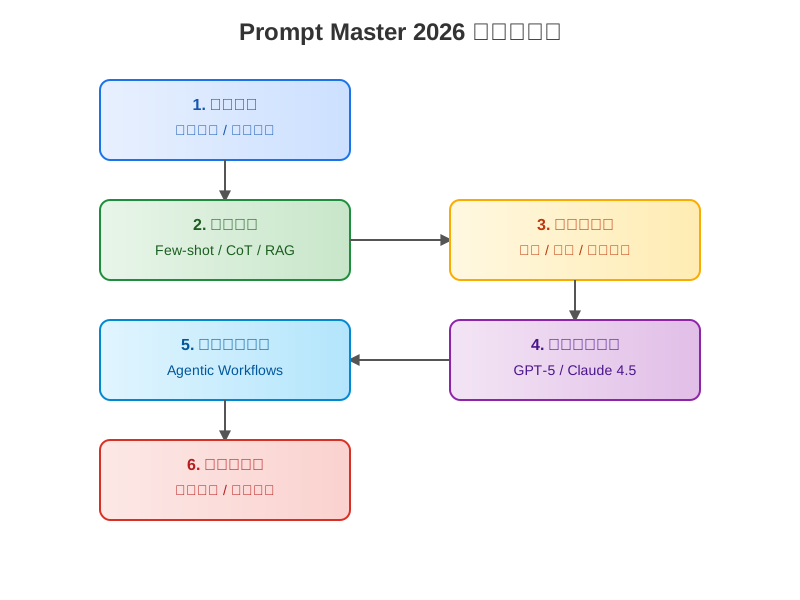
This track takes you from zero to Prompt Master:
- Basics (Introduction): Understand the core elements of a prompt (instruction, context, input, output format).
- Techniques: Master Zero-shot, Few-shot, CoT (Chain of Thought), RAG, and other advanced strategies.
- Prompt Library: Learn classic prompt templates for writing, coding, reasoning, and more.
- Agents: Explore how AI autonomously completes tasks through Tool Use and Planning.
- Models: Understand the characteristics and differences between top models like GPT-5.2, Claude 4.5 Sonnet, and Gemini 3 Pro.
Turn this chapter's knowledge into practical skills
Enter the interactive lab and practice Prompt with real tasks. Get started in 10 minutes.
Lab environment notes
Unless stated otherwise, examples in this tutorial are best tested with these mainstream 2026 models:
- OpenAI: GPT-5.2 / GPT-5.1 Thinking (top-tier reasoning)
- Anthropic: Claude 4.5 Sonnet / Claude 4 Opus (widely regarded as the strongest coding and autonomous agent models)
- Google: Gemini 3 Pro (leading advantages in long-context processing, multimodal, and reasoning)
Note: Older models (like GPT-4o or GPT-3.5) can handle most basic prompts, but for 2026-standard complex logic, large-scale automation, and highly creative tasks, the latest models deliver a dramatically better experience. We strongly recommend keeping up and using each provider's latest flagship models.
Quick navigation
📚 Related resources
❓ Common questions
Open a question to review the practical answer.
What problem does prompt engineering actually solve?
It addresses the fact that models like GPT-5, Claude 4.5 and Gemini 3 default to generic or hallucinated output without guidance. Swapping 'write me some copy' for 'experienced social media marketer, target audience women 25-30, 3 pain points and 5 emojis' redirects probability prediction into the narrow band you actually want.
Why is a prompt called the new programming language?
You no longer write if/else; you orchestrate hundred-billion-parameter models (GPT-5, Claude 4.5 Sonnet, Gemini 3 Pro) using natural language. The four elements—instruction, context, examples, output format—map onto function signature, parameters, and test cases, which is why it is treated as a new kind of programming.
What does Garbage In, Garbage Out look like in a prompt?
Garbage input: 'write me some copy'—you get a bland generic paragraph. Quality input: defined role (experienced social media marketer) + product (zero-sugar sparkling water) + audience (women 25-30) + structure (3 pain points + 5 emojis + purchase CTA). Input information density directly drives output quality.
Which models should I practice prompts on in 2026?
Stick to flagship models from three providers: OpenAI GPT-5.2 / GPT-5.1 Thinking (top-tier reasoning), Anthropic Claude 4.5 Sonnet / Claude 4 Opus (strongest coding and agent work), Google Gemini 3 Pro (long-context and multimodal leadership). GPT-4o or GPT-3.5 still handles basics, but on 2026-grade complex tasks newer flagships deliver a substantially better experience.
What is the most efficient way through the Prompt Master track?
Five stages: basics (the four elements—instruction, context, input, output format) → techniques (Zero-shot, Few-shot, CoT, RAG) → prompt library (writing/coding/reasoning templates) → agents (Tool Use and Planning) → models (differences between GPT-5.2, Claude 4.5 Sonnet, Gemini 3 Pro). Master the elements before chasing techniques, or the techniques become hollow patterns.