
Context Engineering
Why Context Engineering determines AI Agent stability and controllability
Why Context Engineering determines AI Agent stability and controllability
A reusable prompt, example set, evaluation record or safety rule with its task boundary preserved.
Run at least one representative case, inspect the result and record what still requires human review.
TL;DR
Context Engineeringis the key to makingAI Agentsexecute reliably: it covers system prompts, tool instructions, memory, constraints, and observability -- not just "writing a better prompt."- Most failures aren't because the model isn't smart enough. They're because the context design is unclear: silent skips, inconsistent state, wrong tool usage, missing error handling.
- The most effective iteration cycle:
deploy -> observe -> refine -> test, and crystallize behavioral data into reusable rules and rubrics.
Core Concepts
Context Engineering means systematically designing and iterating on the input context around an AI Agent to make it more reliable and controllable in complex tasks. Compared to single-call LLM "prompt engineering," it puts more emphasis on:
System prompt: Define role, boundaries, allowed/forbidden actions, output formatTask constraints: Completion criteria, quality standards, skip rules, retry rulesTool descriptions: When to use which tool, how to fill parameters, how to handle errorsMemory management: How to persist state, what needs long-term storage, how to compress contextError handling: Retry/fallback after failure, and when to escalate to human-in-the-loop
How to Apply
Think of Context Engineering as an engineering feedback loop:
- Write the goal as a verifiable definition (what good looks like)
- Write the execution process as an observable state machine (plan/status/log)
- Use tools to make key steps verifiable (especially for facts and external writes)
- Bake failure modes into the system prompt (e.g., no silent skips, must log justification)
- Keep replaying and reviewing with real tasks (turn "random bugs" into explicit rules)
Case Study: Deep Research Agent
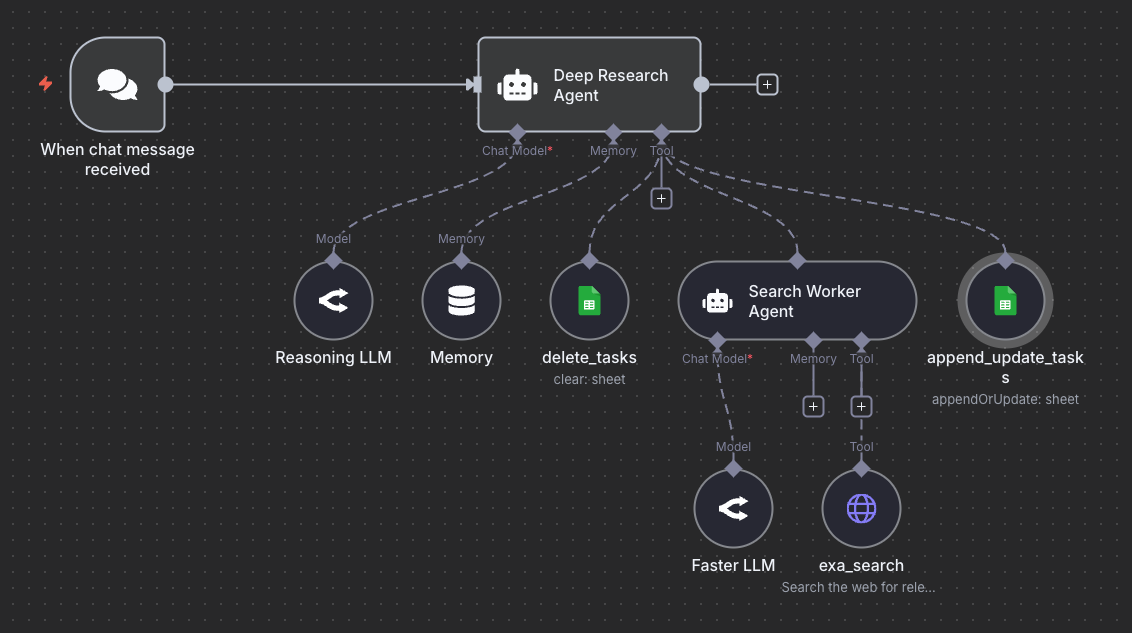
These two issues are extremely common -- pretty much every Deep Research Agent runs into them:
Issue 1: Incomplete Task Execution
Symptom: The orchestrator plans 3 search tasks but only executes 2. The third gets silently skipped.
Root cause: The system prompt didn't spell out "task completion rules," so the agent assumed the task was redundant or unnecessary.
Fix (pick one):
- Flexible: Allow skipping, but require justification and status update
- Strict: All planned tasks must be executed
(Example rules -- English terms kept for direct reuse)
You are a deep research agent responsible for executing comprehensive research tasks.

TASK EXECUTION RULES:
- For each search task you create, you MUST either:
  1. Execute a web search and document findings, OR
  2. Explicitly state why the search is unnecessary and mark it as completed with justification

- Do NOT skip tasks silently or make assumptions about task redundancy
- If you determine tasks overlap, consolidate them BEFORE execution
- Update task status in the spreadsheet after each action
Issue 2: Lack of Debugging Visibility
Symptom: Without logs and state tracking, you can't tell why the agent made certain decisions, which makes iteration nearly impossible.
Fix: Use a simple task tracker (spreadsheet / file) to force observability:
- Task ID
- Search query
- Status (
todo/in_progress/completed) - Results summary
- Timestamp
Self-check Rubric
- Have you eliminated prompt ambiguity (are instructions actionable and verifiable)?
- Have you clearly specified required vs. optional actions?
- Do you have observability (logs, state, tool call replay)?
- Have you covered error cases (retry on failure, partial failure, human escalation)?
- Does the agent behave consistently given the same input (behavioral consistency)?
Practice
Exercise: Write a Context Engineering checklist for a "weekly market research agent."
- Must include: plan format, status value constraints, tool usage rules, failure retry rules, output schema.
- Bonus: Define a simple
evaluation rubric(e.g., 10-point scale: coverage / correctness / citations / actionability).
References
Original (English)
Context engineering is a critical practice for building reliable and effective AI agents. This guide explores the importance of context engineering through a practical example of building a deep research agent.
Context engineering involves carefully crafting and refining the prompts, instructions, and constraints that guide an AI agent's behavior to achieve desired outcomes.
What is Context Engineering?
Context engineering is the process of designing, testing, and iterating on the contextual information provided to AI agents to shape their behavior and improve task performance. Unlike simple prompt engineering for single LLM calls, context engineering for agents involves (but not limited to):
- System prompts that define agent behavior and capabilities
- Task constraints that guide decision-making
- Tool descriptions that clarify when and how to use available functions/tools
- Memory management for tracking state across multiple steps
- Error handling patterns for robust execution
Building a Deep Research Agent: A Case Study
Let's explore context engineering principles through an example: a minimal deep research agent that performs web searches and generates reports.
The Context Engineering Challenge
When building the first version of this agent system, the initial implementation revealed several behavioral issues that required careful context engineering:
Issue 1: Incomplete Task Execution
Problem: When running the agentic workflow, the orchestrator agent often creates three search tasks but only executes searches for two of them, skipping the third task without explicit justification.
Root Cause: The agent's system prompt lacked explicit constraints about task completion requirements. The agent made assumptions about which searches were necessary, leading to inconsistent behavior.
Solution: Two approaches are possible:
- Flexible Approach (current): Allow the agent to decide which searches are necessary, but require explicit reasoning for skipped tasks
- Strict Approach: Add explicit constraints requiring search execution for all planned tasks
Example system prompt enhancement:
You are a deep research agent responsible for executing comprehensive research tasks.

TASK EXECUTION RULES:
- For each search task you create, you MUST either:
  1. Execute a web search and document findings, OR
  2. Explicitly state why the search is unnecessary and mark it as completed with justification

- Do NOT skip tasks silently or make assumptions about task redundancy
- If you determine tasks overlap, consolidate them BEFORE execution
- Update task status in the spreadsheet after each action
Issue 2: Lack of Debugging Visibility
Problem: Without proper logging and state tracking, it was difficult to understand why the agent made certain decisions.
Solution: For this example, it helps to implement a task management system using a spreadsheet or text file (for simplicity) with the following fields:
- Task ID
- Search query
- Status (todo, in_progress, completed)
- Results summary
- Timestamp
This visibility enables:
- Real-time debugging of agent decisions
- Understanding of task execution flow
- Identification of behavioral patterns
- Data for iterative improvements
Context Engineering Best Practices
Based on this case study, here are key principles for effective context engineering:
1. Eliminate Prompt Ambiguity
Bad Example:
Perform research on the given topic.
Good Example:
Perform research on the given topic by:
1. Breaking down the query into 3-5 specific search subtasks
2. Executing a web search for EACH subtask using the search_tool
3. Documenting findings for each search in the task tracker
4. Synthesizing all findings into a comprehensive report
2. Make Expectations Explicit
Don't assume the agent knows what you want. Be explicit about:
- Required vs. optional actions
- Quality standards
- Output formats
- Decision-making criteria
3. Implement Observability
Build debugging mechanisms into your agentic system:
- Log all agent decisions and reasoning
- Track state changes in external storage
- Record tool calls and their outcomes
- Capture errors and edge cases
Warning: Pay close attention to every run of your agentic system. Strange behaviors and edge cases are opportunities to improve your context engineering efforts.
4. Iterate Based on Behavior
Context engineering is an iterative process:
- Deploy the agent with initial context
- Observe actual behavior in production
- Identify deviations from expected behavior
- Refine system prompts and constraints
- Test and validate improvements
- Repeat
5. Balance Flexibility and Constraints
Consider the tradeoff between:
- Strict constraints: More predictable but less adaptable
- Flexible guidelines: More adaptable but potentially inconsistent
Choose based on your use case requirements.
Advanced Context Engineering Techniques
Layered Context Architecture
Context engineering applies to all stages of the AI agent build process. Depending on the AI Agent, it's sometimes helpful to think of context as a hierarchical structure. For our basic agentic system, we can organize context into hierarchical layers:
- System Layer: Core agent identity and capabilities
- Task Layer: Specific instructions for the current task
- Tool Layer: Descriptions and usage guidelines for each tool
- Memory Layer: Relevant historical context and learnings
Dynamic Context Adjustment
Another approach is to dynamically adjust context based on the task complexity, available resources, previous execution history, and error patterns. Based on our example, we can adjust context based on:
- Task complexity
- Available resources
- Previous execution history
- Error patterns
Context Validation
Evaluation is key to ensuring context engineering techniques are working as they should for your AI agents. Before deployment, validate your context design:
- Completeness: Does it cover all important scenarios?
- Clarity: Is it unambiguous?
- Consistency: Do different parts align?
- Testability: Can you verify the behavior?
Common Context Engineering Pitfalls
Below are a few common context engineering pitfalls to avoid when building AI agents:
1. Over-Constraint
Problem: Too many rules make the agent inflexible and unable to handle edge cases.
Example:
NEVER skip a search task.
ALWAYS perform exactly 3 searches.
NEVER combine similar queries.
Better Approach:
Aim to perform searches for all planned tasks. If you determine that tasks are redundant, consolidate them before execution and document your reasoning.
2. Under-Specification
Problem: Vague instructions lead to unpredictable behavior.
Example:
Do some research and create a report.
Better Approach:
Execute research by:
1. Analyzing the user query to identify key information needs
2. Creating 3-5 specific search tasks covering different aspects
3. Executing searches using the search_tool for each task
4. Synthesizing findings into a structured report with sections for:
   - Executive summary
   - Key findings per search task
   - Conclusions and insights
3. Ignoring Error Cases
Problem: Context doesn't specify behavior when things go wrong.
Solution: In some cases, it helps to add error handling instructions to your AI Agents:
ERROR HANDLING:
- If a search fails, retry once with a rephrased query
- If retry fails, document the failure and continue with remaining tasks
- If more than 50% of searches fail, alert the user and request guidance
- Never stop execution completely without user notification
Measuring Context Engineering Success
Track these metrics to evaluate context engineering effectiveness:
- Task Completion Rate: Percentage of tasks completed successfully
- Behavioral Consistency: Similarity of agent behavior across similar inputs
- Error Rate: Frequency of failures and unexpected behaviors
- User Satisfaction: Quality and usefulness of outputs
- Debugging Time: Time required to identify and fix issues
It's important to not treat context engineering as a one-time activity but an ongoing practice that requires:
- Systematic observation of agent behavior
- Careful analysis of failures and edge cases
- Iterative refinement of instructions and constraints
- Rigorous testing of changes
We will be covering these principles in more detail in upcoming guides. By applying these principles, you can build AI agent systems that are reliable, predictable, and effective at solving complex tasks.
Info: Learn how to build production-ready AI agents in our comprehensive course. Join now! Use code PROMPTING20 to get an extra 20% off.
📚 Related resources
❓ Common questions
Open a question to review the practical answer.
Isn't context engineering just a fancy name for prompt engineering?
No. The chapter defines them separately: prompt engineering is about writing a better single LLM call; context engineering is the systematic design around an agent — system prompt, task constraints, tool descriptions, memory management, error handling, all of it. In other words, prompt engineering is a subset; context engineering also covers state, tool use and failure handling across multiple steps.
In the deep-research agent case study, what was the root cause of silent skip?
The chapter pinpoints it: the system prompt never spelled out task-completion rules, so the agent assumed some search tasks were redundant and skipped them without writing a justification. Two fixes: Flexible (skipping is allowed only with explicit reasoning and a status update) or Strict (every planned task must run). The system-prompt enhancement shown in the chapter writes exactly that rule into the instructions.
If an agent behaves unpredictably, what should I fix first?
Observability first. The chapter says it directly: `without logging and state tracking, you cannot tell why the agent did what it did, so you cannot iterate`. Minimum viable: a task tracker — even a spreadsheet or text file — with Task ID, search query, status (todo / in_progress / completed), results summary and timestamp per task. You cannot fix what you cannot replay.
Over-constraint or under-specification — which mistake is more common?
Both, but under-specification dominates in new teams — prompts like `do some research and create a report` ship to production with fully unpredictable behaviour. Over-constraint shows up after painful incidents — `NEVER skip a search`, `ALWAYS perform exactly 3 searches` — and the agent becomes brittle on edge cases. The chapter's middle path: write `goal + allowed deviation + justification required`.
How do I measure whether context engineering is working?
The chapter gives five metrics: task completion rate, behavioural consistency (similarity of behaviour on similar inputs), error rate (frequency of failures and surprises), user satisfaction (output quality and usefulness), and debugging time (how long to find and fix a problem). Pair them with a deploy → observe → refine → test loop and run all five after every prompt change — far more reliable than `it feels stable now`.