
Flan
FLAN overview
FLAN overview
A reusable prompt, example set, evaluation record or safety rule with its task boundary preserved.
Run at least one representative case, inspect the result and record what still requires human review.
TL;DR
- The core idea behind FLAN: reformulate a massive number of tasks into instruction-formatted data and perform large-scale instruction tuning, improving generalization across zero-shot / few-shot / Chain-of-Thought (CoT) settings.
- If you're building LLM applications for real users: prefer "instruction-tuned / chat-tuned" checkpoints. They're generally better at following instructions and produce more stable outputs.
- Including CoT data in instruction tuning often significantly boosts reasoning tasks, but use evaluation to verify you haven't introduced verbosity, format drift, or hallucination.
- Multilingual and low-resource language improvements depend more on training data coverage and task diversity; on the prompt side, be explicit about language + output format.
How to Prompt
Write tasks as "instruction + constraints + output format," with a fallback path for missing info:
Instruction: You are a helpful assistant for <domain>.
Task: <what to do>
Constraints:
- Use the provided context only.
- If key information is missing, ask up to 3 clarifying questions.
Output format:
- Return JSON with fields: answer, assumptions, sources
Self-check Rubric
- Is there clear separation between instruction, context, constraints, and output format?
- When context is missing/conflicting, does the model ask questions or abstain instead of hallucinate?
- Is the output format stable and regression-testable (same input, multiple runs, explainable differences)?
- Are you using representative samples for evaluation (including edge cases and multilingual inputs)?
What's New

Image source: Scaling Instruction-Finetuned Language Models
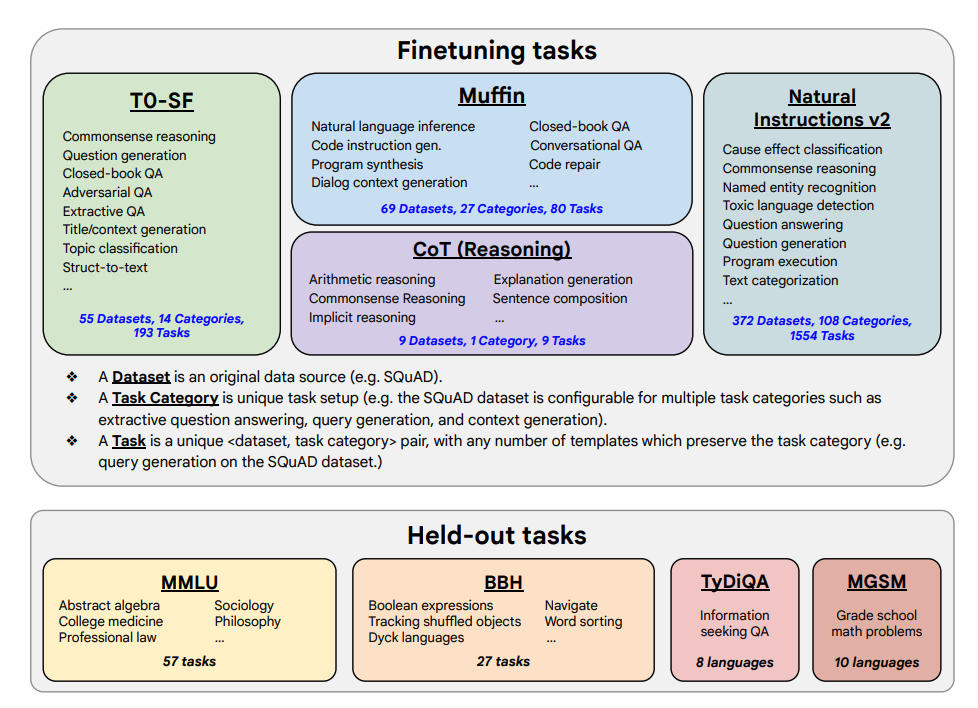
This paper explores the benefits of scaling instruction tuning and how it improves performance across various models (PaLM, T5), prompt settings (zero-shot, few-shot, CoT), and benchmarks (MMLU, TyDiQA). The core variables: scaling the number of tasks (1.8K tasks), scaling model size, and incorporating Chain-of-Thought (CoT) data for joint fine-tuning (using 9 datasets).
Fine-tuning process:
- 1.8K tasks were formulated as instructions and used to fine-tune models
- Used with/without examples (few-shot / zero-shot), with/without CoT
Fine-tuning tasks and held-out tasks:
Capabilities and Key Results
- Instruction tuning scales well with both task count and model size -- suggesting further scaling of both is worthwhile
- Adding CoT datasets to instruction tuning yields strong performance on reasoning tasks
- Flan-PaLM shows improved multilingual capabilities: 14.9% improvement on one-shot TyDiQA; 8.1% improvement on arithmetic reasoning in underrepresented languages
- Flan-PaLM also performs well on open-ended generation, a good indicator of improved usability
- Improved performance on Responsible AI (RAI) benchmarks
- Flan-T5 instruction-tuned models show strong few-shot capabilities and outperform public checkpoints like T5
Results from scaling fine-tuning task count and model size: scaling both model size and fine-tuning tasks is expected to continue improving performance, though returns from scaling task count are diminishing.
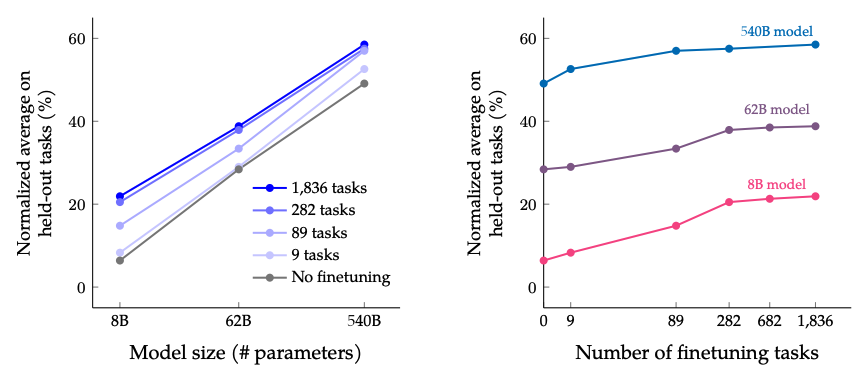
Image source: Scaling Instruction-Finetuned Language Models
Results from fine-tuning on non-CoT and CoT data: jointly fine-tuning on both non-CoT and CoT data improves performance on both evaluations, compared to fine-tuning on just one.

Image source: Scaling Instruction-Finetuned Language Models
Additionally, self-consistency combined with CoT achieves SoTA results on several benchmarks. CoT + self-consistency also significantly improves benchmarks involving math problems (e.g., MGSM, GSM8K).
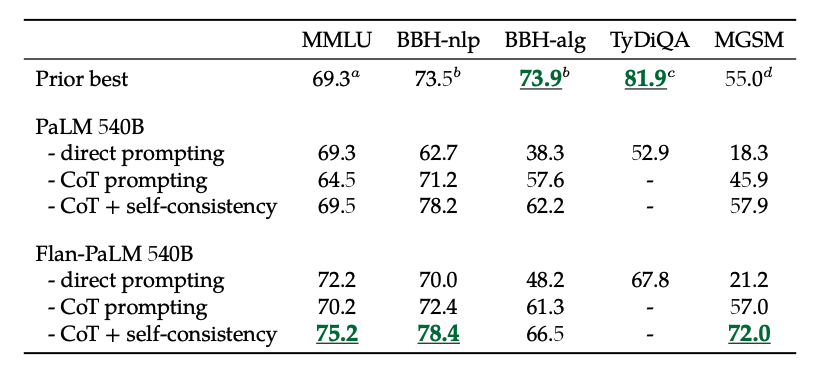
Image source: Scaling Instruction-Finetuned Language Models
CoT fine-tuning unlocks zero-shot reasoning on BIG-Bench tasks via the phrase "let's think step by step." Generally, zero-shot CoT Flan-PaLM outperforms zero-shot CoT PaLM without fine-tuning.
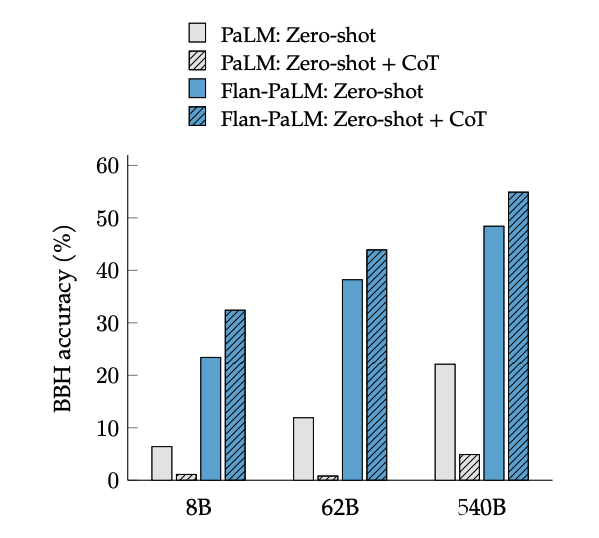
Image source: Scaling Instruction-Finetuned Language Models
Here are some demonstrations of zero-shot CoT from PaLM and Flan-PaLM on unseen tasks.
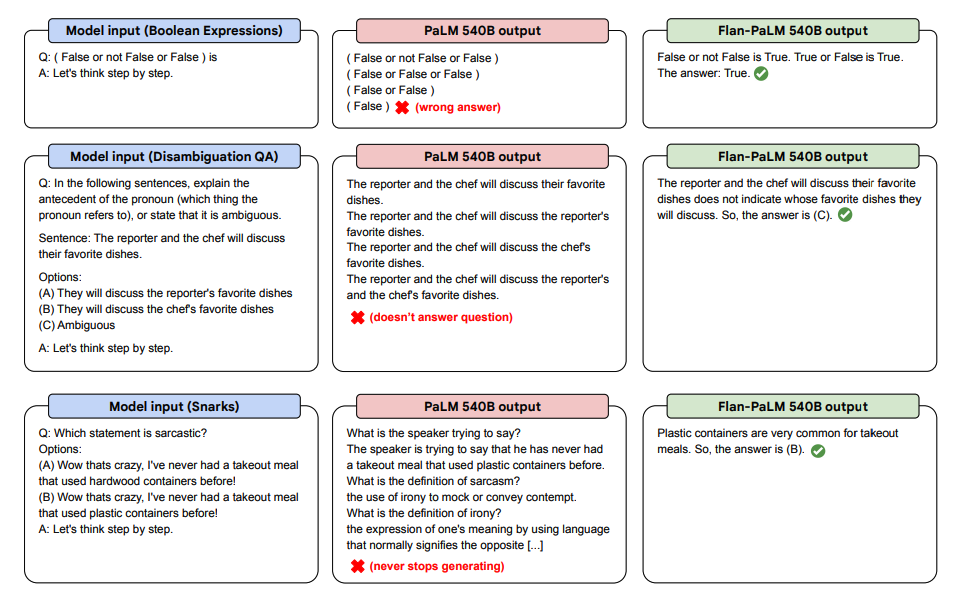
Image source: Scaling Instruction-Finetuned Language Models
More zero-shot prompt examples below. They show how the PaLM model struggles in zero-shot settings with repetition and failure to follow instructions, while Flan-PaLM handles them well. Few-shot examples can mitigate these errors.
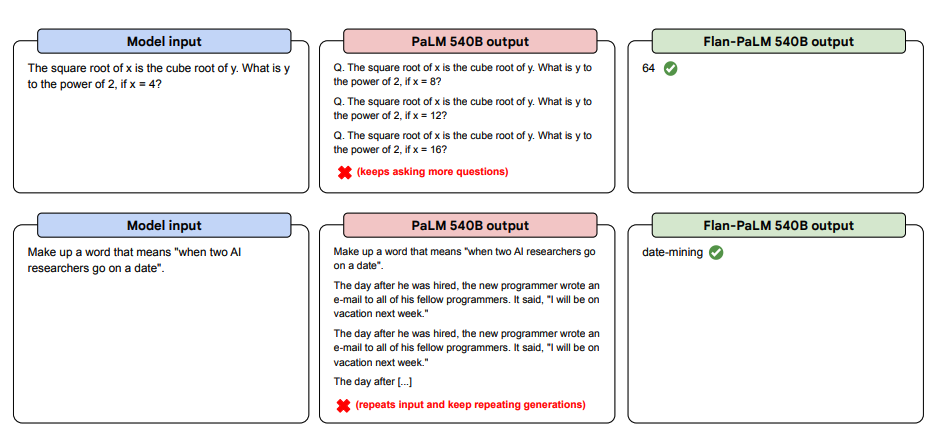
Image source: Scaling Instruction-Finetuned Language Models
Here are examples of the Flan-PaLM model demonstrating more zero-shot capabilities on several challenging open-ended questions:
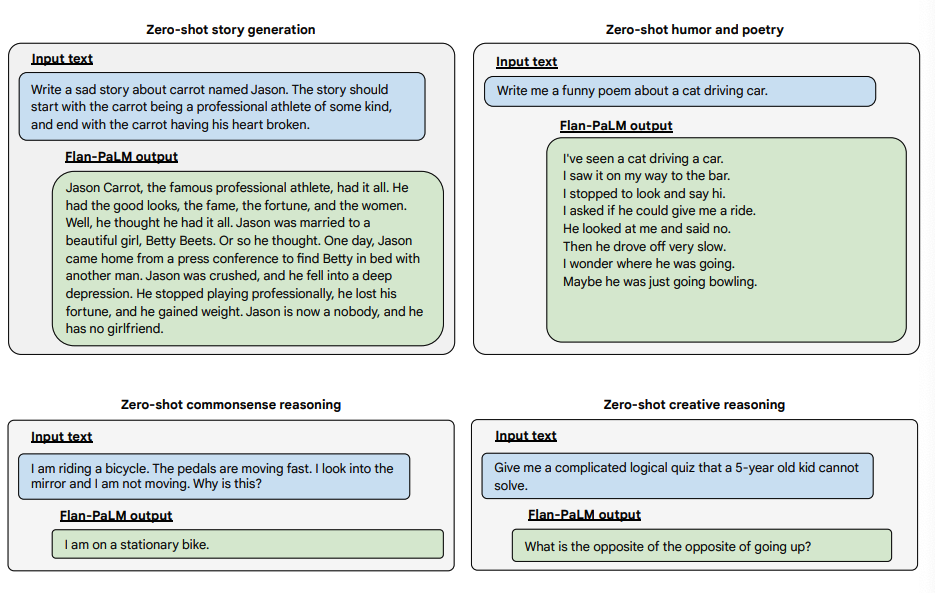
Image source: Scaling Instruction-Finetuned Language Models
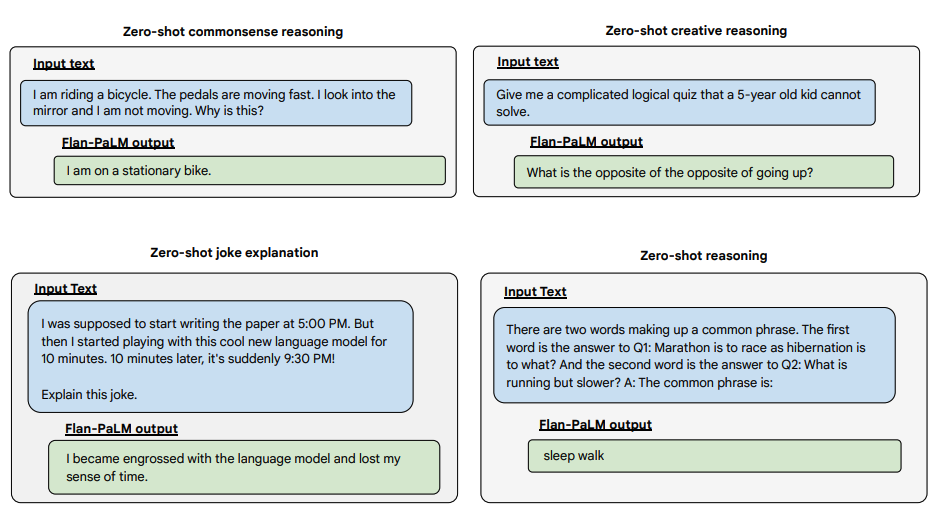
Image source: Scaling Instruction-Finetuned Language Models
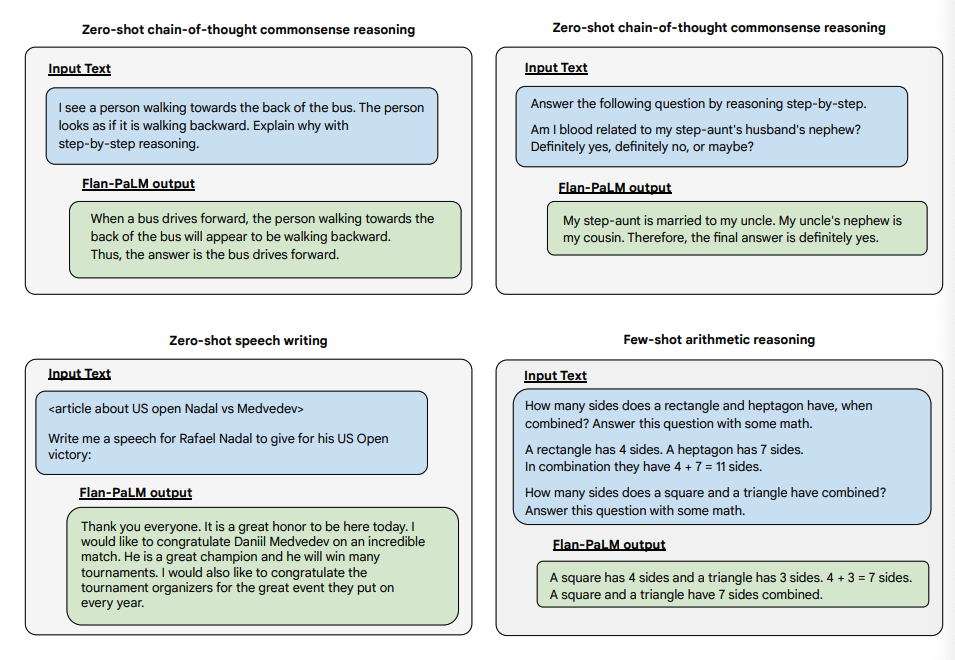
Image source: Scaling Instruction-Finetuned Language Models