
Chain-of-Thought (CoT)
Improve reasoning task reliability with intermediate thinking steps
Improve reasoning task reliability with intermediate thinking steps
A reusable prompt, example set, evaluation record or safety rule with its task boundary preserved.
Run at least one representative case, inspect the result and record what still requires human review.
Chain-of-Thought (CoT) Prompting
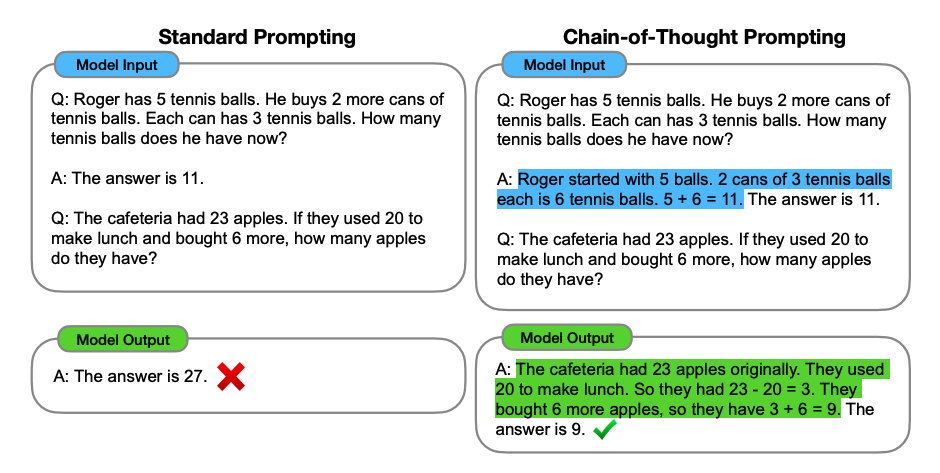
Image source: Wei et al. (2022)
Chain-of-thought (CoT) prompting, introduced in Wei et al. (2022), enables complex reasoning through intermediate steps. Combine it with few-shot prompting and you get much better results on tasks that require thinking before answering.
Prompt:
The odd numbers in this group add up to an even number: 4, 8, 9, 15, 12, 2, 1.
A: Adding all the odd numbers (9, 15, 1) gives 25. The answer is False.

The odd numbers in this group add up to an even number: 17, 10, 19, 4, 8, 12, 24.
A: Adding all the odd numbers (17, 19) gives 36. The answer is True.

The odd numbers in this group add up to an even number: 16, 11, 14, 4, 8, 13, 24.
A: Adding all the odd numbers (11, 13) gives 24. The answer is True.

The odd numbers in this group add up to an even number: 17, 9, 10, 12, 13, 4, 2.
A: Adding all the odd numbers (17, 9, 13) gives 39. The answer is False.

The odd numbers in this group add up to an even number: 15, 32, 5, 13, 82, 7, 1.
A:
Output:
Adding all the odd numbers (15, 5, 13, 7, 1) gives 41. The answer is False.
Perfect result once we provided reasoning steps. And here's what's cool -- you can get away with fewer examples. Even just one example is enough:
Prompt:
The odd numbers in this group add up to an even number: 4, 8, 9, 15, 12, 2, 1.
A: Adding all the odd numbers (9, 15, 1) gives 25. The answer is False.

The odd numbers in this group add up to an even number: 15, 32, 5, 13, 82, 7, 1.
A:
Output:
Adding all the odd numbers (15, 5, 13, 7, 1) gives 41. The answer is False.
Keep in mind that the authors claim this is an emergent ability that only appears in sufficiently large language models.
Turn this chapter's knowledge into practical skills
Enter the interactive lab and practice Prompt with real tasks. Get started in 10 minutes.
Zero-Shot CoT Prompting

Image source: Kojima et al. (2022)
Zero-shot CoT (Kojima et al., 2022) is a neat idea: just add "Let's think step by step" to your prompt. That's it. Let's see how it works on a simple problem.
Prompt:
I went to the market and bought 10 apples. I gave 2 apples to my neighbor and 2 apples to the repairman. Then I went and bought 5 more apples and ate 1. How many apples do I have left?
Output:
11 apples
Wrong. Now let's try with the magic phrase.
Prompt:
I went to the market and bought 10 apples. I gave 2 apples to my neighbor and 2 apples to the repairman. Then I went and bought 5 more apples and ate 1. How many apples do I have left?

Let's think step by step.
Output:
First, you start with 10 apples.
You gave 2 apples to your neighbor and 2 apples to the repairman, so you have 6 apples left.
Then you bought 5 more apples, so now you have 11 apples.
Finally, you ate 1 apple, so you have 10 apples left.
Pretty impressive that such a simple prompt works this well. It's especially useful when you don't have examples to include in your prompt.
Auto-CoT (Automatic Chain-of-Thought)
Crafting effective and diverse CoT examples by hand is tedious. And manual work often leads to suboptimal solutions. Zhang et al. (2022) proposed a way to eliminate the manual effort: use LLMs with "Let's think step by step" to automatically generate reasoning chains. But auto-generated chains can contain errors. So diversity matters -- that's why they proposed Auto-CoT, which samples questions with diversity and generates reasoning chains for demonstrations.
Auto-CoT has two main stages:
- Stage 1: Question Clustering -- partition the given questions into clusters
- Stage 2: Demonstration Sampling -- pick a representative question from each cluster and use Zero-Shot-CoT with simple heuristics to generate its reasoning chain
The heuristics are things like question length (e.g., 60 tokens) and number of reasoning steps (e.g., 5 steps). This encourages simple and accurate demonstrations.
Here's the process:
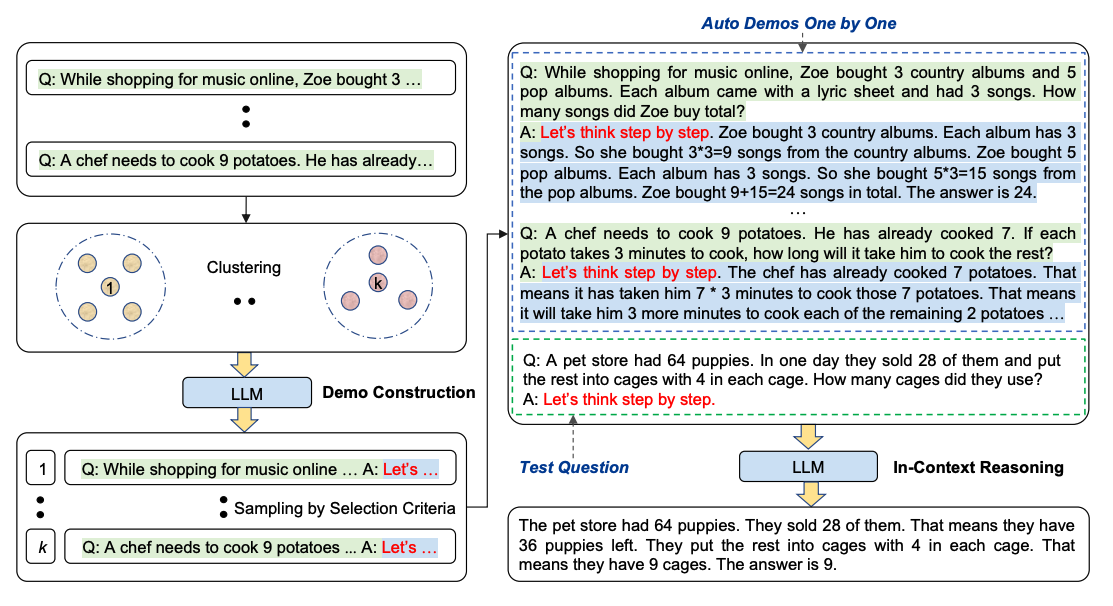
Image source: Zhang et al. (2022)
Auto-CoT code is available here: Github.
📚 Related resources
❓ Common questions
Open a question to review the practical answer.
What's the difference between Chain-of-Thought and regular few-shot?
The difference lives in the 'answer' field of each demonstration. Few-shot writes `A: Answer is False.` CoT (Wei et al. 2022) writes `A: Adding all the odd numbers (9, 15, 1) gives 25. The answer is False.`—the intermediate reasoning is explicit. The model imitates that reasoning pattern, and the odd-sum problem is suddenly solved.
What's zero-shot CoT? Does adding one sentence really boost reasoning?
Kojima et al. 2022 (arxiv 2205.11916) found that appending `Let's think step by step.` to the original prompt makes the model spontaneously produce reasoning chains. In the chapter's 10-apples arithmetic problem, the plain prompt returns `11 apples` (wrong); adding step-by-step decomposes it correctly to `10 apples left`. Zero demonstrations, zero engineering effort.
CoT is called an emergent ability—what does that mean?
Wei et al. 2022's claim: CoT only appears in 'sufficiently large' language models—small models actually get worse with reasoning chains. Exact thresholds depend on architecture, but the typical 'emergent' inflection sits north of 100B parameters. So running CoT on a small model isn't just useless—it can hurt accuracy.
What does Auto-CoT save compared to regular CoT?
It removes the cost of hand-writing demonstrations. Plain CoT needs diverse, high-quality demos written by humans, which is labor-intensive and easy to bias. Zhang et al. 2022 (arxiv 2210.03493) introduces two stages: (1) cluster the questions, (2) pick a representative from each cluster and auto-generate its reasoning chain with zero-shot CoT 'Let's think step by step.' Heuristics: 60-token length, 5 reasoning steps.
When should I use CoT, and when shouldn't I?
Use CoT for arithmetic, common-sense reasoning, symbolic reasoning, and multi-hop QA—anything that benefits from intermediate steps. Skip CoT for classification, extraction, translation, and summarization where input maps directly to output—adding step-by-step just bloats the response and inflates token cost. CoT can multiply token counts several times over, so on cost-sensitive high-frequency tasks be careful.