
OLMo
OLMo overview
OLMo overview
A reusable prompt, example set, evaluation record or safety rule with its task boundary preserved.
Run at least one representative case, inspect the result and record what still requires human review.
TL;DR
- OLMo is Allen Institute of AI's open language model initiative: it emphasizes open data, open training code, and open evaluation, aiming to improve LLM research reproducibility and transparency.
- Good for learning: data curation, training and evaluation pipelines (especially useful in research/educational contexts).
- Engineering advice: run evaluation on your tasks before deciding whether to adopt it (or use it as a comparison model).
Reading Guide
The value of this page isn't just benchmarks -- it's "how open is it, exactly." Focus on:
- Data and data pipelines (e.g., Dolma)
- Training and intermediate artifacts (weights/checkpoints/logs)
- Evaluation tools and reproducibility (e.g., OLMo-Eval, Catwalk)
Original (English)
In this guide, we provide an overview of the Open Language Mode (OLMo), including prompts and usage examples. The guide also includes tips, applications, limitations, papers, and additional reading materials related to OLMo.
Introduction to OLMo
The Allen Institute of AI has released a new open language model and framework called OLMo. This effort is meant to provide full access to data, training code, models, evaluation code so as to accelerate the study of language models collectively.
Their first release includes four variants at the 7B parameter scale and one model at the 1B scale, all trained on at least 2T tokens. This marks the first of many releases which also includes an upcoming 65B OLMo model.
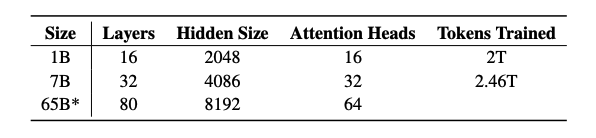
The releases includes:
- full training data, including the code that produces the data
- full models weights, training code, logs, metrics, and inference code
- several checkpoints per model
- evaluation code
- fine-tuning code
All the code, weights, and intermediate checkpoints are released under the Apache 2.0 License.
OLMo-7B
Both the OLMo-7B and OLMo-1B models adopt a decoder-only transformer architecture. It follows improvements from other models like PaLM and Llama:
- no biases
- a non-parametric layer norm
- SwiGLU activation function
- Rotary positional embeddings (RoPE)
- a vocabulary of 50,280
Dolma Dataset
This release also includes the release a pre-training dataset called Dolma -- a diverse, multi-source corpus of 3 trillion token across 5B documents acquired from 7 different data sources. The creation of Dolma involves steps like language filtering, quality filtering, content filtering, deduplication, multi-source mixing, and tokenization.
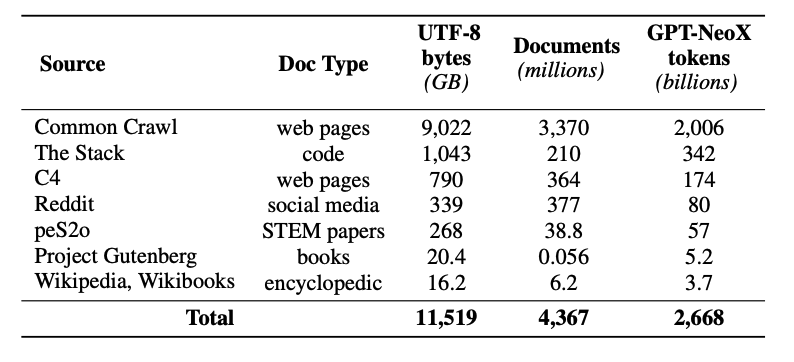
The training dataset includes a 2T-token sample from Dolma. The tokens are concatenated together after appending a special EOS token to the end of each document. The training instances include groups of consecutive chunks of 2048 tokens, which are also shuffled.
More training details and hardware specifications to train the models can be found in the paper.
Results
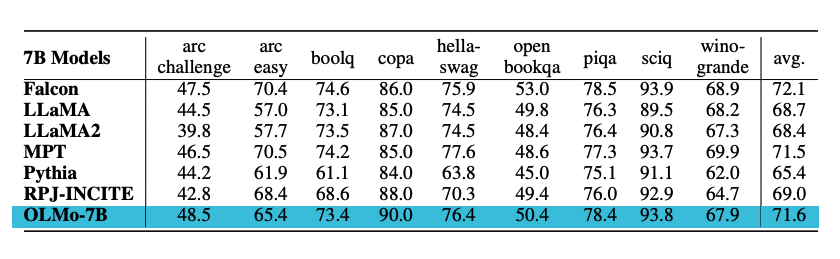
The models are evaluated on downstream tasks using the Catwalk. The OLMo models are compared to other several publicly available models like Falcon and Llama 2. Specifically, the model is evaluated on a set of tasks that aim to measure the model's commonsense reasoning abilities. The downstream evaluation suite includes datasets like piqa and hellaswag. The authors perform zero-shot evaluation using rank classification (i.e., completions are ranked by likelihood) and accuracy is reported. OLMo-7B outperforms all other models on 2 end-tasks and remains top-3 on 8/9 end-tasks. See a summary of the results in the chart below.
Prompting Guide for OLMo
Here's a minimal reusable prompting template (code block stays English -- just swap the variables):
You are a helpful assistant.

Task: <describe the task>
Constraints:
- Follow the requested output format exactly.
- If you are unsure, say \"Unsure\" and list what information is missing.
- Do not fabricate citations or facts.

Output format:
<define a strict JSON schema or a bullet list template>

Input:
<paste the user input or context here>
Common iteration directions:
- If output keeps drifting on format: make
Output formatstricter (field names, enum values, examples) - If hallucination is a problem: require
Evidenceoutput (copy snippets from context) or connect RAG - If the task is complex: have the model output a plan first, then execute (plan -> draft -> verify)
Figures source: OLMo: Accelerating the Science of Language Models