
ToT
Tree of Thoughts: explore the solution space via search
Tree of Thoughts: explore the solution space via search
A reusable prompt, example set, evaluation record or safety rule with its task boundary preserved.
Run at least one representative case, inspect the result and record what still requires human review.
For complex tasks that require exploration or strategic lookahead, traditional prompting techniques don't cut it. Yao et al. (2023) proposed the Tree of Thoughts (ToT) framework, which builds on chain-of-thought prompting and guides language models to explore thoughts as intermediate steps for general problem solving.
ToT maintains a tree of thoughts, where thoughts are coherent language sequences that serve as intermediate steps toward solving a problem. This lets the LM evaluate its own intermediate thoughts during rigorous reasoning. It combines the ability to generate and evaluate thoughts with search algorithms (BFS, DFS) to systematically explore while validating forward and backtracking.
Here's how the ToT framework works:
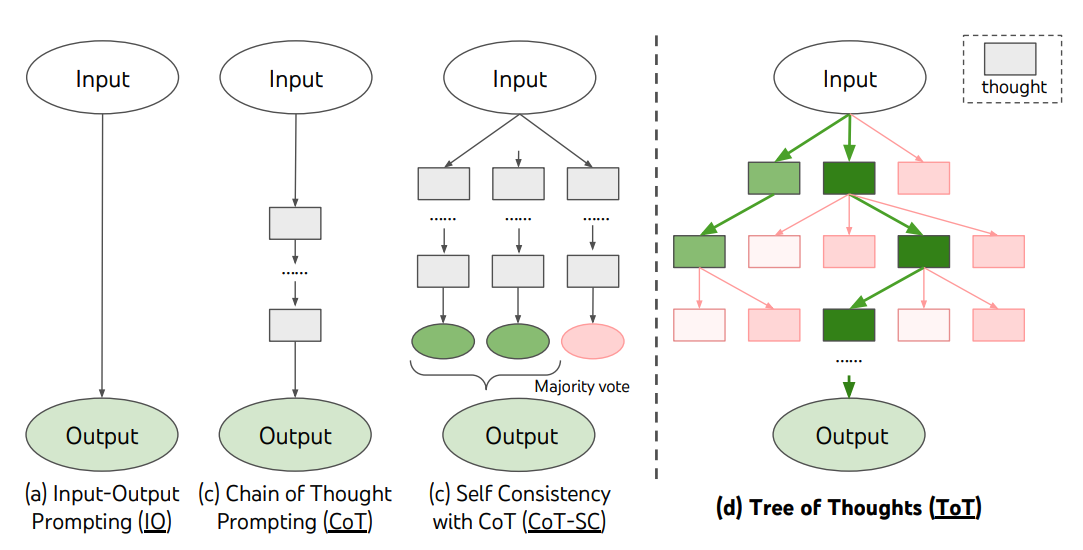
Image source: Yao et al. (2023)
ToT requires defining the number of thoughts/steps and the number of candidates per step, depending on the task. For example, the "Game of 24" in the paper is a math reasoning task that needs 3 thought steps, each requiring an intermediate equation. Each step keeps the top 5 candidates.
For the Game of 24, ToT uses breadth-first search (BFS), where the LM evaluates each thought candidate as "sure/maybe/impossible." The authors explain: "the aim is to promote correct partial solutions that can be verified as sure with few lookahead trials, eliminate impossible partial solutions based on 'too big/too small' commonsense, and keep the rest as maybe." Each step samples 3 evaluations. The process looks like this:
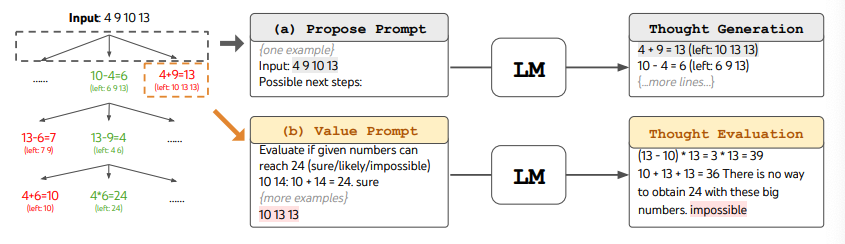
Image source: Yao et al. (2023)
The results speak for themselves -- ToT significantly outperforms other prompting methods:
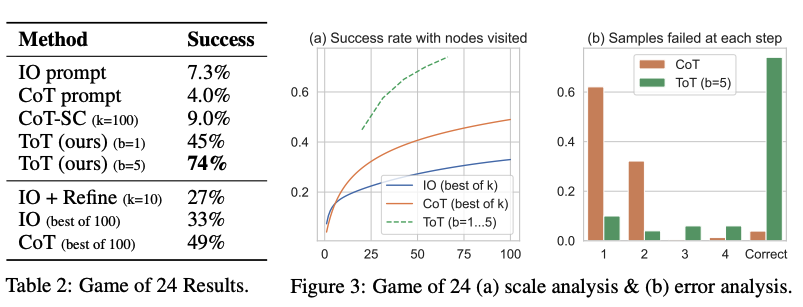
Image source: Yao et al. (2023)
Code examples can be found here and here.
Big picture: Yao et al. (2023) and Long (2023) share a similar core idea -- both enhance LLM problem-solving through multi-turn conversation in a tree search format. The main difference is that Yao et al. (2023) uses DFS/BFS/beam search, while Long (2023) proposes a "ToT Controller" trained via reinforcement learning to drive the search strategy (including when to backtrack and how far). DFS/BFS/beam search are generic -- they don't adapt to specific problems. A RL-trained ToT Controller, on the other hand, can learn from new datasets or through self-play (think AlphaGo vs. brute force search). So even with a frozen LLM, an RL-based ToT system can keep evolving and learning.
Hulbert (2023) distilled the main ToT concepts into a short prompt that guides the LLM to evaluate intermediate thoughts in a single prompt. Here's an example:
Imagine three different experts are answering this question.
Each expert writes down the first step of their thinking, then shares it.
Then each expert writes down the next step of their thinking and shares it.
Continue until all experts have completed all their steps.
If any expert makes a mistake, remove that expert from the discussion.
Question: ...
📚 Related resources
❓ Common questions
Open a question to review the practical answer.
How is Tree of Thoughts different from CoT?
CoT is one linear reasoning chain — once it goes wrong, it stays wrong. ToT (Yao et al., 2023) maintains a tree of thoughts where each node is an intermediate step, the LM scores branches itself, and a search algorithm (BFS / DFS / beam) explores forward and backtracks when needed. On exploratory tasks like the Game of 24, ToT outperforms CoT by a wide margin.
How does ToT actually solve the Game of 24?
The paper breaks the task into 3 thought steps, each producing one intermediate equation, keeping the best 5 candidates per step under BFS. Every candidate is graded by the LM as sure / maybe / impossible based on whether it can still reach 24; impossibles get pruned via too-big/too-small heuristics, sures go first, maybes wait. Net result: a large accuracy lift over CoT.
When is ToT worth the cost over CoT?
Use ToT when the task genuinely needs to explore multiple paths and backtrack — math puzzles, planning, outline generation. For simple arithmetic, extraction or single-step reasoning, CoT is plenty. ToT expands N candidates × M steps every run, so token cost and latency balloon to several times CoT — measure before rolling it out at scale.
What's the Hulbert ToT prompting trick?
Hulbert (2023) compressed the ToT framework into a single prompt: imagine three experts, each writes down the first step of their thinking and shares it, then the next step, and so on — if any expert makes a mistake, remove them from the discussion. It's lightweight ToT inside one shot, no search code required, ideal for plain ChatGPT users.
Yao 2023 vs Long 2023 — both are called ToT, what's the difference?
Same core idea — multi-round dialogue searching a tree for complex problems. The split is search policy: Yao 2023 uses generic DFS / BFS / beam search; Long 2023 introduces an RL-trained ToT Controller that decides when to backtrack and how far. The controller can learn from new data or self-play, so even with a frozen LLM the ToT system keeps improving.