
Grok-1
Grok-1 overview
Grok-1 overview
A reusable prompt, example set, evaluation record or safety rule with its task boundary preserved.
Run at least one representative case, inspect the result and record what still requires human review.
TL;DR
- Grok-1 is an open-weight MoE model from xAI (base model checkpoint). It's more of a research/comparison artifact than a ready-to-use chat agent.
- Think of it as a "base model sample" -- you'll need additional instruction tuning / alignment before it's suitable for conversation and production use.
- For engineering use: do task-level evaluation first, set up safety guardrails, and apply necessary fine-tuning or prompt constraints.
Key Focus Areas
When reading this page, pay attention to:
- MoE inference characteristics (active weights ratio)
- Pretraining cutoff (implications for knowledge recency)
- Benchmark results as positioning (good for comparison, doesn't guarantee your task performs the same)
Original (English)
Grok-1 is a mixture-of-experts (MoE) large language model (LLM) with 314B parameters which includes the open release of the base model weights and network architecture.
Grok-1 is trained by xAI and consists of MoE model that activates 25% of the weights for a given token at inference time. The pretraining cutoff date for Grok-1 is October 2023.
As stated in the official announcement, Grok-1 is the raw base model checkpoint from the pre-training phase which means that it has not been fine-tuned for any specific application like conversational agents.
The model has been released under the Apache 2.0 license.
Results and Capabilities
According to the initial announcement, Grok-1 demonstrated strong capabilities across reasoning and coding tasks. The last publicly available results show that Grok-1 achieves 63.2% on the HumanEval coding task and 73% on MMLU. It generally outperforms ChatGPT-3.5 and Inflection-1 but still falls behind improved models like GPT-4.
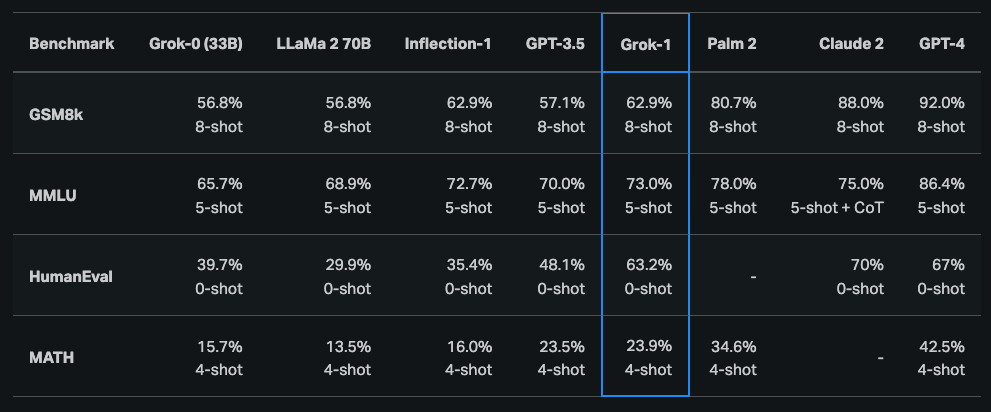
Grok-1 was also reported to score a C (59%) compared to a B (68%) from GPT-4 on the Hungarian national high school finals in mathematics.

Check out the model here: https://github.com/xai-org/grok-1
Due to the size of Grok-1 (314B parameters), xAI recommends a multi-GPU machine to test the model.