
Prompt Chaining
Break tasks into steps and generate incrementally for more controllable output
Break tasks into steps and generate incrementally for more controllable output
A reusable prompt, example set, evaluation record or safety rule with its task boundary preserved.
Run at least one representative case, inspect the result and record what still requires human review.
Introduction
To make LLMs more reliable, one key prompting technique is breaking tasks into subtasks. Once you've identified the subtasks, you feed each subtask's prompt to the model and use the result as part of the next prompt. That's prompt chaining -- decomposing a task into subtasks and creating a series of prompt operations.
https://www.youtube.com/embed/CKZC5RigYEc?si=EG1kHf83ceawWdHX
Prompt chaining can handle really complex tasks that an LLM might struggle with using a single detailed prompt. In a chain, each step transforms or processes the generated response until you reach the desired result.
Beyond performance, prompt chaining also improves transparency, controllability, and reliability. You can pinpoint where the model goes wrong and improve performance at specific stages.
It's especially useful for building LLM-powered conversational assistants and creating personalized user experiences.
Prompt Chaining Examples
Prompt Chaining for Document QA
Prompt chains work great for scenarios involving multiple operations or transformations. For example, a common LLM use case is answering questions based on large text documents. You can design two prompts: the first one extracts relevant quotes to answer the question, and the second one uses those quotes plus the original document to generate the actual answer.
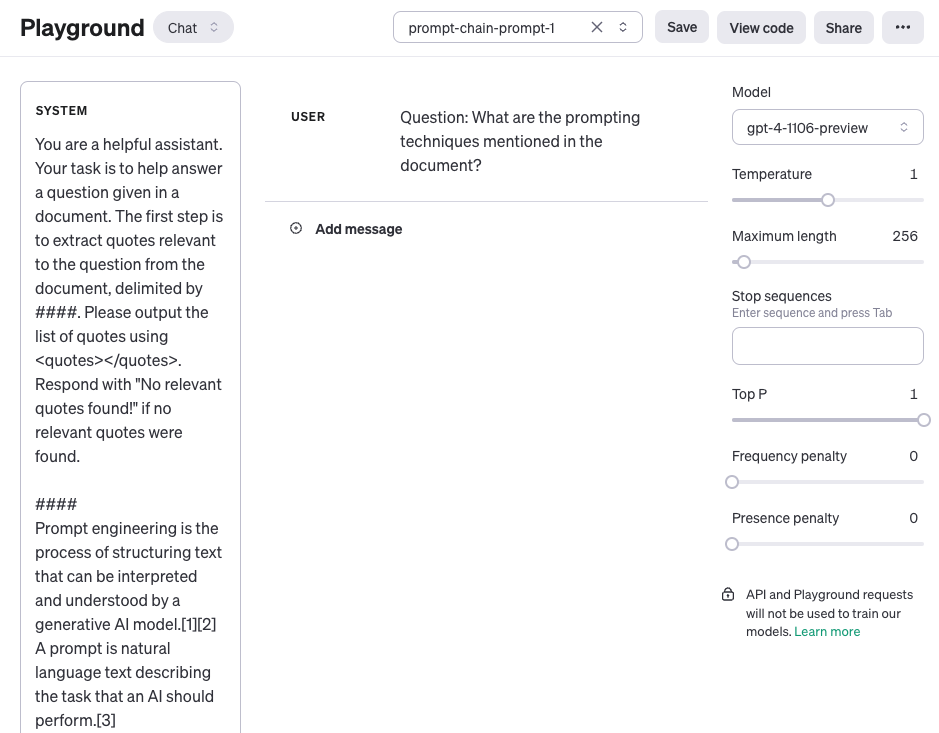
The first prompt below extracts relevant quotes from a document based on a question. For simplicity, we've added a placeholder {{document}}. To test this, you could copy-paste a Wikipedia article, like the one on Prompt Engineering. Since this uses a long context, we went with OpenAI's gpt-4-1106-preview. You can also use other long-context LLMs like Claude.
Prompt 1:
You are a helpful assistant. Your task is to answer a question based on a document.
Step 1: Extract quotes that are relevant to the question from the document delimited by ####.
Output the quote list using <quotes></quotes>. If you cannot find any relevant quotes, respond with "No relevant quotes found!".

####
{{document}}
####
Here's a screenshot of the full prompt, including the question passed via the user role.
Prompt 1 output:
<quotes>
- Chain-of-thought (CoT) prompting[27]
- Generated knowledge prompting[37]
- Least-to-most prompting[38]
- Self-consistency decoding[39]
- Complexity-based prompting[41]
- Self-refine[42]
- Tree-of-thought prompting[43]
- Maieutic prompting[45]
- Directional-stimulus prompting[46]
- Textual inversion and embeddings[59]
- Using gradient descent to search for prompts[61][62][63][64]
- Prompt injection[65][66][67]
</quotes>
The quotes returned from the first prompt now become input for the second prompt. You could clean them up -- say, remove citation markers -- using another prompt in the chain. But for now, let's skip that. The second prompt takes the extracted quotes and generates a helpful answer based on both the document and the quotes:
Prompt 2:
Using the relevant quotes extracted from the document (delimited by <quotes></quotes>) and the original document (delimited by ####), write an answer to the question. Make sure the answer is accurate, friendly, and helpful.

####
{{document}}
####

<quotes>
- Chain-of-thought (CoT) prompting[27]
- Generated knowledge prompting[37]
- Least-to-most prompting[38]
- Self-consistency decoding[39]
- Complexity-based prompting[41]
- Self-refine[42]
- Tree-of-thought prompting[43]
- Maieutic prompting[45]
- Directional-stimulus prompting[46]
- Textual inversion and embeddings[59]
- Using gradient descent to search for prompts[61][62][63][64]
- Prompt injection[65][66][67]
</quotes>
Prompt 2 output:
The prompt techniques mentioned in the document include:

1. Chain-of-thought (CoT) prompting[27]
2. Generated knowledge prompting[37]
3. Least-to-most prompting[38]
4. Self-consistency decoding[39]
5. Complexity-based prompting[41]
6. Self-refine[42]
7. Tree-of-thought prompting[43]
8. Maieutic prompting[45]
9. Directional-stimulus prompting[46]
10. Textual inversion and embeddings[59]
11. Using gradient descent to search for prompts[61][62][63][64]
12. Prompt injection[65][66][67]

Each technique applies a distinct strategy to improve or constrain interactions with large language models to produce desired outputs.
As you can see, simplifying and creating prompt chains is a useful approach when responses need multiple operations or transformations. As an exercise, try designing a prompt that strips the citation markers (e.g., [27]) from the response before sending it to the end user.
You can also find more prompt chaining examples in this documentation, which uses the Claude LLM. Our examples were inspired by and adapted from theirs.
📚 Related resources
❓ Common questions
Open a question to review the practical answer.
What is prompt chaining, and why not just use one long prompt?
Prompt chaining splits a task into subtasks, with one prompt per step where each step's output feeds the next. A single mega-prompt often fails on complex tasks; chaining improves transparency, control, and reliability—you can pinpoint and optimize the exact step that broke.
What does a typical two-step chain look like for document QA?
Step 1: have the model extract relevant quotes from `####{{document}}####`, wrap them in `<quotes></quotes>`, and reply `No relevant quotes found!` if none exist. Step 2: feed those extracted quotes plus the original document back in, and have the model write the final answer grounded in those quotes. The chapter uses `gpt-4-1106-preview`; for long-context scenarios you can swap in Claude.
What's the biggest benefit of prompt chaining?
Beyond raw performance, three engineering wins: transparency (you see every intermediate result), controllability (each step's prompt can be edited independently), and reliability (failures are localized to a specific step). Conversational assistants and personalized LLM apps benefit most—users can see 'retrieve → filter → answer' play out, which beats a black box for trust.
How do I cleanly pass step-1 output into step-2?
Wrap output in structured tags. Step 1 returns `<quotes>...</quotes>`, and step 2's prompt references that tagged block alongside `####original document####` as a second delimiter. The chapter's step-2 instruction: 'Using the relevant quotes (delimited by <quotes></quotes>) and the original document (delimited by ####), write an answer.' Each delimiter has a job, so the model never confuses data sources.
Are prompt chaining and CoT the same thing?
No. CoT generates a reasoning chain inside a single prompt—every step happens in one inference call. Prompt chaining is a sequence of separate prompt calls, with external code in between (cleaning extracted quotes, stripping citation markers like `[27]`) before feeding the next step. Chaining gives you engineering hooks; CoT doesn't.